
 thecryptobasic.com
A new analysis from the crypto investment platform River Financial shows that at least 50 countries have expanded access to Bitcoin ($BTC) since 2020.
The firm compiled a dataset tracking government actions related to Bitcoin over the past six years. Overall, the data show that most regulatory changes have moved toward greater acceptance and integration rather than restrictions.
In fact, River’s broader research suggests that at least 50 countries have improved access to Bitcoin through regulatory measures since 2020, compared with only 4 that tightened restrictions.
Key Points
- Analysis from River Financial shows that at least 50 countries have expanded access to Bitcoin since 2020.
- More countries are opening access than restricting it, with only four nations tightening crypto regulations over the same period.
- Of these Bitcoin-friendly jurisdictions, 34 countries have approved Bitcoin ETPs, enabling regulated investor exposure to $BTC.
- Some restrictions remain, with countries like Venezuela banning Bitcoin mining in 2024 and China maintaining strict limits on crypto mining activities.
34 Countries Offer Bitcoin ETPs
One of the clearest indicators of growing acceptance is the rapid rise of institutional investment vehicles. According to River, 34 countries have approved Bitcoin exchange-traded products (ETPs), allowing investors to gain regulated exposure to the cryptocurrency.
Countries that currently offer Bitcoin ETFs include the United States, Canada, Switzerland, Germany, Sweden, and Hong Kong, among others. These investment products have increasingly served as a bridge between traditional finance and the digital asset ecosystem, particularly in developed markets.
Meanwhile, Russia adopted a different strategy. Instead of focusing primarily on investment products, the country legalized Bitcoin mining and permitted its use for international payments in 2024, opening another pathway for state-level crypto integration.
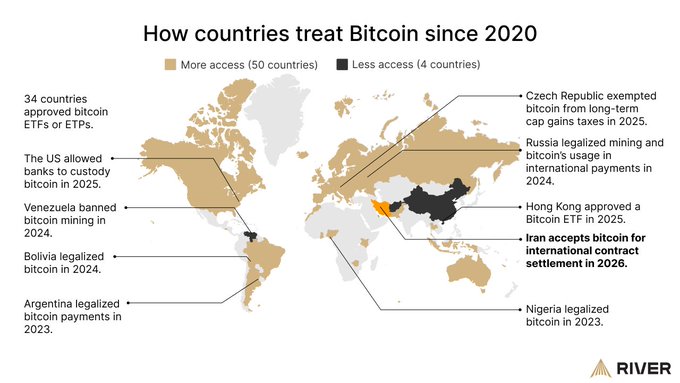
Major Regulatory Milestones
Several policy decisions highlighted in the chart mark turning points in Bitcoin’s integration into mainstream finance. In the United States, regulators allowed banks to custody Bitcoin in 2025, enabling financial institutions to hold the asset on behalf of clients and expand crypto-related services.
In Europe, the Czech Republic introduced tax reforms that exempt long-term Bitcoin holdings from capital gains taxes, signaling a supportive stance toward digital asset investment.
Emerging Markets Drive Adoption
The data also highlights a growing shift among emerging economies, where governments are increasingly legalizing Bitcoin use.
For instance, Nigeria legalized Bitcoin in 2023, a significant move given the country’s large and tech-savvy population. Argentina followed a similar path in 2023, legalizing Bitcoin payments as part of broader economic reforms aimed at stabilizing its financial system.
Likewise, Bolivia reversed its earlier stance and legalized Bitcoin in 2024, marking another example of regulatory change in Latin America.
These policy shifts suggest that countries facing inflation, currency volatility, or limited access to global financial infrastructure may be more willing to experiment with alternative financial systems.
Restrictions Remain Limited
Despite the overall expansion in access, some governments continue to impose restrictions. For example, Venezuela banned Bitcoin mining in 2024, citing concerns over energy consumption and regulatory oversight. China also maintains strict restrictions on Bitcoin mining, which prompted a large share of global mining activity to relocate elsewhere.
As a result, the United States now hosts the largest share of global Bitcoin mining activity, underscoring how regulatory environments can reshape the industry’s geography.
Even so, River’s data indicates that restrictive policies remain relatively rare compared with the growing number of measures that expand access to Bitcoin worldwide.
Iran Accepts Bitcoin for Oil Transit
The analysis resurfaced amid renewed attention to Iran’s use of Bitcoin in international trade. Reports indicate that the country may require vessels to pay transit tolls in Bitcoin to pass through the Strait of Hormuz, one of the world’s most critical oil shipping routes.
Reacting to the development, River posted a sarcastic message on X, noting that Iran chose Bitcoin over more than 100 traditional currencies as a payment method. The firm emphasized the irony of the decision, noting that critics frequently label Bitcoin a Ponzi scheme or warn of future quantum-computing threats, yet a nation-state still chose to use it for settlement.