
 techgaged.com
The commodity that once powered global inflation fears is retreating fast. Following a fragile U.S.-Iran ceasefire announced in early April 2026, Brent crude and WTI futures plunged more than 13-16%, dropping below the psychologically important $100 per barrel mark.
Brent settled around $94.75, while WTI fell to approximately $94.41 in the immediate aftermath, sparking a broad relief rally in risk assets.
As energy costs ease, investors are asking a timely question: could Bitcoin finally catch a bid from this macroeconomic thaw?
From Geopolitical Heat to Cooling Relief
The recent oil spike—fueled by tensions around the Strait of Hormuz—had briefly pushed prices well above $100, stoking inflation concerns and pressuring rate-cut expectations.
The ceasefire brought swift relief: oil tumbled as markets priced in potential reopening of key shipping routes and reduced supply disruption risks.
Stocks surged, the dollar softened, and broader risk sentiment improved almost overnight.
For Bitcoin, which often moves in sympathy with growth-sensitive assets during macro shifts, this transition could prove meaningful.
High oil prices tend to raise production costs (including energy for mining) and heighten fears of sticky inflation that delays monetary easing.
A sustained drop reverses that dynamic, potentially reopening the door for looser policy and renewed liquidity flows into risk assets like $BTC.
Decoding Bitcoin’s Current Chart Setup
Daily and weekly charts (April 12, 2026 – 07:29 UTC) on Binance reveal a market in consolidation mode. On the daily timeframe, $BTC/USD trades near $71,671, down roughly 2% intraday, with price interacting with the middle Bollinger Band (20-period SMA).
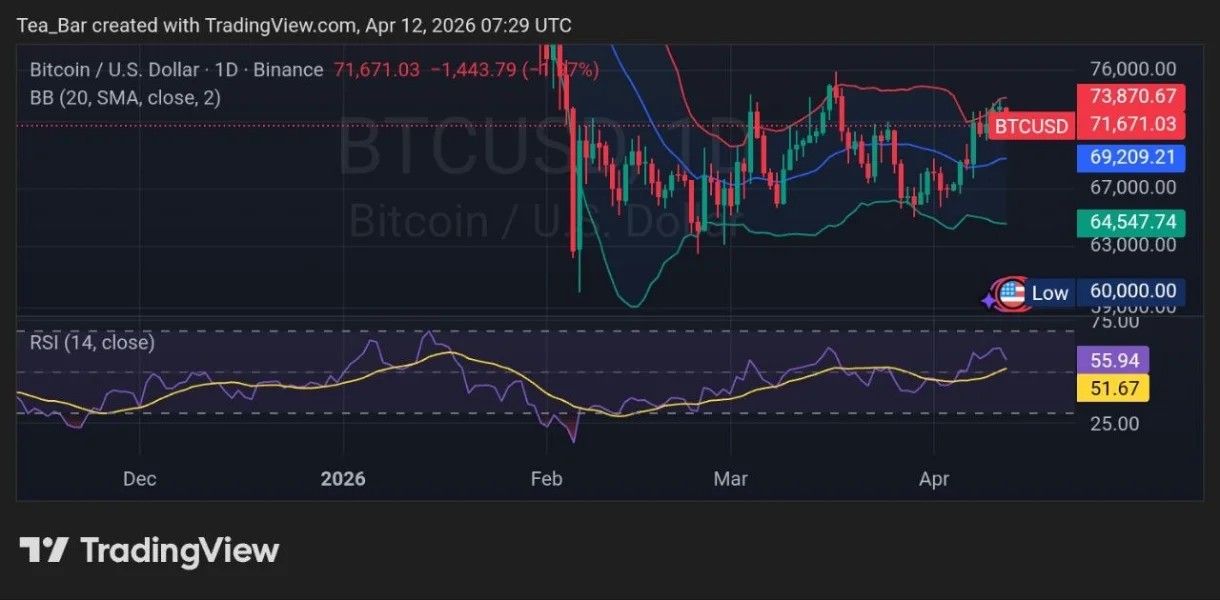
The upper band sits around $73,871, while the lower band hovers near $64,548, suggesting room for expansion on either side.
RSI (14) reads 51.67–55.94, hovering in neutral territory—not overbought, but showing mild bullish divergence on the daily.
The weekly view tells a longer story: $BTC has pulled back from its recent support turn resistance, with RSI cooling to around 39, and MACD displaying a bearish histogram and crossing signals.
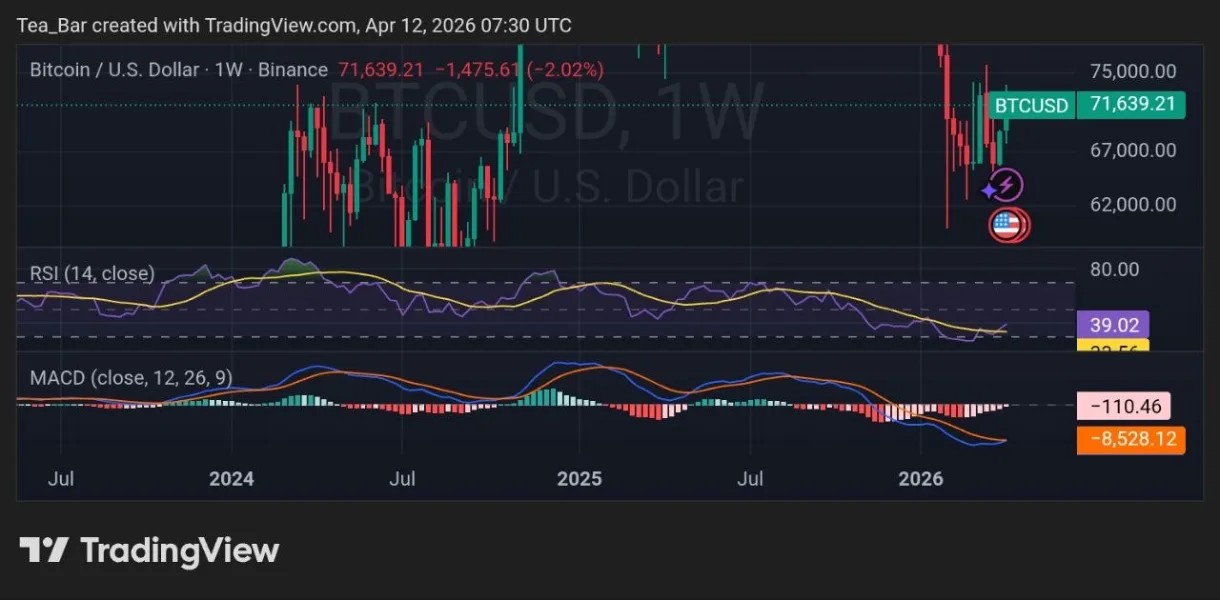
This setup reflects a market that has digested prior volatility but remains sensitive to external catalysts.
Historically, Bitcoin has shown only modest long-term correlation with oil, yet short-term transmission often occurs through inflation expectations and Fed policy repricing.
When oil spikes create “higher for longer” fears, risk assets—including $BTC—can suffer. The reverse holds when energy costs moderate.
Could Lower Oil Ignite a $BTC Rebound?
Bitcoin currently sits at a crossroads where easing energy pressures could provide the liquidity backdrop bulls have been waiting for.
If oil stabilizes well below $100 and inflation expectations are moderate, the path of least resistance may tilt higher—potentially testing resistance near $73,000–$75,000 in the near term.
For traders and long-term holders alike, today’s oil retreat offers a reminder that crypto does not exist in isolation.
Macro forces still matter, and a cooler commodity backdrop could be the spark that helps Bitcoin reclaim momentum.
Whether this shift marks the start of a meaningful recovery or merely a temporary breather depends on how geopolitics and central banks evolve in the weeks ahead.
One thing is clear: when oil loses its grip on $100, the entire risk complex—including Bitcoin—gets a fresh chance to breathe.
Disclaimer:
This article is for informational purposes only and does not constitute financial, investment, or trading advice. The views expressed are based on publicly available data, market observations, and the author’s interpretation at the time of writing. Cryptocurrency markets are highly volatile and unpredictable, and past performance or current technical setups do not guarantee future results. Readers should conduct their own research and consult with a qualified financial advisor before making any investment decisions. TechGaged does not accept liability for any losses incurred based on the information presented.