
 finbold.com
The mounting fears that leaps in quantum computing could fundamentally break Bitcoin ($BTC) grew once more on March 31, 2026, when Google (NASDAQ: GOOGL) published a landmark whitepaper on the topic.
Indeed, the document – author in cooperation with Coinbase (NASDAQ: COIN), the Stanford Institute for Blockchain Research, and the Ethereum Foundation as collaborators – showcased that the danger the new technology could uncover a private key using a public key is credible and one of the co-authors, Justin Drake, even opined on X that the event might come as soon as 2032.
Today is a monumentous day for quantum computing and cryptography. Two breakthrough papers just landed (links in next tweet). Both papers improve Shor's algorithm, infamous for cracking RSA and elliptic curve cryptography. The two results compound, optimising separate layers of…
— Justin Drake (@drakefjustin) March 31, 2026
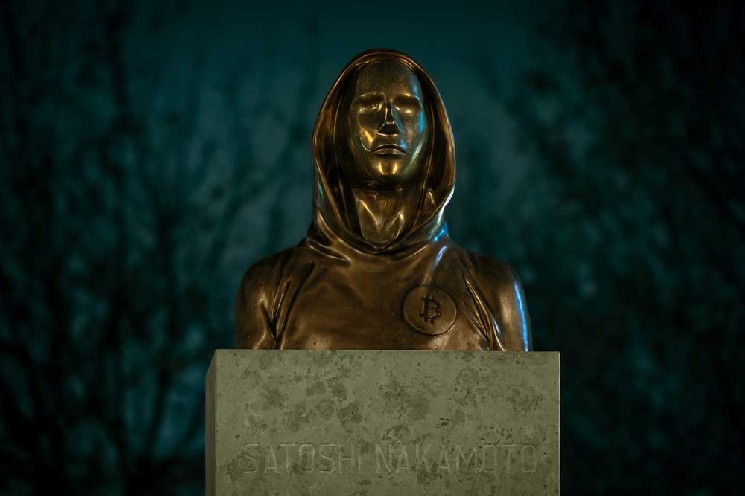
Still, combing through one of the oldest and largest relevant forums, Bitcointalk, reveals that Satoshi Nakamoto not only thought about the possibility but apparently wasn’t particularly worried about quantum computing.
What Satoshi Nakamoto thought about quantum computing and Bitcoin
Specifically, replying to the topic titled ‘Major Meltdown,’ Satoshi noted that as long as the breakthrough does not arrive completely unexpectedly and development takes some time, Bitcoin could find ways of adapting to the new risk:
True, if it happened suddenly. If it happens gradually, we can still transition to something stronger. When you run the upgraded software for the first time, it would re-sign all your money with the new stronger signature algorithm. (by creating a transaction sending the money to yourself with the stronger sig)
Unfortunately for modern $BTC investors and enthusiasts, the topic was closed without extending beyond its first page, and Satoshi did not offer a more detailed proposal on the changes that could theoretically be implemented.
Nonetheless, it demonstrated that the father of modern cryptocurrency did not perceive technology such as quantum computing and artificial intelligence (AI) as existential threats, though it does implicitly show that Bitcoin’s custodians must not become complacent.
Bitcoin price shows no investor reaction to quantum AI whitepaper
Elsewhere, Bitcoin price performance indicates that the majority of investors are still not particularly worried about the mounting dangers of quantum AI. At press time on April 1, $BTC is changing hands at $68,726 after a daily rebound of 2.28%.
Additionally, the world’s premier cryptocurrency appears driven by downward momentum gained by the decline from the October all-time high, and external factors, among which the Iran war has emerged as arguably the most important.
This setup is also evident in the fact that, despite the latest rebound and the lack of a major reaction to Google’s latest quantum AI whitepaper, Bitcoin experienced its worst start to a year since 2018 in the first quarter of 2026.
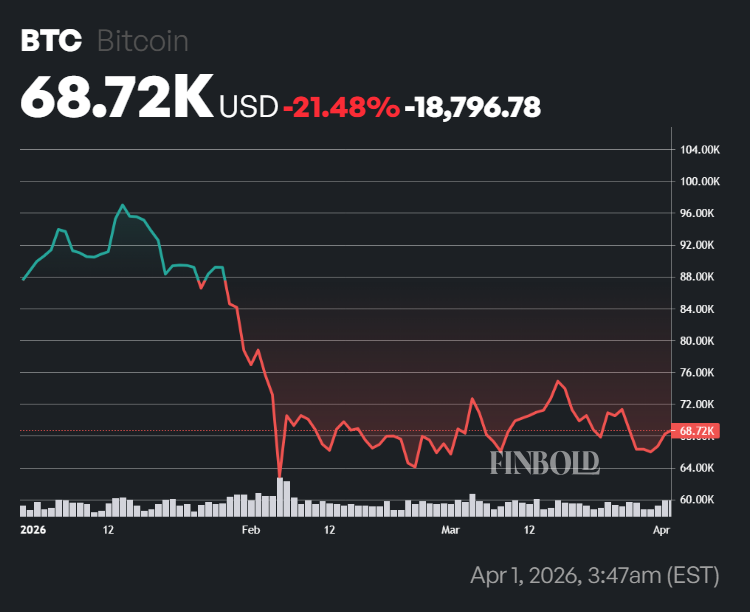
Specifically, $BTC retraced 21.48% since the start of the year and almost 45% from its late 2025 all-time high.
Featured image via Shutterstock