
 en.bitcoinsistemi.com
As the US-Iran conflict enters its fifth week, negotiations continue but have yet to yield results.
At this point, yesterday US President Donald Trump announced that he was giving Iran 10 more days. While calling on Iran to reach an agreement, Trump said that the ongoing negotiations with Iran were “going very well,” and gave Tehran until April 6th to finalize a deal.
Iran, however, rejected the US offer on the grounds that it “only serves the interests of Washington and Tel Aviv.”
Furthermore, Iran’s Revolutionary Guard announced that the Strait of Hormuz was closed and that anyone attempting to pass through the waterway would face “harsh measures.”
Why Are Bitcoin and Altcoins Falling?
Rising tensions in the Middle East, increasing oil prices, and rising interest rate forecasts due to inflation risk concerns have increased pressure on risky assets like Bitcoin ($BTC).
Bitcoin fell to $66,400, its lowest level since March 9. Ethereum (ETH) also led the decline in altcoins, dropping below $2,000.
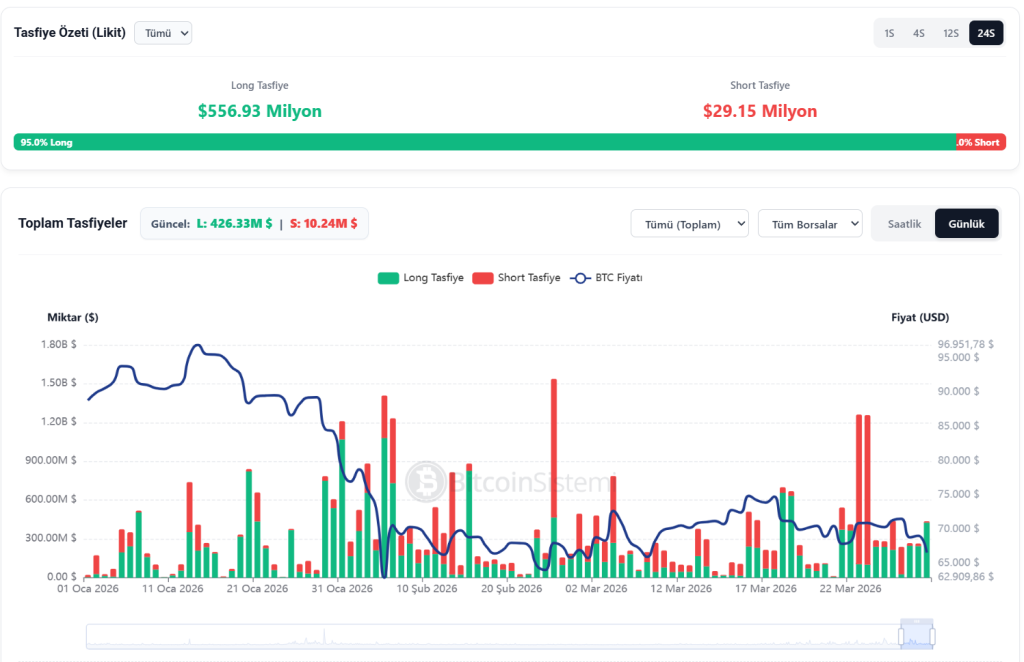
According to our website data, liquidations in the last 24 hours reached $585 million. Of this, $556 million consisted of long positions and $29 million of short positions.
Bitrue cryptocurrency exchange analyst Andri Fauzan Adziima said the main reason for Bitcoin’s decline is geopolitical developments related to the Middle East war and macroeconomic risk aversion.
The US dollar index rose to 100.148, continuing to put pressure on Bitcoin and other risky assets.
Block Scholes analyst Thahbib Rahman said, “Like all other macro assets, Bitcoin is traded based on geopolitical developments. Trump’s vague statements yesterday about the possibility of a ceasefire with Iran contributed to Bitcoin falling to $67,000. Because Bitcoin doesn’t like uncertainty.”
As a result, if tensions in the Middle East ease and the dollar weakens, liquidity could return to Bitcoin and cryptocurrencies, supporting a renewed rise.
However, if the dollar continues to strengthen along with oil and bond yields, risky assets like $BTC may continue to fall.
*This is not investment advice.