
 thecryptobasic.com

The Bitcoin to gold correlation has dropped to its lowest level since November 2022, during the heat of the 2022 bear market.
Notably, the correlation recently hit a low of -0.88 amid the latest recovery campaign from Bitcoin ($BTC), which has pushed its price above the pivotal $70,000 psychological mark. This indicates that Bitcoin has continued to move in the opposite direction to gold (XAU) since October 2025.
Key Points
- The Bitcoin-Gold correlation recently declined to -0.88, marking its lowest level since the heat of the previous bear market in November 2022.
- This metric has continued to decline after hitting a high of 0.28 in mid-October 2025 amid Bitcoin’s price struggles since that period.
- The consistent drop indicates that Bitcoin and gold have moved in the opposite direction during this period.
- While earlier declines came from gold outperforming Bitcoin, the latest crash has played out while Bitcoin outperforms gold.
- The last three times the correlation index dropped below -0.48, it recovered either through a drop in gold’s price or an increase in Bitcoin’s value.
Gold’s Initial Outperformance Against Bitcoin
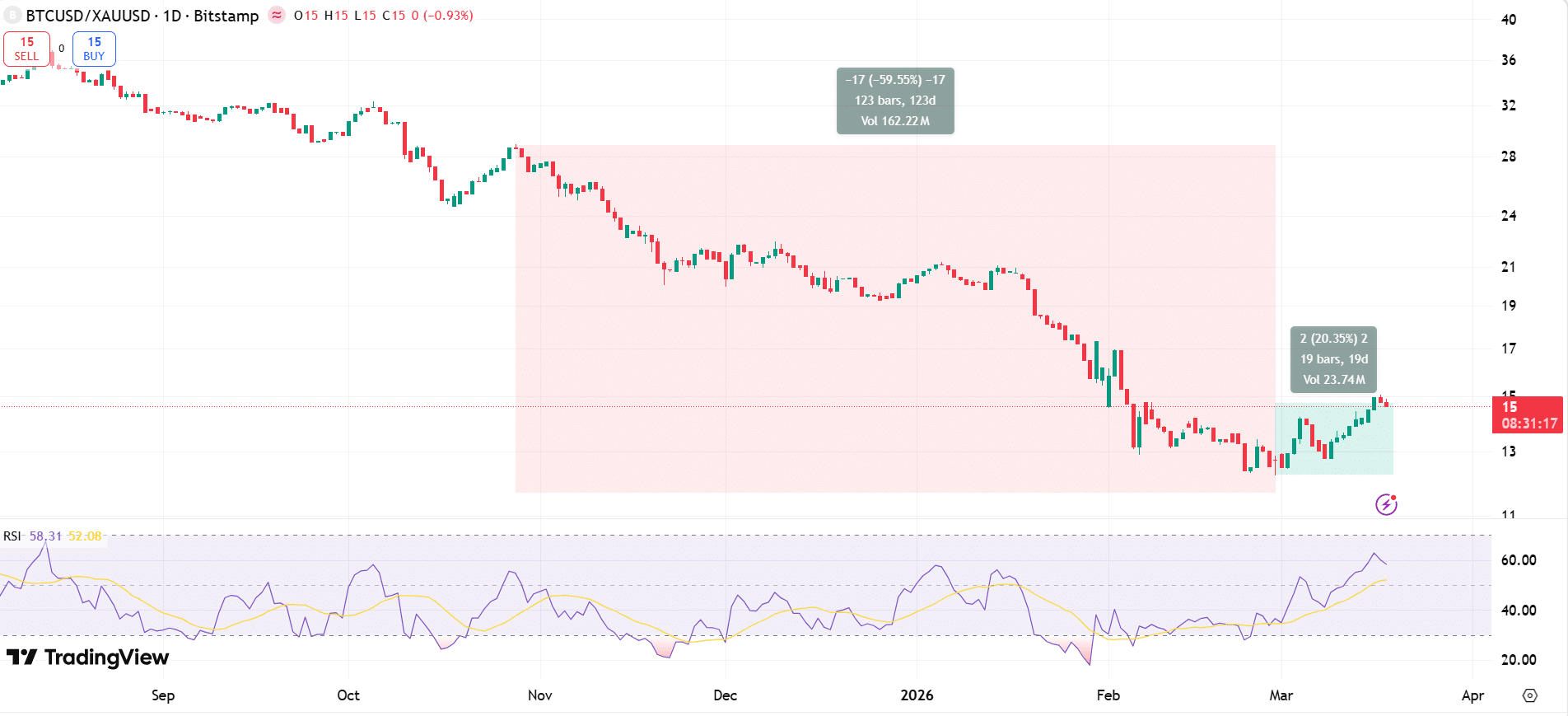
The constant decline was recently spotlighted by market analytics resource CryptoQuant, as it confirmed that both assets have moved against each other. Notably, this trend began after the Bitcoin to gold correlation rose from a low of -0.486 in September to a peak of 0.289 by October 2025. This coincided with the $BTC/XAU pair sitting at 30.
Following this peak, Bitcoin faced consistent price struggles, while gold performed exceptionally well amid economic and geopolitical uncertainties. As a result, the $BTC/XAU pair dropped from 30 at the start of Q4 2025 to around 20 in late December. Due to their divergent performances, the Bitcoin-Gold correlation also crashed to -0.55 during this period.
Interestingly, the correlation started recovering again after -0.55. However, this was due to gold also facing some price struggles alongside Bitcoin, rather than Bitcoin recovering from its downtrend. The correlation coefficient rose to -0.22 in early February, but began dropping again until it hit the recent 4-year low of -0.88.
Bitcoin Mounts a Comeback
However, the latest drop recorded by the coefficient was largely driven by Bitcoin outperforming gold, not the other way around. Specifically, the $BTC/XAU pair crashed to a 3-year low of around 12 ounces in late February amid gold’s performance. However, as the Israel-Iran conflict began, Bitcoin staged a comeback.
Bitcoin has now added 3 ounces of gold to currently trade at 15 ounces, recording eight consecutive intraday gains against gold from March 9 to 16, before it recently faced a roadblock. This occurred as Bitcoin rose 7.7% from $65,868 on Sept. 28 to the current price of around $71,000, while gold dropped 6% from $5,182 per ounce to $4,869 within the same period.
What Happens Next?
Currently, $BTC has begun losing its momentum against gold despite gold also facing rapid declines. This comes as Bitcoin bears attempt to push the crypto firstborn below the $70,000 psychologically important support level. At press time, $BTC changes hands at $71,330, battling to retain $71,000 before the next leg up.
Interestingly, historical data shows that the last three times the Bitcoin to gold correlation coefficient dropped below the -0.48 level, it recovered immensely. This recovery either came from gold witnessing declines or from Bitcoin recovering.
Specifically, when the metric dropped to -0.611 in April 2025, $BTC changed hands at $80,000. From here, the coefficient surged as Bitcoin rose from $80,000 to $106,000 by June 2024. During this period, $BTC outperformed gold, pushing the correlation coefficient to a high of 0.60.
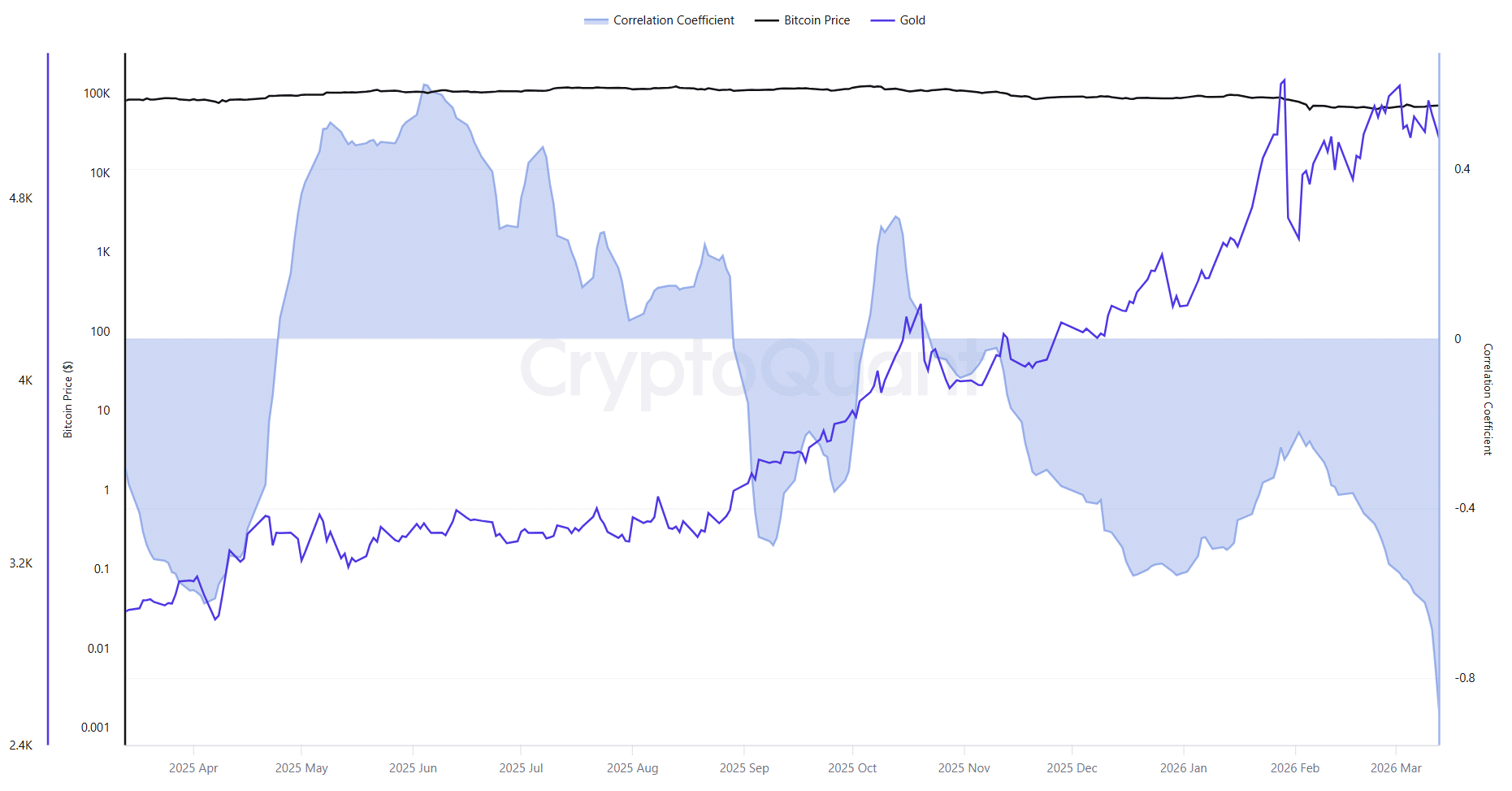
When the coefficient dropped to -0.486 in September 2025, it recovered again as $BTC spiked from $112,000 to its all-time high of $126,000 by October 2025. Another drop in the metric to -0.55 in December 2025 resulted in a rebound, which coincided with gold’s decline during that period.
Today, the metric has declined to a historic low, and a rebound may again ensue. If the previous trend continues, this rebound could occur when Bitcoin rises to greater heights or gold sees a decline. However, overall, the coefficient often recovers when Bitcoin and gold move alongside each other, and this could occur in multiple ways.