
 beincrypto.com

Bitcoin ($BTC) has shown notable sensitivity to major macroeconomic events, from tariff announcements to US presidential election results.
With 2026 being a US midterm election year, attention is turning to what the political cycle could mean for the world’s largest cryptocurrency.
Midterm Years Hit Markets Hard, Then Reward Patience
In a recent report, Binance Research explained how midterm election years affect risk assets. According to the report, midterm election years have been the weakest within the four-year presidential cycle for the S&P 500 due to heightened political uncertainty.
Historically, the S&P 500 has experienced average peak-to-trough pullbacks of around 16%, with corrections exceeding 10% in seven of the past 10 midterm cycles.
Bitcoin, which has shown a strong correlation with equities, has suffered an average decline of 56% during US midterm election years.
Follow us on X to get the latest news as it happens
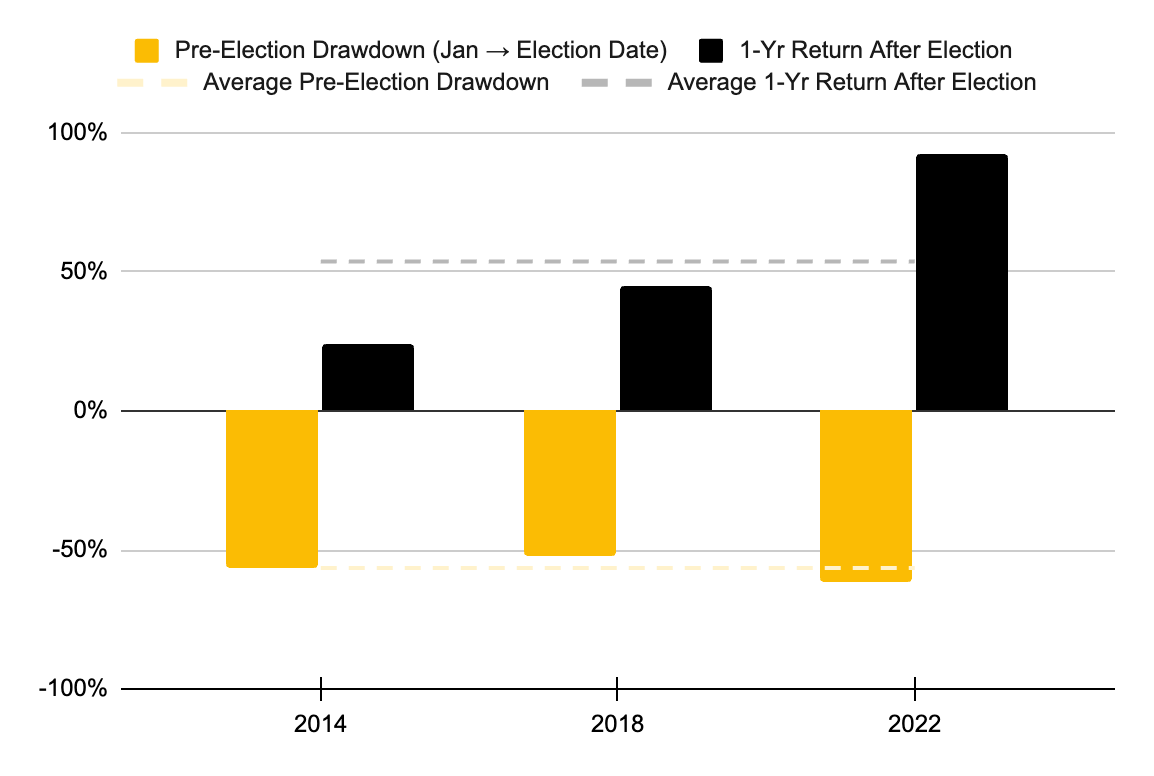
Data from the same research illustrates a clear post-election recovery. In the 12 months following midterms, the S&P 500 has risen about 19% on average. Bitcoin’s recovery has been even more dramatic, gaining roughly 54% in the same timeframe.
The pattern reflects a broader dynamic. Political uncertainty suppresses risk appetite, and the resolution of that uncertainty triggers a reallocation back into higher-beta assets like $BTC.
“Once election outcomes are determined and uncertainty is resolved, markets have historically staged powerful rallies,” the report read.
Analysts Converge on a Late-2026 Bottom For Bitcoin
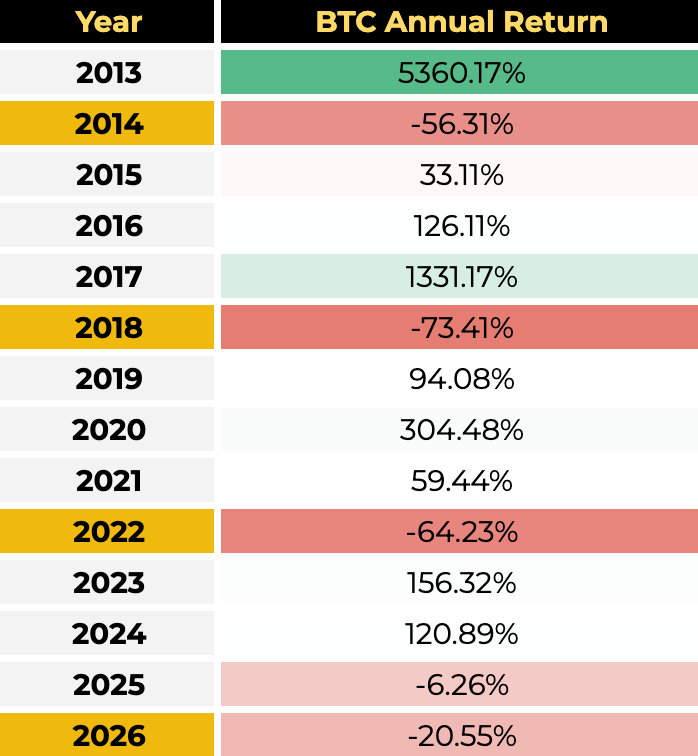
Meanwhile, a crypto analyst observed that the last three midterm years (2014, 2018, and 2022) were “coincidentally bear market years for Bitcoin.” He added that historically, Bitcoin has bottomed right around or shortly after the November elections.
“2026 midterms are in November. The pattern doesn’t guarantee a crash but it says don’t expect a clean bottom before then,” the analyst said.
Midterm election years and $BTC:
— VirtualBacon (@virtualbacon) March 5, 2026
2014 – bearish. Bottom came after midterms.
2018 – bearish. Capitulation right after midterms. Bottom one month later.
2022 – bearish. FTX collapsed on midterm week. Bottom that same week.
3/3.
2026 midterms are in November. The pattern doesn't… pic.twitter.com/QyZYzYjmzw
This timeline aligns with several other forecasts. Recently, on-chain analyst Willy Woo suggested that the bearish trend could end in Q4 2026. One analyst goes further, projecting that Bitcoin could fall to $30,000 by the end of 2026 before launching another multi-year rally.
CryptoQuant’s analysis narrows the window further, estimating the market could bottom between June and December of 2026, with September through November as the most likely range.
Overall, the convergence of Binance Research’s historical data, on-chain metrics from CryptoQuant, and independent analyst timelines points in the same direction. If the pattern holds, the second half of 2026, particularly the months around the November midterms, could mark a critical inflection point for Bitcoin.
Still, it’s not guaranteed that the pattern will hold this year. Markets respond to a mix of monetary policy, global risk events, and crypto-specific catalysts that may shift from cycle to cycle.
The post Why the 2026 US Midterm Election Is a Key Event To Watch for Bitcoin appeared first on BeInCrypto.