
 cryptotale.org
- Polymarket now gives a 54% chance that Bitcoin could slide to $45K later in 2026.
- Bitcoin trades near $67,735 while price stays below the $69,199 Fibonacci mark today.
- ETF flows turned uneven as Iran-linked risks added fresh uncertainty to Bitcoin.
Prediction-market traders are increasingly pricing the possibility of Bitcoin falling toward $45,000 in 2026 as volatility rises and the cryptocurrency trades near $67,735 on the daily $BTC/$USDT chart. Data from Polymarket shows traders placing significant probabilities on several downside scenarios. The platform assigns a 75% probability that Bitcoin could fall to $55,000, a 67% chance of reaching $50,000, and a 54% likelihood of dropping to $45,000.
🚨BITCOIN COULD CRASH BELOW $45K THIS YEAR
— Coin Bureau (@coinbureau) March 8, 2026
Polymarket traders are now pricing in the possibility of Bitcoin falling below $45K in 2026 as market volatility intensifies.
With 75% betting on $BTC to certainly fall to $55K. pic.twitter.com/N0lYua3Kt1
At the same time, traders continue to price higher targets. Polymarket markets show an 82% probability for Bitcoin reaching $75,000, a 69% chance for $80,000, and a 49% probability for $90,000.
The prediction markets reflect growing uncertainty around Bitcoin’s direction in 2026. Market participants now track both bullish and bearish outcomes while reacting quickly to shifting financial conditions.
Prediction Markets Reflect Rising Uncertainty
Polymarket functions as a prediction market, which enables users to purchase and sell outcome shares. The share prices function as market participants’ collective probability assessments about upcoming events.
Traders update probability assessments throughout the trading day whenever market participants introduce fresh data. The market continuously displays changes in expectations about macroeconomic trends and investor emotions, as well as the dangers present in financial markets.
The Polymarket snapshot shows that traders now use more downside protection measures against potential negative outcomes. The market shows increasing interest in betting on lower price targets, while traders still believe that Bitcoin will achieve higher price levels.
The divergence between bullish and bearish probabilities illustrates a divided market outlook. Participants simultaneously price recovery scenarios and deeper declines for the cryptocurrency.
Chart Data Shows Bitcoin Trading Near Key Levels
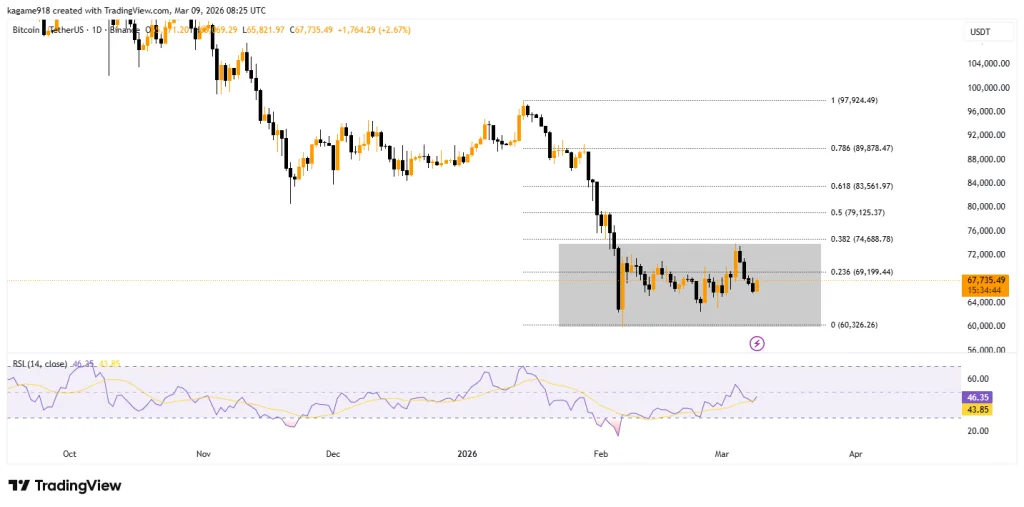
Bitcoin currently trades at 67,735 $USDT on the $BTC/$USDT one-day Binance chart. The latest daily candle opened at 65,971, reached a high of 68,069, and touched a low of 65,821. The session gained 1,764.29 points, representing a 2.67% increase for the day.
Price action remains inside a wide trading zone marked on the chart. The gray box stretches from the 0 Fibonacci level at 60,326.26 to the 0.382 retracement level at 74,688.78. Bitcoin currently trades slightly below the 0.236 retracement level at 69,199.44.
Source: TradingView
The broader Fibonacci structure maps a decline from 97,924 at the 1.0 level. Other key retracement levels include 89,878 at 0.786, 83,561 at 0.618, 79,125.37 at 0.5, and 74,688 at 0.382. The sequence shows a sharp drop from the mid-$90,000 range into early February. The decline ended with a sharp selloff that briefly tested the 60,326.26 support floor.
Since that move, Bitcoin has traded sideways near the mid-$60,000 range. Repeated swings around this level indicate hesitation rather than a decisive recovery. Momentum indicators reflect that uncertainty. The 14-day RSI closed at 46.35, while the RSI moving average stood at 43.85.
Related: Trump Cyber Plan Now Backs Bitcoin and Blockchain Security
Institutional Flows and Global Risks Shape Outlook
Analysts also point to institutional flows as a major factor shaping Bitcoin’s recent movements. Many investors now access Bitcoin through regulated financial products. Orkun Mahir Kılıç, co-founder of blockchain firm Citrea, linked the recent market move to institutional demand.
“The recent move in Bitcoin can largely be attributed to renewed institutional demand entering the market through spot exchange-traded funds,” Kılıç told DL News. “ETFs are increasingly acting as the main gateway for traditional capital.”
ETF trading data shows a shift in sentiment during the week. Investors placed more than $900 million into BlackRock’s iShares Bitcoin Trust (IBIT) from Monday through Wednesday. Later in the week, sentiment changed. Data from Farside Investors shows IBIT investors sold $143.5 million in shares on Friday.
Across all Bitcoin ETFs, investors sold a combined $349 million. Geopolitical risks also entered market discussions. According to a report from South Korea’s Seoul Kyungjae, Bloomberg Intelligence strategist Mike McGlone warned that Iran-related tensions could pressure Bitcoin prices. McGlone said such risks could push Bitcoin toward $50,000. He also suggested silver could fall toward $50 per ounce.
At the same time, industry participants argue that global disruptions could accelerate long-term crypto adoption. “In the near term, Bitcoin often trades as a risk asset and reacts to macro shocks like the recent Iran crisis,” Jordan Jefferson, founder of the Dogecoin wallet MyDoge, told DL News.
“But every sanctions crackdown, banking freeze, and currency failure reinforces the long-term argument for permissionless financial infrastructure.” As traders monitor prediction-market odds, ETF flows, and geopolitical developments, one question continues to shape market debate: Could Bitcoin’s next major move send prices toward the $45,000 level now priced by traders?
Disclaimer: The information provided by CryptoTale is for educational and informational purposes only and should not be considered financial advice. Always conduct your own research and consult with a professional before making any investment decisions. CryptoTale is not liable for any financial losses resulting from the use of the content.