
 thecryptobasic.com
Despite the ongoing Israel-Iran war, short-term Bitcoin holders have yet to show the usual risk-off reaction associated with geopolitical tensions.
Notably, rising tensions between the U.S., Israel, and Iran have rattled financial markets, pushing oil prices to fresh multi-month highs and putting pressure on risk assets. Bitcoin has not escaped the volatility.
Since Feb. 26, the crypto firstborn has fallen 3.6%, bringing its price to $65,548. When the war officially started, Bitcoin slipped below $65,000, dropping to $63,037 on Feb. 28, before climbing back above the $65,000 mark.
However, despite the sharp headlines and sudden price swings, on-chain data shows that one important group of investors has stayed calm. Specifically, short-term Bitcoin holders have not reacted the way they typically do during major global crises.
Key Points
- Joint strikes from the U.S. and Israel against Iran have triggered another conflict in the Middle East, impacting asset prices.
- Bitcoin has dropped 3.6% since Feb. 26 to $65,548, briefly hitting $63,037 on Feb. 28 before recovering above $65,000.
- However, short-term holders appear to be showing more resilience, avoiding their typical panic-selling campaign during global tensions.
- These holders sent 89,000 $BTC to exchanges at a loss during the Feb. 5 capitulation, but loss-driven inflows have since declined.
- Analysts see upside toward $80,000–$91,000 if $70,800 breaks, while a drop below $62,000 could trigger a move toward deeper support.
On-Chain Data Shows Fading Panic Among Bitcoin STHs
Verified CryptoQuant analyst Moreno recently highlighted the resilience demonstrated by Bitcoin short-term holders (STHs). Specifically, his analysis focused on the Short-Term Holder Profit and Loss to Exchanges metric, which tracks how recent buyers move their coins.
Notably, these investors usually drive quick price swings because they tend to react fast when markets turn negative. Earlier in the month, on Feb. 5 and 6, short-term holders sent a massive 89,000 $BTC to exchanges at a loss within just 24 hours. This marked a wave of panic selling.
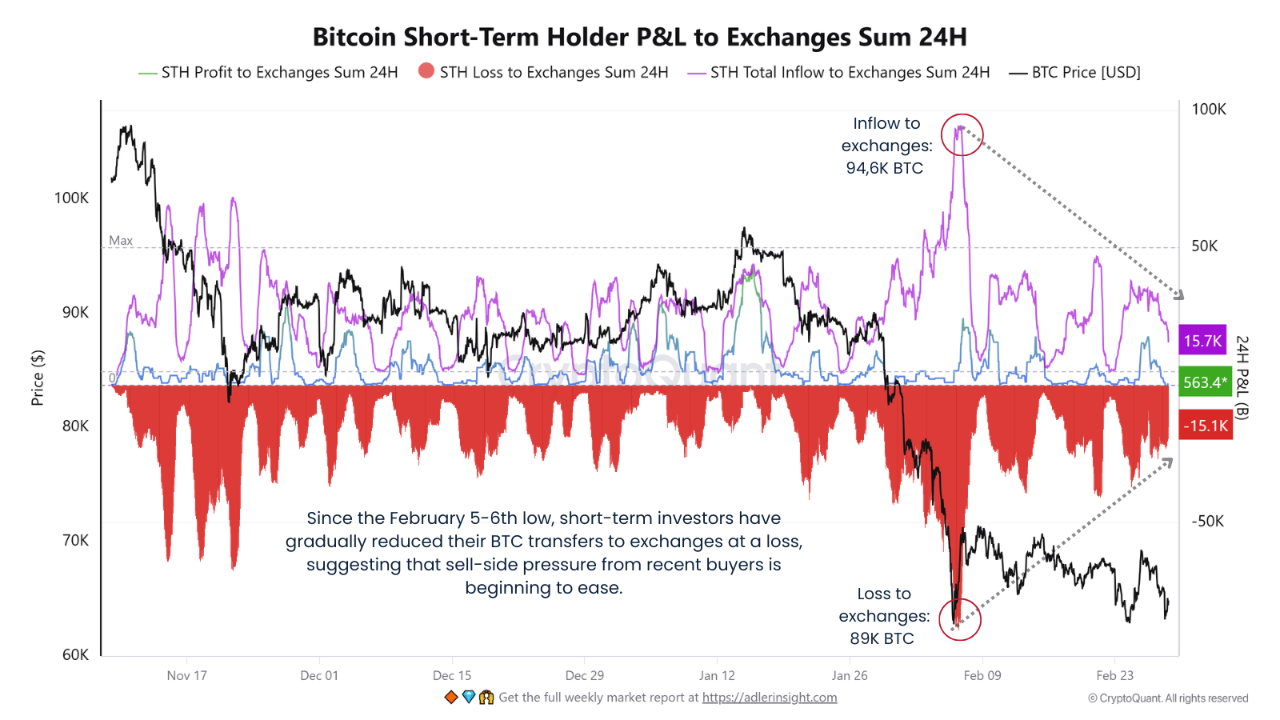
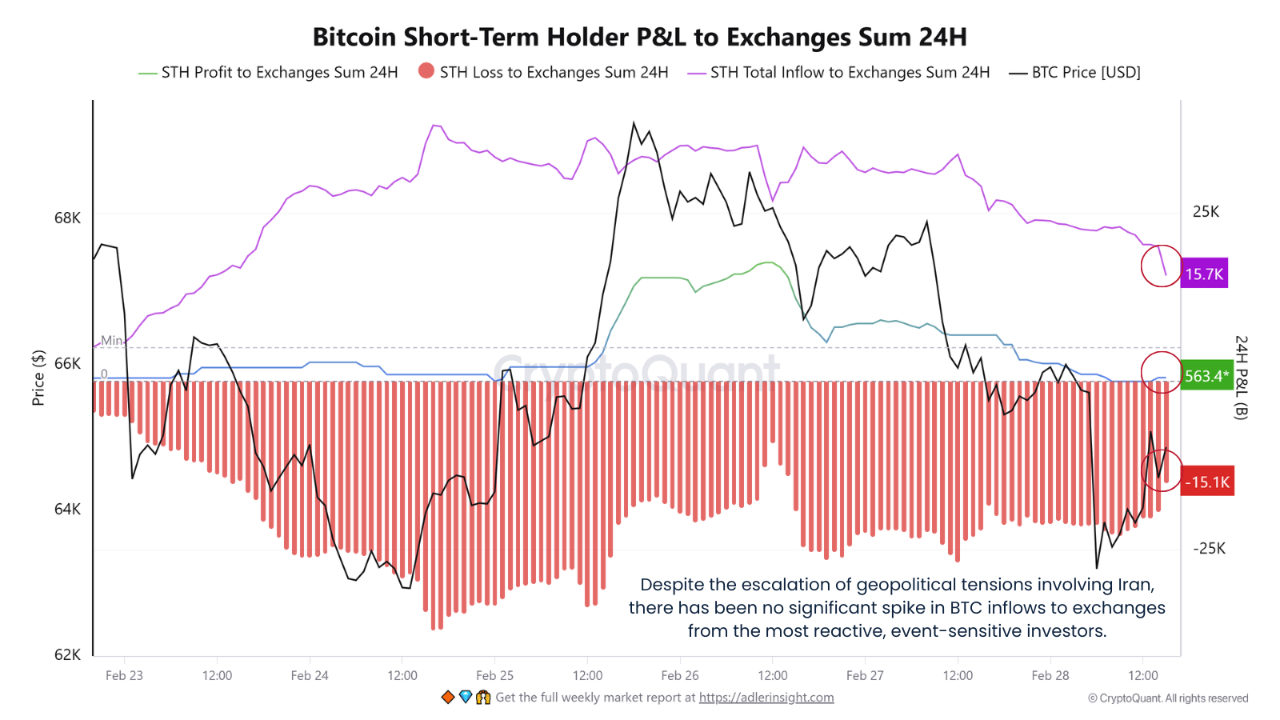
However, since then, things have changed. Specifically, loss-driven transfers to exchanges have steadily dropped. Even after the latest escalation involving Iran, short-term holders did not rush to sell.
When Bitcoin dipped into the $63,000 to $64,000 range on Feb. 28, exchange inflows from this group stayed low. There was no major spike in profit-taking and no fresh wave of panic-driven selling, despite the kind of geopolitical shock that often triggers it.
Why This Matters
Moreno believes this matters because markets often find stability after weaker hands finish selling. The steady decline in loss-driven transfers suggests that much of the recent selling pressure may already be behind us.
Going forward, he says traders should watch whether exchange inflows from short-term holders remain quiet. If they stay low, it could point to seller exhaustion and possibly a recovery. If inflows suddenly jump, especially at a loss, it would signal that capitulation is not over.
If this calm continues, Bitcoin could stabilize and possibly follow the rebound patterns seen after the February 2022 and June 2025 conflicts. However, if short-term holders start sending large amounts to exchanges again, especially at a loss, the price could revisit $62,000 or even the $57,772 support level.
Historical Data from Past Wartime Moves
Speaking on the situation in the Middle East, market analyst Ted Pillows compared the current situation to earlier conflicts. In February 2022, when Russia invaded Ukraine, Bitcoin first dropped and then rallied 40%. In June 2025, when Israel attacked Iran, Bitcoin again fell before climbing 25%.
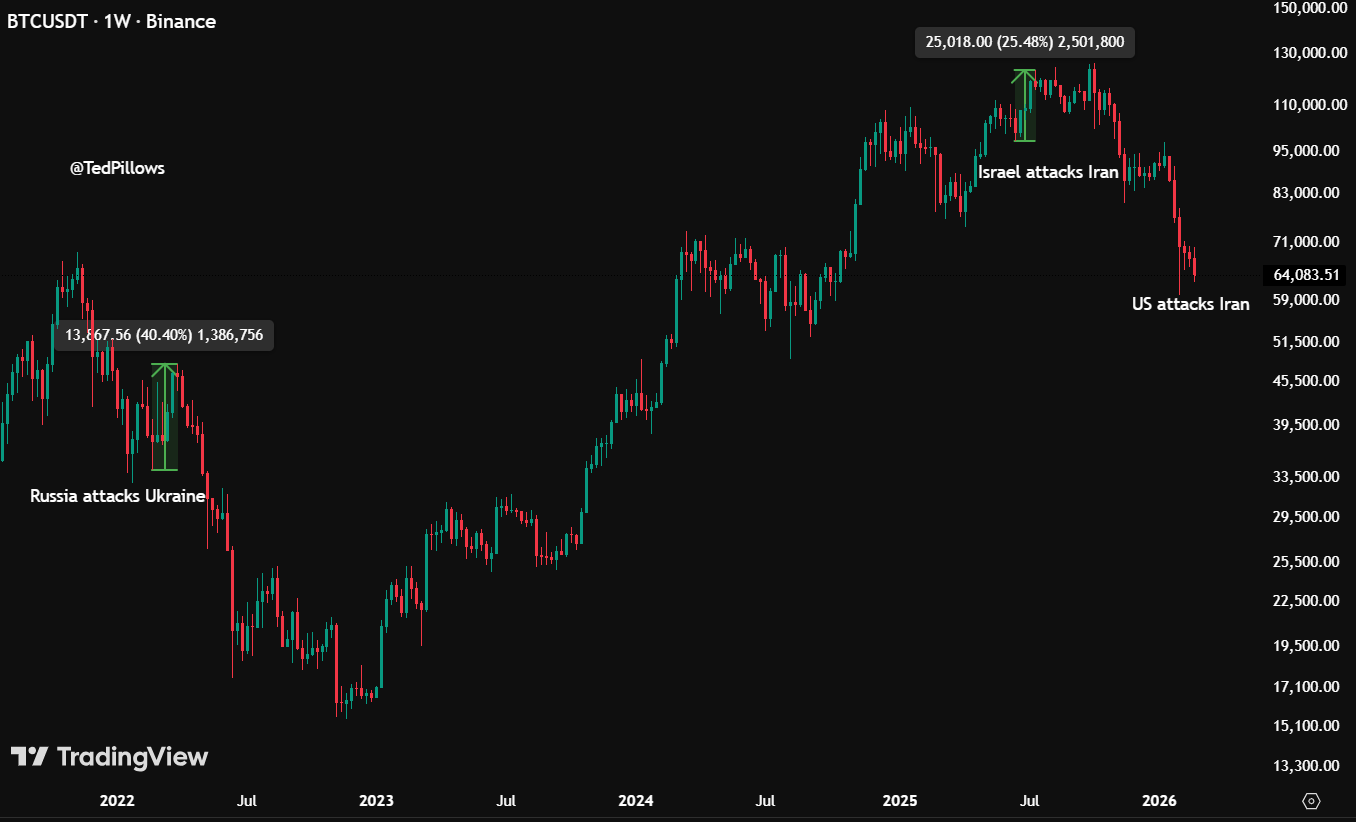
Now, after the U.S. attacked Iran in February 2026, Bitcoin has dropped once more. Pillows has begun questioning whether history could repeat itself with another strong rebound.
Possible Bitcoin Paths from Here
Meanwhile, another market commentator, Mak Investment, pointed out that after Iran’s operation, gold and oil prices jumped, Asian stock markets dropped, and liquidations increased. Still, Bitcoin held up better than many stocks, showing relative strength during a risk-off mood.
$BTC
Geçen hafta sonu yaşanan İran operasyonunun ardından piyasalar sarsıldı. Altın ve Petrol yükseldi, Asya borsaları geriledi, yüksek likidasyonlar yaşandı. Bitcoin hisse senetlerinden belirgin şekilde daha dirençli bir görüntü verdi. Risk off ortamında dayanıklı durması… pic.twitter.com/JKHvvJAf03— MAK (@makinvestment) March 2, 2026
Mak also stressed that Bitcoin remains in a 47-48% mid-cycle correction from its $126,000 peak in October 2025. The analyst compared this pullback to similar corrections during the 2017 and 2021 bull runs. Mak identified $70,800 at the 0.5 Fib. retracement level as strong resistance and $57,772 at the 0.618 level as key support.
He presented two possible paths. If tensions stay contained and Bitcoin breaks above $70,800, the price could quickly move toward the $80,000-$91,000 range. However, if the conflict spreads and Bitcoin falls below $62,000, it could drop sharply into a lower green demand zone.
War Escalates Across the Middle East
At press time, the Iran-Israel conflict has grown into a full-scale regional war now in its third day. On Feb. 28, joint U.S.-Israeli strikes hit Iranian leadership, military bases, nuclear facilities, missile systems, and command centers. The strikes killed Iran’s Supreme Leader Ayatollah Ali Khamenei along with other senior military figures.
Iran responded quickly with waves of missiles and drones targeting Israel, U.S. bases, and several Gulf states. U.S.-Israeli forces have struck more than 2,000 targets across 131 Iranian cities and provinces, claiming air superiority over Tehran.
Iran’s retaliation has reached locations including Beit Shemesh, Bahrain, Iraq, Saudi Arabia, Qatar, the United Arab Emirates, Cyprus, and a UK base. Hezbollah in Lebanon has also fired rockets into Israel, leading to Israeli strikes on Beirut suburbs and southern Lebanon.