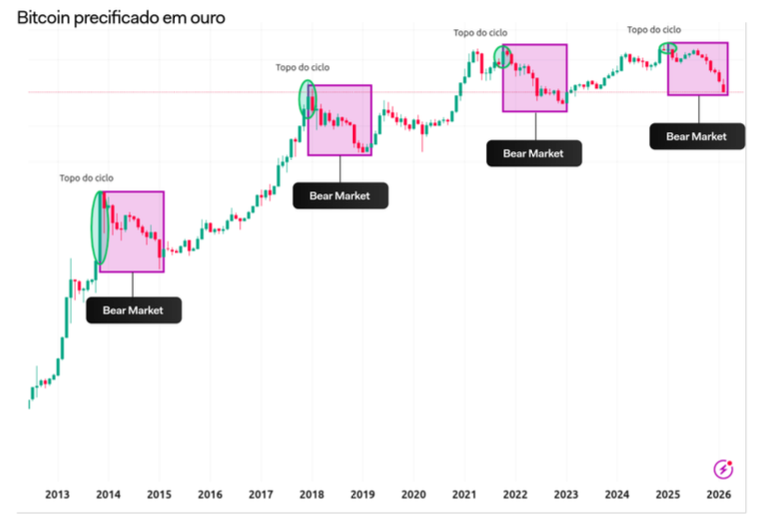
The divergence reflects broader macro forces.
Since the start of Donald Trump’s new mandate, markets have faced aggressive trade tariffs, domestic institutional disputes in the U.S., and rising tensions with China and Iran. Rising tensions with the latter have since resulted in ongoing military conflict.
Global uncertainty, measured via the World Uncertainty Index, has exploded as a result. Gold benefited from that shift, rising more than 80% over the past year to $5,280. As capital rotated into bullion, bitcoin weakened against it sooner than it did against the dollar, Mercado Bitcoin’s analyst wrote.
Exchange-traded funds have also added pressure. Since November, about $7.8 billion has flowed out of spot bitcoin ETFs, roughly 12% of the $61.6 billion total.
However, this fear-driven sell-off only paints part of the picture.
While reactive capital is fleeing bitcoin, large-scale investors or "whales" are treating the downturn as an accumulation zone, the report adds, pointing to Abu Dhabi’s major investment firms Mubadala Investment Company and Al Warda Investments adding in spot bitcoin ETF exposure in mid-February.
Against this backdrop, Szuster calls for investors to build their positions intelligently and leverage a dollar-cost averaging strategy to take advantage of current market fear and avoid timing issues.
“Historically, buying during periods of fear has been more effective than buying during euphoria,” he wrote. “Does this mean it's already the bottom? No. But it means that, statistically, we are in the zone where the best average prices are usually built.”

 coindesk.com