Bhutan’s Bitcoin strategy dates back to 2019, when the country quietly launched a state-backed mining initiative powered largely by hydroelectric energy. Since then, the country accumulated an estimated $765 million worth of Bitcoin through mining, making it one of the biggest sovereign holders of the asset.
However, Arkham data indicates that the cost of mining a single Bitcoin roughly doubled since the most recent halving, which greatly reduced profitability. As a result, Bhutan is now producing far fewer coins than it did during peak periods. In 2023 alone, the country mined approximately 8,200 Bitcoin, which current conditions no longer support.
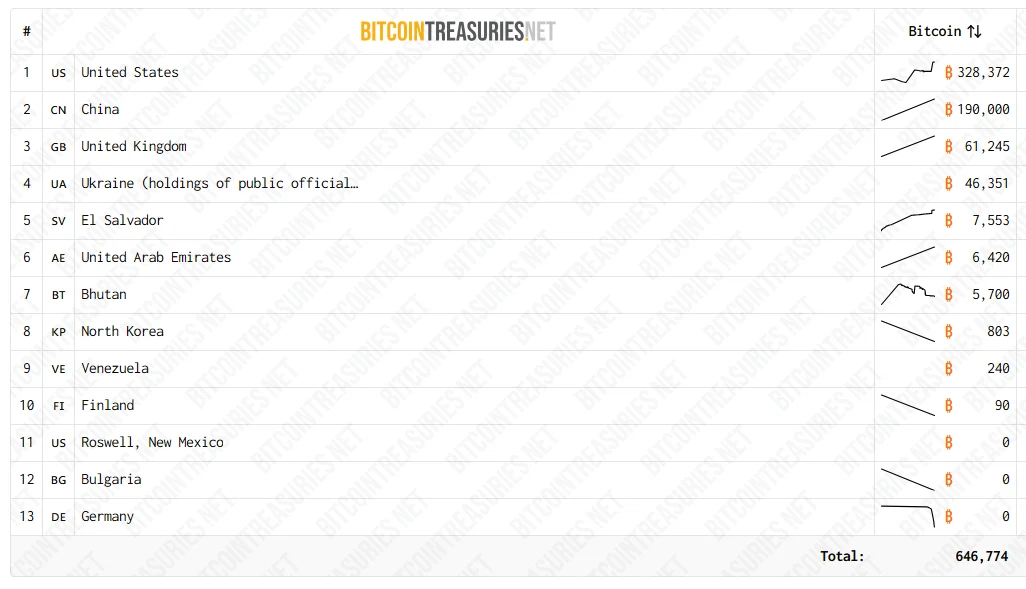
Government Bitcoin holdings (Source: BitcoinTreasureis.NET)
These recent sales materially reduced Bhutan’s overall Bitcoin reserves. Holdings have fallen from a peak of 13,295 $BTC in October of 2024 to roughly 5,700 $BTC today. This decline also altered Bhutan’s standing among government Bitcoin holders. Data from Bitcoin Treasuries shows that Bhutan slipped to seventh place globally, now trailing the United States, China, the United Kingdom, Ukraine, El Salvador, and the United Arab Emirates.
While the government has not publicly explained the latest transfers, Arkham pointed out that Bhutan has a history of selling Bitcoin in sizable batches, often around $50 million at a time.
US Bitcoin ETF Investors Hold On
While Bhutan might be looking to offload its Bitcoin, US-based spot Bitcoin ETF investors are showing relatively strong conviction despite the prolonged downturn in Bitcoin’s price. This is according to commentary from leading ETF analysts and market researchers.
ETF analyst James Seyffart said in a post on X that ETF holders are “still hanging in there pretty good,” even as Bitcoin continues a four-month downtrend that pushed prices well below recent highs.
Seyffart explained that current ETF investors are experiencing their largest paper losses since US spot Bitcoin ETFs launched in January of 2024. With Bitcoin trading below $73,000, he estimates that ETF holders are sitting on unrealized losses of roughly 42%. Despite this, Seyffart thinks that recent outflows are still modest when viewed against the scale of inflows during the market’s peak.
Before the October downturn, cumulative net inflows into spot Bitcoin ETFs stood at approximately $62.11 billion, but have since declined to around $55 billion, based on preliminary figures from Farside Investors. Seyffart characterized this pullback as relatively mild given the size of earlier inflows.
Similar observations were shared by investment researcher Jim Bianco, who said the average spot Bitcoin ETF holder is currently about 24% underwater but continues to hold positions rather than capitulate. That behavior suggests a level of long-term conviction, even as price weakness persists.
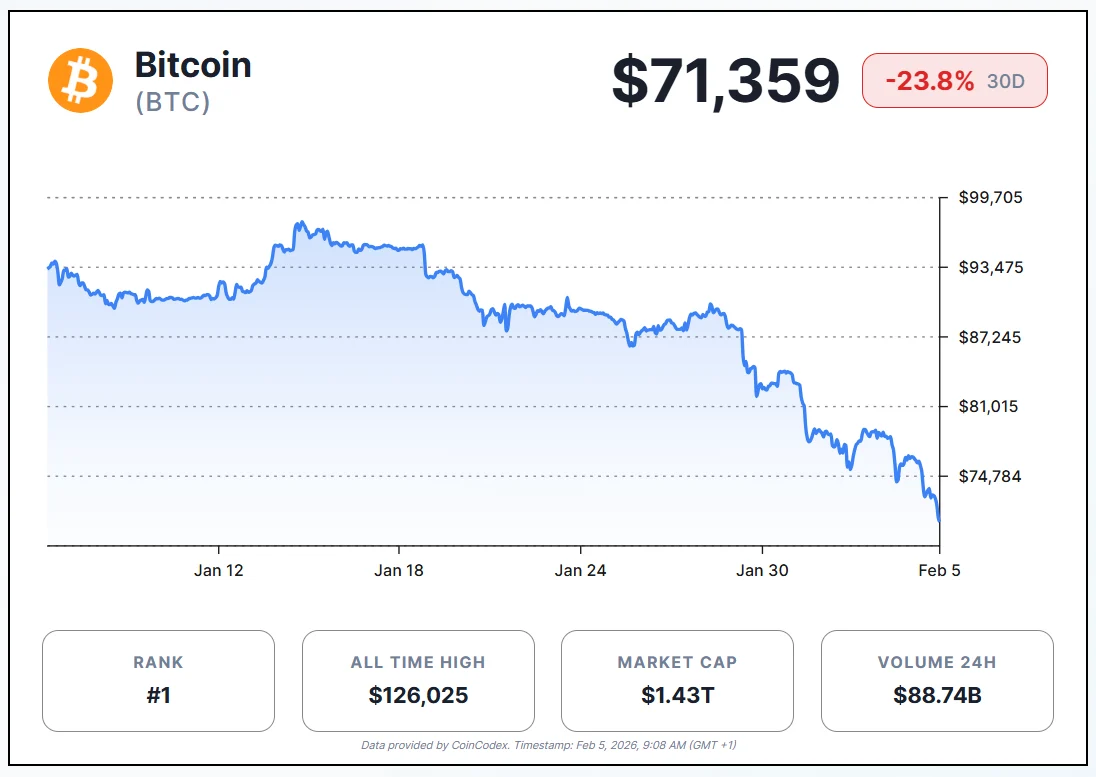
On the other hand, not everyone is optimistic. Crypto analytics account Rand pointed out that the market has now recorded three consecutive months of ETF outflows for the first time, coinciding with a roughly 25% drop in Bitcoin’s spot price over the past month.
$BTC price action over the past month (Source: CoinCodex)
Some analysts argue that bearish sentiment may be overly narrow in focus. ETF analyst Eric Balchunas warned that investors are being “very short-sighted,” as Bitcoin has gained more than 400% since 2022, far outperforming traditional assets like gold and silver over the same period.

 coinpaper.com