
 beincrypto.com

Bitcoin enters the first full week of February under mounting macro pressure, trading in a volatile sub-$80,000 range as risk appetite weakens and markets brace for key US labor data.
With recession fears resurfacing, ETF flows turning cautious, and speculation growing around the Federal Reserve’s next policy move, this week’s economic calendar could prove decisive for near-term $BTC sentiment.
5 US Economic Events To Influence Bitcoin and Crypto Sentiment This Week
From job openings to payrolls, each data point feeds into expectations around rate cuts—still one of Bitcoin’s most powerful macro catalysts. Here’s what to watch.
JOLTS Job Openings
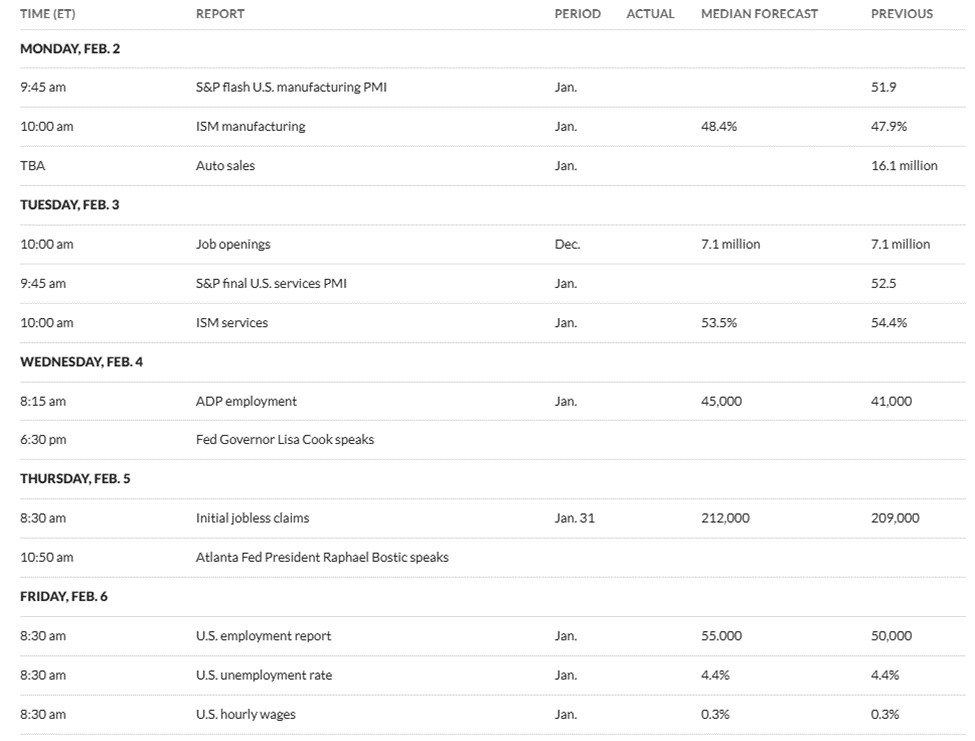
The JOLTS Job Openings report for December 2025, due at 10:00 AM ET, will provide insight into labor demand by tracking the number of unfilled jobs in the US.
Economists surveyed by MarketWatch expect roughly 7.1 million openings, broadly unchanged from November’s revised 7.146 million, which already undershot expectations and signaled cooling momentum.
A downside surprise would reinforce the narrative of a softening labor market, strengthening expectations for Federal Reserve rate cuts later in 2026.
Historically, such conditions have supported Bitcoin as looser monetary policy boosts liquidity and risk assets. Conversely, a stronger-than-expected print could delay easing expectations and weigh on $BTC.
Market reaction has been mixed in recent months. Despite November’s miss, Bitcoin briefly dipped below $91,000 before stabilizing.
As of this writing, $BTC trades for $75,908 amid broader risk-off sentiment and government shutdown concerns.
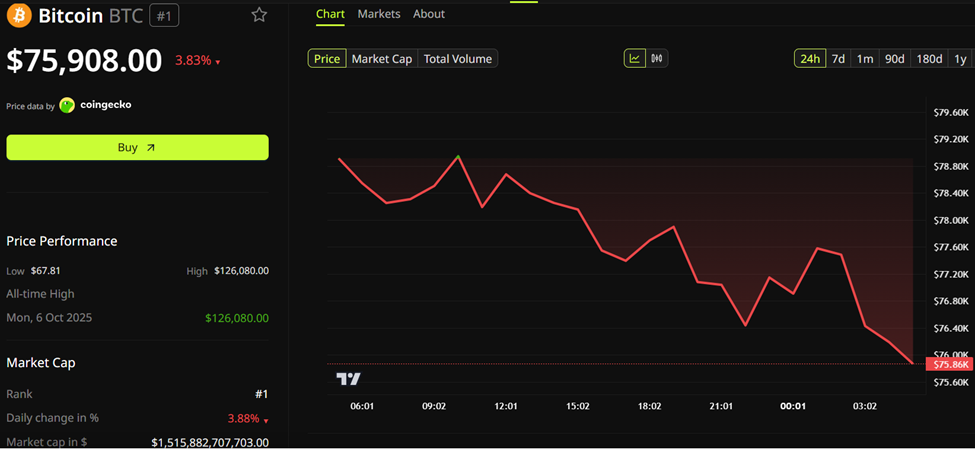
A weak JOLTS reading could act as a relief trigger if it aligns with projections of unemployment rising toward 4.5% in 2026.
ADP Employment Report
Wednesday’s ADP Employment report, released around 8:15 AM ET, estimates private-sector job growth and often sets the tone ahead of Friday’s official payrolls.
Forecasts point to 45,000 jobs added in January, modestly above December’s 41,000, though the broader consensus ranges closer to 47,000.
For Bitcoin, the direction matters more than the number. A downside miss could revive recession fears and accelerate bets on earlier or deeper Fed rate cuts—conditions that have historically favored $BTC during liquidity-driven rallies.
Stronger data, by contrast, would suggest labor resilience and reduce the urgency to ease, potentially pressuring crypto prices.
Earlier mixed jobs data produced little immediate $BTC reaction, but subsequent weaker payrolls helped drive a rally toward $92,000.
With Bitcoin now trading defensively amid ETF outflows and macro uncertainty, a soft ADP print could help stabilize sentiment heading into Friday’s report.
Initial Jobless Claims
Initial Jobless Claims for the week ending January 31 will be released at 8:30 AM ET, offering one of the timeliest snapshots of labor market stress. It would indicate the number of US citizens who filed for unemployment insurance for the first time that week.
Claims are expected at 212,000, slightly above the prior week’s 209,000, which already exceeded forecasts.
🚨 US Initial Jobless Claims:
— Crypto Treasure (@Riding_Cryptos) January 29, 2026
Actual: 209K
Exp.: 205–206K
Ties to Powell yesterday:
• "Unemployment rate showing signs of stabilization" -claims reinforce this, no red flags.
• Fed pause continues (rates steady),>pic.twitter.com/UObtIuhkKc
Rising claims would add to evidence that the labor market is losing momentum, reinforcing dovish policy expectations and potentially supporting Bitcoin. A surprise decline, however, could revive hawkish concerns and limit upside for risk assets.
Recent claims data have failed to spark sustained $BTC moves, with prices largely dictated by broader market sell-offs.
Still, with sentiment hovering near extreme fear levels and unemployment projected to trend higher in 2026, any meaningful upside surprise in claims could skew risk-reward back in Bitcoin’s favor.
US Employment Report (Nonfarm Payrolls)
Friday’s Nonfarm Payrolls report is the week’s main event. Forecasts call for 55,000 jobs added in January, unemployment to hold at 4.4%, and wages to rise 0.3% month-over-month. Estimates vary widely, with some analysts bracing for payrolls as low as 32,000.
Here's the thing: Markets are bracing for Friday’s Nonfarm Payrolls (est +32K, Unemployment 4.5%)—a key read on whether the Fed stays hawkish or pivots. Crypto’s already in Extreme Fear, with $BTC down 1.8% and $ETH off 5.6% this weekend. Weak data could spark a relief rally; hot…
— TraderHC (@traderhc) February 1, 2026
Weak employment data would strengthen the case for Fed rate cuts in a cooling economy, an outcome that has previously sparked sharp $BTC rallies.
In December, payrolls came in below expectations, and Bitcoin surged toward $92,000 shortly after. A strong report, however, could reinforce a prolonged Fed pause and pressure $BTC, which is already down from recent highs following leverage flushes and macro anxiety.
With revisions often amplifying volatility, Friday’s data could define Bitcoin’s near-term direction. In a market primed for policy pivots, even a modest miss may be enough to trigger a relief rally.
Bitcoin remains highly sensitive to US labor data as traders reassess the Fed’s policy trajectory. While strong numbers could cap upside, a string of soft prints would reinforce the case for easing—and potentially reset risk sentiment across crypto markets.
Here’s a sharper, cleaner rewrite with tighter logic, clearer stakes, and a more authoritative news tone—without losing nuance or overhyping the impact.
Strategy’s (MSTR) Q4 2025 Earnings
Due after market close on February 5, 2026, at 5:00 PM ET, this report remains a key sentiment catalyst for Bitcoin, given the firm’s role as the largest corporate $BTC treasury holder.
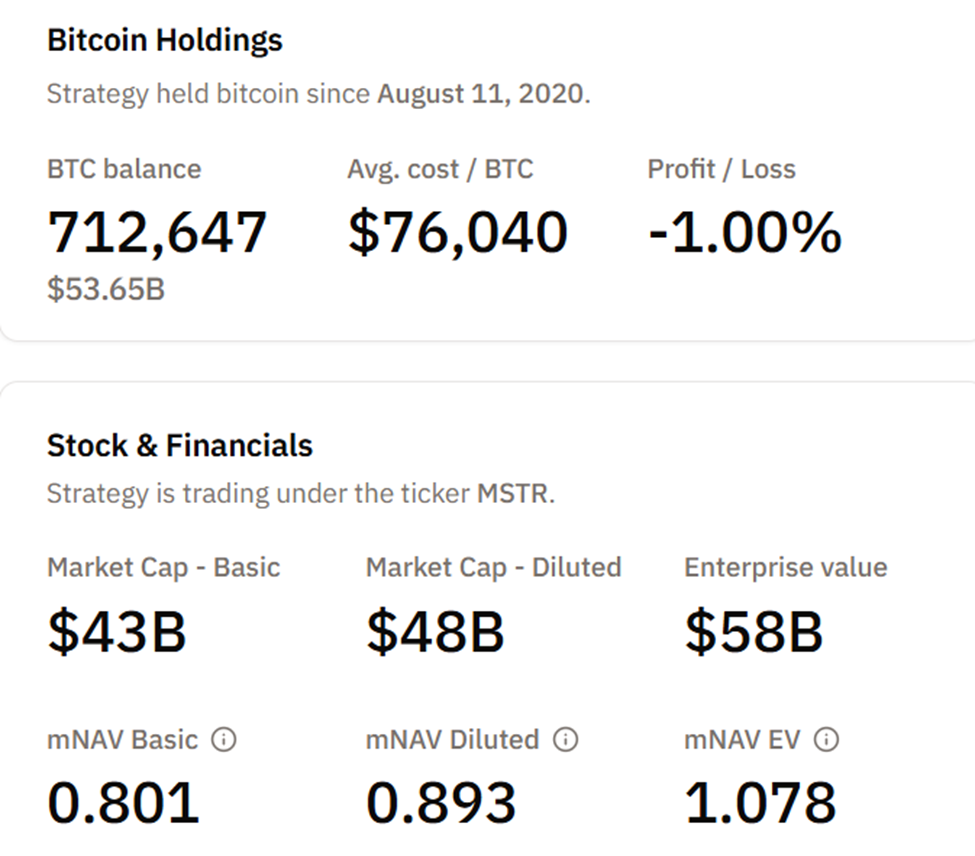
The company now holds approximately 712,647 $BTC, worth an estimated $53.65 billion at current prices, representing roughly 3.4% of Bitcoin’s circulating supply.
 $BTC Holdings">
That exposure places MicroStrategy’s earnings squarely at the intersection of accounting optics and broader crypto market psychology.
Consensus expectations point to a Q4 EPS loss of around -$18.06, significantly wider than last year’s -$3.20, largely driven by fair-value accounting impairments tied to Bitcoin’s Q4 drawdown.
Revenue is forecast at $117–119 million, flat to slightly lower year over year, suggesting that the core software business continues to play a secondary role to the firm’s Bitcoin strategy.
A larger-than-expected loss or cautious commentary on leverage, dilution, or capital structure could intensify concerns about margin pressure should $BTC slide further. This is particularly so given that prices are hovering near MicroStrategy’s estimated average cost basis of approximately $76,000.
As #Bitcoin fell below $75,000, Michael Saylor(@saylor)'s @Strategy's 712,647 $BTC is now facing an unrealized loss of over $900M.https://t.co/iFtYbgyI3Q pic.twitter.com/p3gQpkzDuU
— Lookonchain (@lookonchain) February 2, 2026
While the firm’s Bitcoin remains largely unencumbered, negative optics alone could weigh on $BTC sentiment through perceived forced-selling risk.
That said, there is no immediate liquidation risk tied to MicroStrategy’s convertible debt structure. Any reaffirmation of long-term conviction, continued accumulation, or fresh capital-raising plans could reinforce bullish narratives around corporate Bitcoin adoption.
The post Strategy (MSTR) Earnings Among 5 US Data Points To Flip Bitcoin Market This Week appeared first on BeInCrypto.