
 beincrypto.com

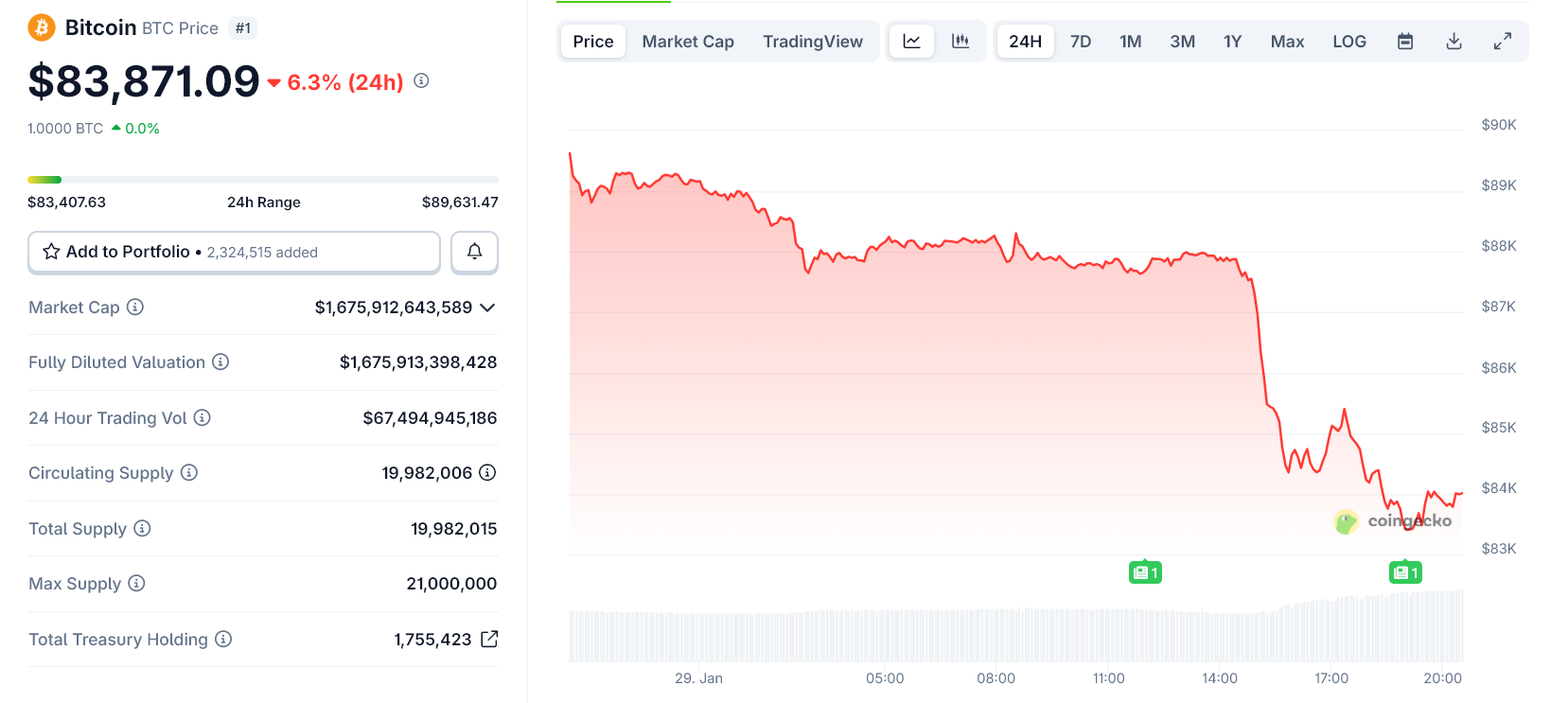
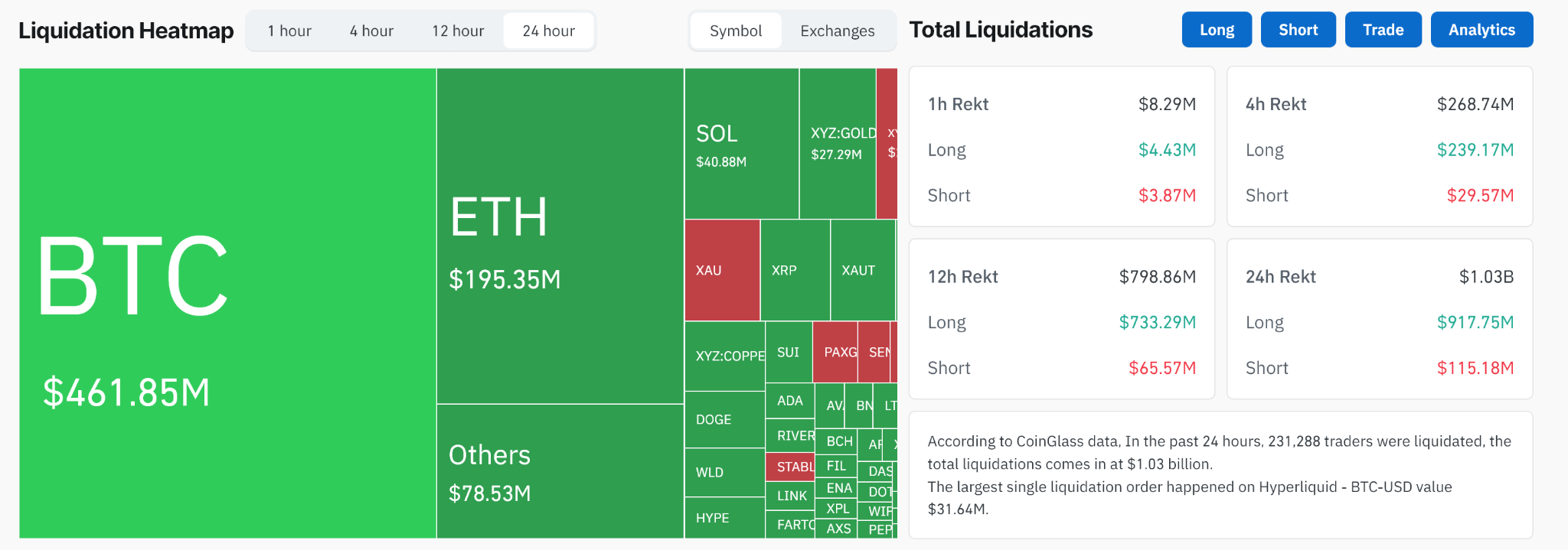
Bitcoin sold off sharply on Wednesday, falling more than 6% in 24 hours and briefly dipping into the low $83,000 range. The decline unfolded rapidly late in the session, cutting through intraday support levels with little immediate buying response.
The move comes as three macro risks converge at once: rising US-Iran tensions, mounting expectations of a US government shutdown, and a severe winter crisis straining infrastructure across North America.
US-Iran Tensions Reignite Global Risk-Off Positioning
Geopolitical risk resurfaced after Washington issued fresh warnings toward Tehran, while Iran signaled readiness to respond forcefully to any military escalation.
Naval movements in the Middle East and new sanctions rhetoric have raised concerns about miscalculation, particularly as diplomatic channels remain strained.
Markets typically treat early stages of geopolitical escalation as a risk-off signal rather than a hedge scenario.
For Bitcoin, this often translates into short-term de-risking, especially when leveraged positioning is elevated and liquidity is thin.

Government Shutdown Fears Tighten Financial Conditions
At the same time, investors are increasingly pricing in a US government shutdown as funding negotiations stall ahead of a key deadline.
Without a last-minute agreement, multiple federal agencies could face operational disruptions, delaying payments and reducing near-term fiscal clarity.
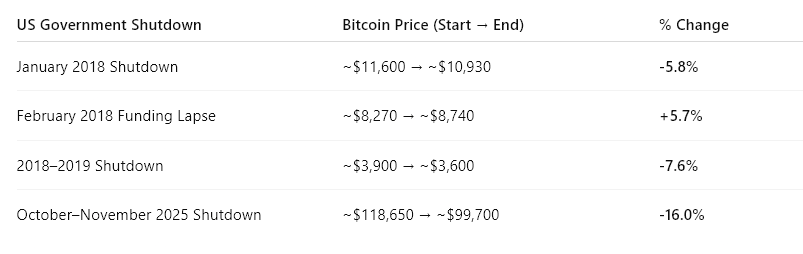
Historically, Bitcoin price has notably dropped during the last three shutdowns, losing as high as 16%.
In practice, traders reduce exposure first and reassess later, particularly in markets already showing signs of demand weakness.
Winter Crisis Adds Mining Shock
A severe winter storm continues to disrupt large parts of the US and Canada, causing power outages, transport delays, and infrastructure strain.
While weather events rarely act as primary Bitcoin catalysts, they contribute to broader risk aversion when layered on top of geopolitical and fiscal stress.
In this case, the storm functions more as a compounding factor, reinforcing a defensive market mood rather than directly impacting Bitcoin’s network or mining activity.
Bitcoin hashrate just saw its biggest drawdown since Oct 2021.
— CryptoQuant.com (@cryptoquant_com) January 29, 2026
US winter storms forced miners offline, pushing hashrate down 12% since Nov 11 to 970 EH/s, the lowest since Sept 2025.
The decline had already started as $BTC corrected from $126K to ~$100K. pic.twitter.com/LudRmBO0lv
Price Action Signals Forced Selling
Bitcoin’s intraday chart shows a prolonged drift lower followed by a sharp late-session breakdown. The lack of a strong bounce suggests the move was driven less by discretionary sellers and more by forced positioning adjustments, such as liquidations and stop-loss triggers.
This type of price behavior typically appears when liquidity is insufficient to absorb sudden sell pressure, a condition closely tied to weakening spot demand.
ETF Flows Have Quietly Flipped From Tailwind to Headwind
One of the most important structural shifts is visible in US spot Bitcoin ETF flows. Year-to-date, ETFs have net sold roughly 4,600 $BTC, compared with net inflows of nearly 40,000 $BTC over the same period last year.
This change matters because ETFs have been the most consistent source of spot demand in this cycle.
When that bid weakens, rallies struggle to sustain momentum and drawdowns become more violent, as fewer buyers step in to absorb supply.
Bitcoin down to $85K, as demand continues to contract.
— Julio Moreno (@jjcmoreno) January 29, 2026
One example, ETFs have net sold ~4.6K $BTC so far this year, compared to a net buy of ~40K $BTC over the same period in 2025.
Monitor Bitcoin demand by clicking the link in the next post. pic.twitter.com/uj5DP32ss4
Retail Demand Contraction Undermines Market Stability
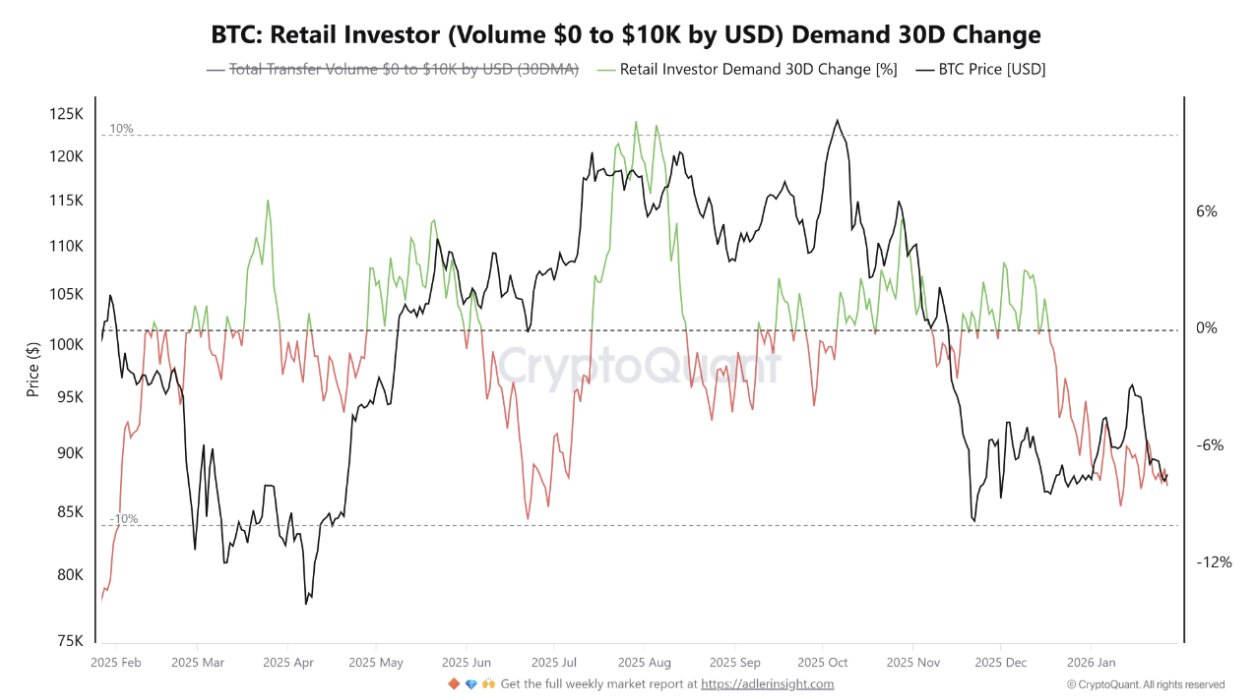
On-chain data tracking transactions between $0 and $10,000 shows retail demand contracting sharply over the past month. This indicates not just slower accumulation, but declining participation from smaller investors.
Markets can tolerate temporary retail absence, but prolonged contraction removes an important stabilizing force.
Combined with ETF outflows, the market becomes increasingly dependent on short-term traders and leverage, both of which amplify volatility.
Supply-in-Loss Suggests the Market Is Not Fully Reset
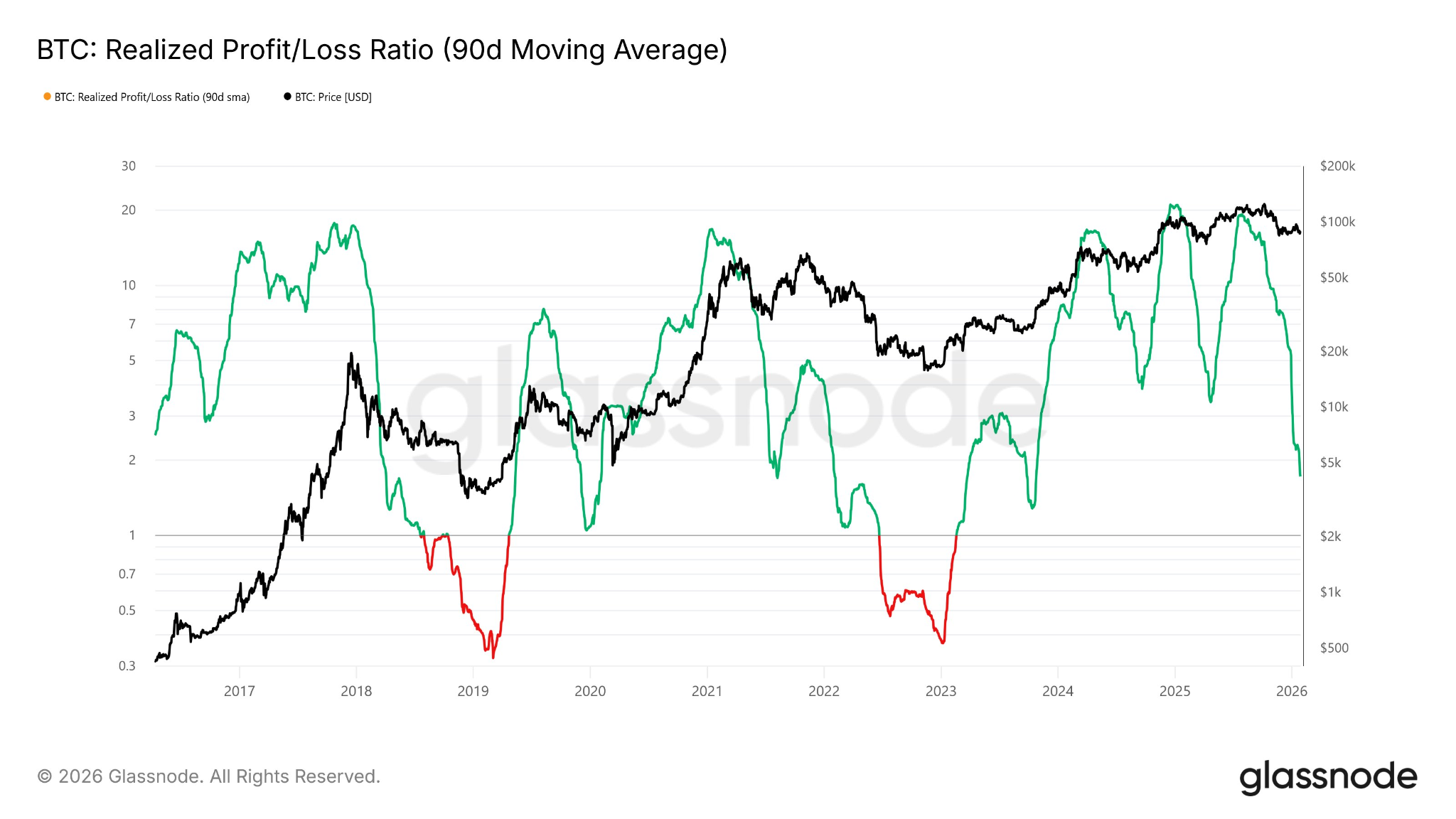
Despite the sell-off, Bitcoin’s supply-in-loss metric remains relatively low by historical standards. This means the majority of holders are still sitting on unrealized gains, a condition that often precedes further downside rather than marking a bottom.
When price falls into zones where more supply flips into loss, selling pressure can accelerate as sentiment shifts and risk tolerance tightens.
Early Bear Market Signal
— CryptoQuant.com (@cryptoquant_com) January 28, 2026
“Historically, this shift has marked the early phase of bear markets, when losses begin to spread beyond short-term holders and gradually reach longer-term participants.” – By @Woo_Minkyu
Link ⤵️https://t.co/Y1HIXfUmLw pic.twitter.com/u9daSX9N4o
Are These Events Causing the Sell-Off — or Exposing Weakness?
The data suggests the latter. US-Iran tensions and shutdown fears likely acted as catalysts, accelerating risk reduction. However, ETF outflows and collapsing retail demand point to a market that was already vulnerable.
Rather than creating new weakness, macro shocks appear to have revealed structural fragility that had been building beneath the surface.
What the Charts Imply for the Week Ahead
If demand conditions remain unchanged, Bitcoin may continue to experience choppy price action with weak rebounds. Any relief rally would need to be supported by improving ETF flows or stabilization in retail demand to sustain upside.
On the downside, a decisive break below the recent lows could trigger another wave of forced selling.
For now, Bitcoin’s trajectory appears less dependent on headlines and more on whether underlying demand returns before volatility forces another reset.
The post US-Iran Tension, Government Shutdown, Winter Crisis: Bitcoin Heading For a Bloodbath? appeared first on BeInCrypto.