
 cryptoslate.com

Bitcoin’s 2026 problem is the weekend
I keep coming back to this line because it feels brutally true in the way only markets can be true.
The only thing worse than buying Bitcoin this year was not buying Bitcoin. If you held dollars, you got quietly taxed.
The dollar has been sliding, and the mood around “anti-dollar” assets has been getting louder by the day.
If you held hard assets, you got rewarded loudly and publicly, with the kind of chart that makes people text you screenshots at 2 a.m.
Gold has traded above $5,000 an ounce, silver has pushed into triple digits, and even the S&P 500 is up on the year.
Then you look at Bitcoin, the asset that built its whole personality around being the exit door from fiat.
The scoreboard says it basically did nothing. That’s where people stop, shrug, and move on to the next trade.
That’s a mistake.
The real story in this tape is weirder, and it’s sitting inside the clock.
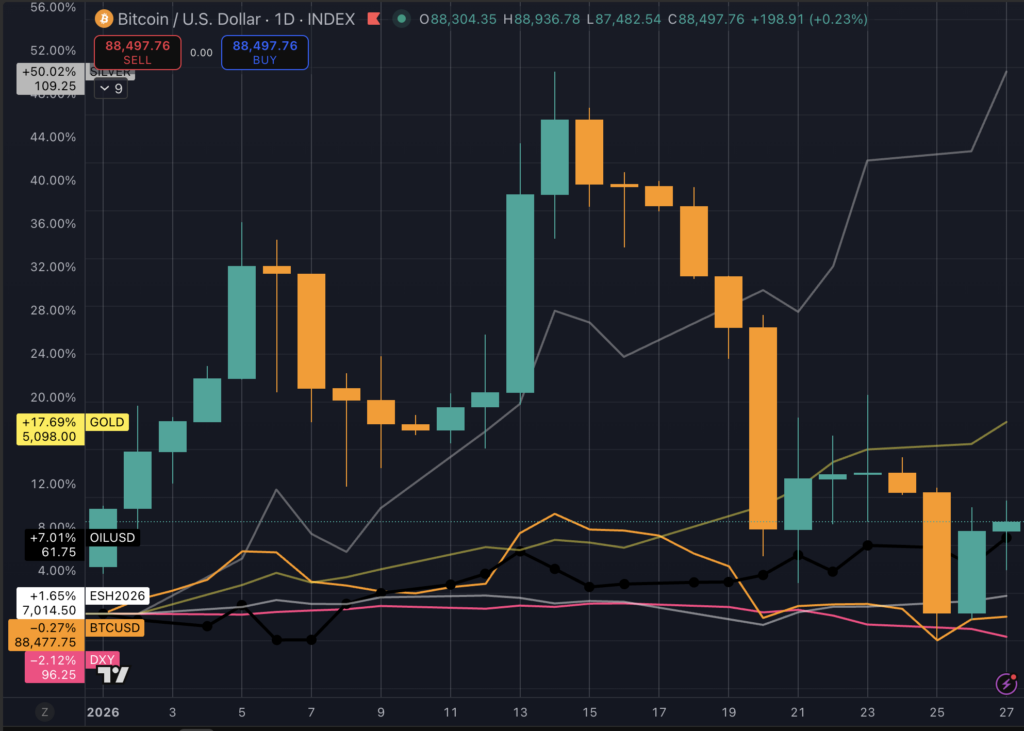
The scoreboard everyone is staring at
Here’s how 2026 has looked so far in plain percentage terms, measured from the first available print after Jan. 1 through Jan. 27 at 15:00 UTC.
| Asset | Return (Jan. 1–Jan. 27, 15:00 UTC) |
|---|---|
| Silver | +46.22% |
| Gold | +16.59% |
| Oil | +6.35% |
| S&P futures | +1.49% |
| Bitcoin | -0.07% |
| DXY | -1.94% |
If you’re reading this like a normal person, the takeaway is obvious.
Metals won, oil did fine, equities did fine, the dollar lost, and Bitcoin treaded water.
The problem is that “treaded water” is a 24/7 illusion.
Bitcoin trades all the time, the others don’t
Bitcoin trades every hour of every day. There is no close, no weekend break, no mercy. People can buy it after dinner, during a flight, or on a Sunday morning, right in the middle of whatever news cycle is panicking everyone.
Most of the other lines on this chart live on “almost always” schedules. That’s still different from “always.”
DXY futures trade for 21 hours a day. S&P futures give you “nearly 24-hour” access during the week. CME calls it around-the-clock liquidity, and that’s true in the way every futures trader understands: It’s open most of the time that matters.
Crypto, especially spot Bitcoin, falls into the category of 24/7 trading. It keeps going when everyone else is supposed to be resting. That sounds like an advantage.
In this dataset, it behaved like a cost.
The “fair” comparison makes Bitcoin look worse
When you compare assets, you either compare them on their own clocks, or you force them onto the same timestamps.
So I ran the data both ways.
First pass, “as traded,” you get the flat Bitcoin result.
Second pass, overlap-only, you only look at timestamps where every market has a price.
That way, the comparison happens inside the same hours. The overlap window starts at Jan. 2, 00:00 UTC. It runs through Jan. 27, 15:00 UTC.
| Asset | Return (Overlap-only window) |
|---|---|
| Bitcoin | -1.24% |
| Gold | +16.44% |
| Silver | +46.17% |
| Oil | +6.48% |
| S&P futures | +1.46% |
| DXY | -1.94% |
So the “Bitcoin was flat” story is already shakier than it looks.
And the bigger point still hasn’t landed. Bitcoin’s pain this year has looked like opportunity cost. That opportunity cost showed up at a very specific time.
Bitcoin’s entire 2026 came down to Saturdays and Sundays
Here’s the cleanest thing in the dataset, and it’s the one detail I can’t unsee.
From Jan. 1 through Jan. 27, Bitcoin’s compounded return split cleanly between weekdays and weekends.
| Period | UTC days | Compounded return (Jan. 1–Jan. 27) |
|---|---|---|
| Weekdays | Monday–Friday | +3.21% |
| Weekends | Saturday–Sunday | -3.17% |
| Net | All days | ~0% (flat) |
In other words, Bitcoin spent the week acting like it wanted to go higher. Then it spent the weekend undoing the work.
If you want to know which weekends did the damage, the dataset gives you that too.
| Weekend ending (UTC) | Weekend return |
|---|---|
| Jan. 18 | -1.97% |
| Jan. 25 | -3.33% |
Bitcoin failed to rally, but not in a vacuum. It performed in a way that revealed who was in control of the tape when the grown-up markets were off the clock.
This is what “digital gold” looked like in ounces
People talk about Bitcoin as a hedge in dollars, which is understandable because your P&L is usually denominated in dollars.
But when the hard-asset trade is on, dollars can be the wrong measuring stick.
So I priced Bitcoin in the stuff that actually ran. Using the overlap-only window:
| Bitcoin priced in | Change (Overlap-only window) |
|---|---|
| Gold ounces | -15.18% |
| Silver ounces | -32.44% |
| S&P futures | -2.66% |
This is why I think my “only thing worse…” line hits on an emotional level.
Bitcoin didn’t collapse, and that can feel like a win when you’re trained to expect drama. Your purchasing power still bled away. It bled away against the exact assets people buy when they’re anxious about policy, money, and geopolitics.
That anxiety is all over mainstream coverage right now.
The Washington Post framed the gold and silver move around a shift away from the dollar, central bank buying, and a broad grab for safety. The Guardian described gold’s $5,000 print as a flight into a safe haven.
The World Bank has been explicit about the relationship between uncertainty and gold. It expects precious metals to stay elevated into 2026, with policy uncertainty and geopolitics at the center of the story.
Bitcoin’s job description says it should thrive in that environment. The data says something else is happening.
Bitcoin is trading like equity beta, not a metal
Correlation gets abused a lot. I’m not going to pretend a single month tells you what an asset “is.”
Still, the overlap-only hourly returns paint a consistent picture.
| Pair | Correlation (overlap-only hourly returns) |
|---|---|
| Bitcoin vs. S&P futures | ~0.40 |
| Bitcoin vs. gold | ~-0.06 |
| Bitcoin vs. silver | ~0.00 |
So when people look at this year and ask why Bitcoin didn’t keep up with the hard-asset run, the answer that fits the data is simple.
Bitcoin spent this window behaving more like a risk asset than a safe haven. That becomes more important when you connect it back to the weekend pattern. Risk assets are where you raise cash when you feel nervous.
Crypto has a structural feature that makes it a tempting place to do that: It’s open. Even general 24/7 trading explainers tend to land on the same idea.
Round-the-clock markets can mean thinner liquidity at odd hours, and that can make moves sharper.
The data shows a version of that reality where weekends became the trap door.
Why this matters going forward
If Bitcoin is going to “catch up” in a metals-led tape, it probably needs one thing above everything else.
It needs to stop leaking on weekends. That’s a bold claim. It also gives us a clean way to track the story in real time.
If the next few weekends turn into flat or positive contributions, then the “weekday rally, weekend fade” pattern breaks.
Bitcoin has a chance to behave like a macro asset again. If the pattern persists, the opportunity cost keeps stacking.
Bitcoin’s claim to being the cleanest anti-fiat trade keeps getting challenged by the oldest anti-fiat trade humans have. We can also connect that to the institutional flow narrative that’s been creeping into serious Bitcoin forecasts.
Standard Chartered’s research team has been saying the next leg depends heavily on ETF demand.
Their revised path puts Bitcoin around $150,000 by end-2026, while stripping out incremental corporate treasury buying from the model.
That matters here because weekends are the part of the tape where the traditional rails are quiet, and the crypto rails keep running.
If Bitcoin wants to trade like a grown-up hedge, it needs grown-up flows that are willing to hold risk through the weekend. Or it needs enough depth that weekend selling stops mattering.
The market will tell you which one it gets.
The human version of this story
Most people don’t experience “correlation.” They experience regret. They see gold ripping, silver going vertical, and Bitcoin sitting there like it’s waiting for an invitation. They wonder if the whole thing was a lie.
Then they zoom in and notice Bitcoin did have energy during the week. The energy vanished the moment the calendar flipped into Saturday. That’s relatable because it matches how people actually live.
Monday is resolve.
Friday is confidence.
Saturday is doomscrolling.
Sunday is bargaining.
Bitcoin priced that emotional loop into the chart. The underlying data shows the week acting like a market trying to bid Bitcoin back into the macro conversation.
The weekend looked like a market using Bitcoin as the place to take risk off, because it was the only big, liquid thing that never closed (even while certain world leaders are still posting to social media).
That’s the real punchline.
Bitcoin’s 2026 hasn’t been defined by one giant crash or one glorious breakout. It’s been defined by a leak, and the leak has a schedule.
What to watch next
| What to watch | Why it matters |
|---|---|
| Bitcoin’s weekend contribution each week | The sign matters more than the size at first. A shift to flat or positive weekends would break the “weekday rally, weekend fade” pattern. |
| Bitcoin priced in ounces, not dollars | The ratio tells you whether Bitcoin is gaining “hard money” credibility relative to what’s actually leading the tape. |
| Whether gold and silver stay bid | The macro backdrop is doing the heavy lifting. The World Bank expects precious metals strength to remain a feature into 2026 under uncertainty. |
| Broader market mood | The S&P being up while the dollar slides is a reminder this isn’t a simple panic tape. It’s a rotation tape. |
For now, the most important lesson is the one that sounds almost too basic.
Time matters. Bitcoin trades in a world that never turns the lights off.
This month, that came with a bill.