
en
Back to the list

Bitcoin Aims at $91,000, As Revealed by 3 Key Price Levels

source-logo  u.today 16 December 2025 17:04, UTC
image

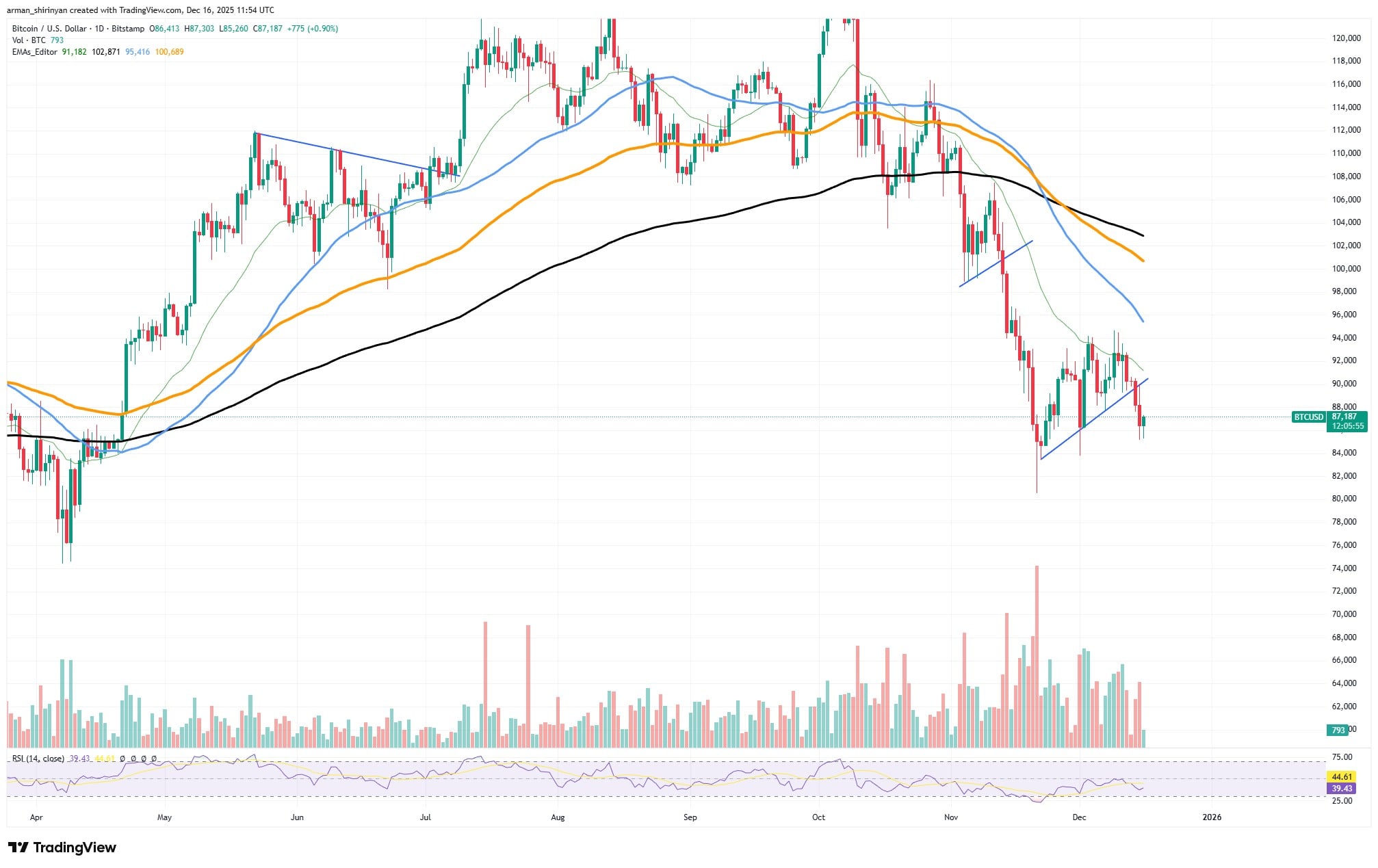
On the charts, Bitcoin’s recent decline below $90,000 appears dramatic, but structurally itis more of a controlled reset than a trend failure. Bitcoin has stabilized in the mid-to-high $80,000s, where liquidity, derivatives positioning and spot demand are beginning to align once more following a steep sell-off from the $100,000-$105,000 range.

Closing above

The first level to be monitored is between $83,500 and $85,000. On the liquidation heatmap, this area is noticeable as a dense liquidity pocket that has already served as a reaction floor. Here, buyers intervened forcefully during the sell-off, absorbing forced liquidations and keeping the price stable.

Article image

Know when your
coins move

Alerts, real-time prices, and market news — all in one app
qr-code Point your phone camera to install
4.8 based on 40K reviews in the App Store and Google Play

As long as Bitcoin consistently closes above this range, the downward trend will lose steam. A clear break below it would reopen the door to further declines, but there is currently no follow-through on that scenario.

Bitcoin enters consolidation

The second, and most significant, magnet is the current consolidation of Bitcoin between $86,500 and $87,000. This region is now in short-term equilibrium, with sufficient absorption to stop a free fall and sufficient liquidity on both sides to maintain price rotation.

The third key level, which ranges from $90,800 to $91,500, is higher. Unfulfilled orders from the breakdown and resting liquidity are abundant in this area. It is an obvious upside target in terms of market mechanics.

A push into $91,000 becomes less of a bullish fantasy and more of a mechanical result, fueled by liquidity-seeking behavior, if Bitcoin reclaims and holds the $88,500-$89,000 range.

From a wider angle, the trend is damaged but unbroken. The recent sell-off flushed leverage rather than long-term holders, the long-term structure is still higher than previous cycle peaks, and the 200-day moving average is still in place.

u.today