
 cointelegraph.com

Global macro analyst Luke Gromen has turned near-term bearish on Bitcoin, even placing a drop to the $40,000 range among the possible outcomes for 2026. He argues that the number-one crypto looks vulnerable as macro conditions and investor narratives shift.
In a recent appearance on the RiskReversal podcast, Gromen largely stuck by the core debasement trade thesis for fiat currencies and hard assets, but said that gold and certain equities are doing a better job than Bitcoin (BTC) of expressing that view right now, saying, “Basically everything but gold and the dollar are likely to get waylaid.”
The debasement trade thesis is a bet that governments will quietly reduce the real value of their debts through inflation and currency weakening, so investors shift out of fiat and into scarce or real assets like gold, commodities, and Bitcoin that are expected to hold their purchasing power better over time.
Gromen turns cautious on Bitcoin
Gromen pointed to Bitcoin’s failure to make new highs versus gold, a break of key moving averages, and growing chatter about quantum risk as signs that the risk‑reward has worsened in the near term.
For longtime followers, that marks a notable turn in tone. Gromen has spent the past few years lumping Bitcoin in with gold as part of the debasement trade, and a broader bet on fiscal dominance, rising debt-to-GDP ratios, and the need to inflate away real liabilities.
In this interview, by contrast, he repeatedly framed BTC as a position that can and should be sized down tactically, even as he stays structurally bullish on the idea that fiat currencies will be debased over time.
Related: Michael Saylor hints at next Bitcoin buy as BTC falls below $88K
Macro jitters and quantum fears
Gromen’s comments land at a time when quantum risk, macro uncertainty, and valuation jitters are all weighing on Bitcoin sentiment.
The chorus of cautious macro outlooks is getting louder, as analysts question whether Bitcoin can sustain its post‑exchange-traded fund gains, as concerns about the AI industry and weak US labor and consumer data weigh on the market.
At the same time, the narrative around quantum computing has shifted from purely theoretical to a perceived medium‑term risk in some circles, even if most cryptographers still think practical attacks on Bitcoin’s cryptography remain distant.
Related: Bitcoin price down 20%, stablecoin market cap down $2B: November in charts
Bitcoin analysts push back
Bitcoin‑focused analysts, however, are far from convinced by Gromen’s near‑term bear case, dismissing his reasons as not well thought out and arguing that citing broken moving averages and lagging performance versus gold is a classic way to sell into weakness rather than identify a top.
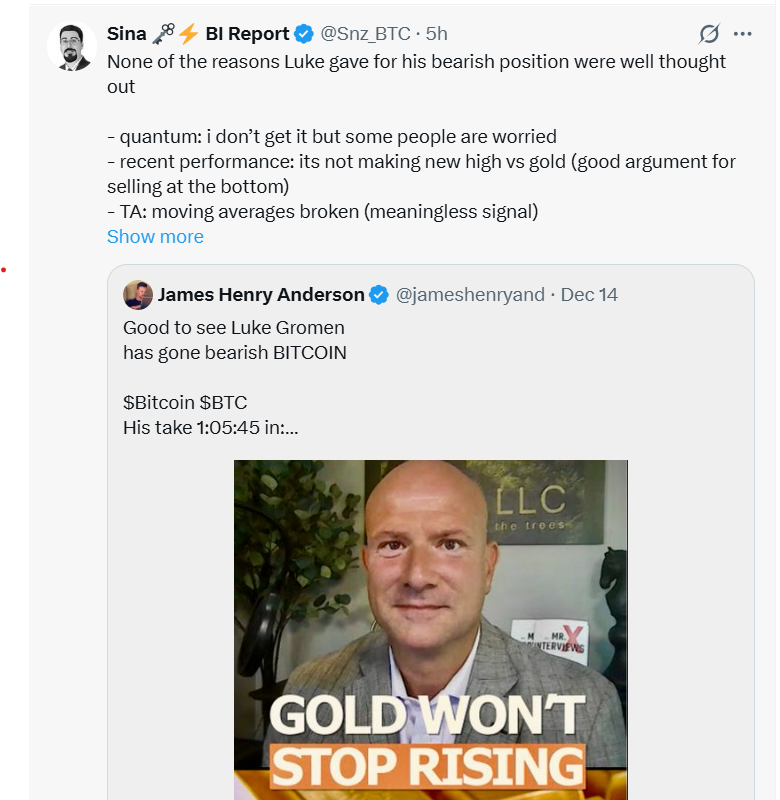
Onchain analyst Checkmate said that much of Gromen’s evidence seemed to come from X narratives rather than underlying data, and Troy Cross, a fellow at the Bitcoin Policy Institute, framed the call as a trade on the perception of quantum risk rather than the actual cryptographic threat.
Related: Why Vitalik believes quantum computing could break Ethereum’s cryptography sooner than expected
Flows, debasement, and the long game
Market data offers a more mixed picture than outright doom. After a sharp exodus in November, US spot Bitcoin ETFs have swung back to modest net inflows in December, suggesting headline demand has stabilized even as macro commentary cools.
The broader debasement thesis that Gromen helped popularize still underpins many longer‑term bullish arguments for BTC alongside gold.
For now, his stance may be less a capitulation on Bitcoin’s role in the debasement trade and more a reminder that even its macro‑sympathetic supporters are willing to fade BTC tactically when the narratives and charts line up against it.