
 blockworks.co

Digital assets are not quite like any others. That’s part of what makes them appealing to many — but it can also spur confusion.
Trying to quantify the relationship between $BTC, for example, and other asset classes is becoming more prevalent as more investors seek diversification and hedging opportunities.
A clear finding in a recent FTSE Russell report: The rolling correlations of bitcoin and ether returns sharply increased with risk-on assets since 2020.
If we look at $BTC in particular, the Russell 1000 index — comprising US large-cap stocks — has a 0.58 correlation to the asset. That relationship is nearly as strong for $BTC and US financial stocks and US tech stocks — at 0.53 and 0.52, respectively.
The correlation, since Covid, between $BTC and US high-yield credit (the most “risk-on” fixed income asset class) stands at 0.49.
Prior to the Covid-19 outbreak (spurring inflation and monetary tightening), all these correlations were much closer to zero.
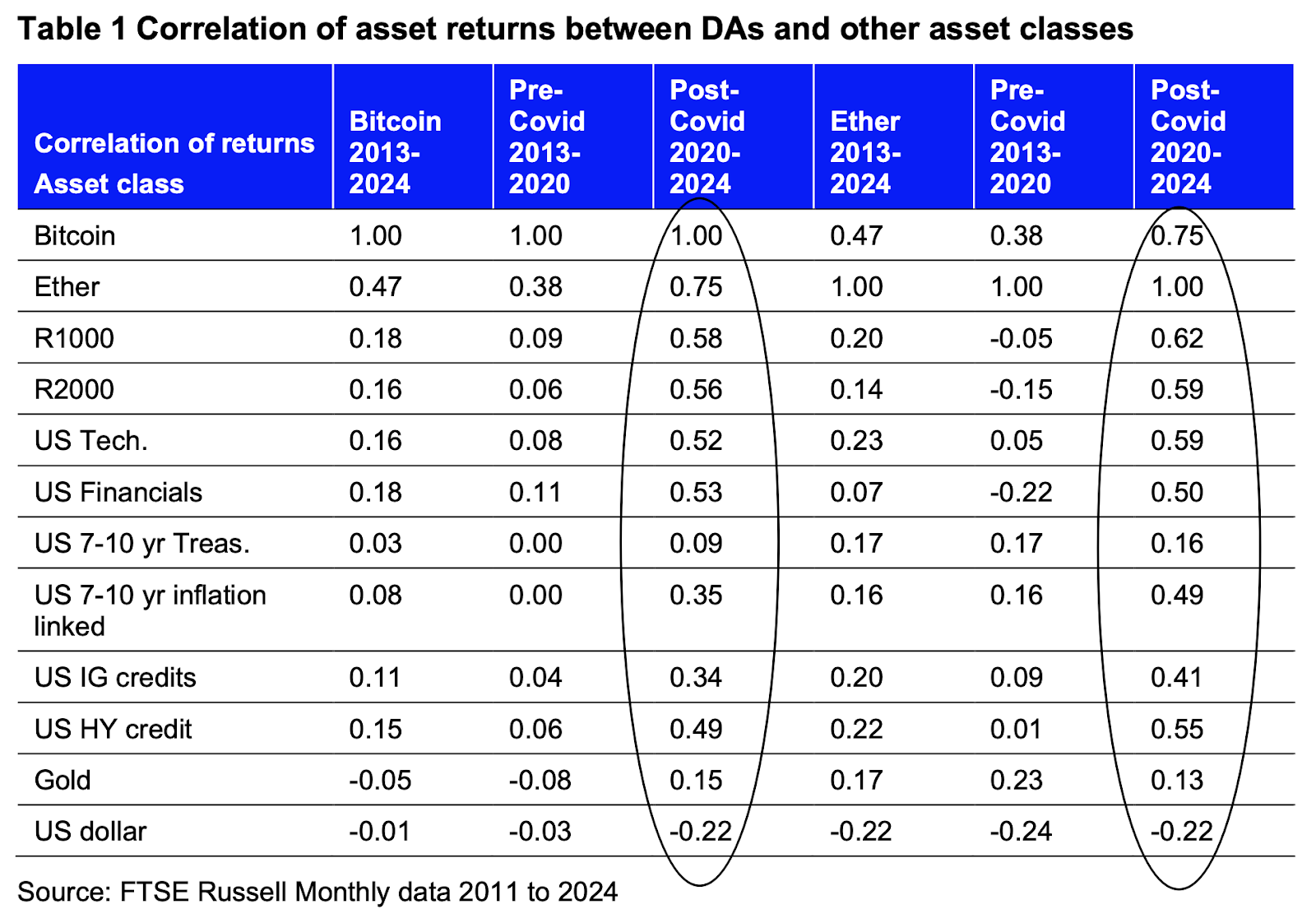
7–10 year US Treasurys were rather unique in not seeing a meaningfully higher correlation to $BTC after Covid. And the US dollar is the only asset showing negative correlation to $BTC and $ETH over those years.
Despite bitcoin often being compared to gold, the $BTC-gold correlation in the post-Covid era is only 0.15.
$BTC’s high volatility (and the varying importance of safe haven and store-of-value characteristics in financial markets) may obscure the “true correlation” between these assets’ returns, the report notes.
It adds: “But the true correlation may simply be low, reflecting the fact that bitcoin and $ETH are predominantly risk-on assets, whereas gold has a long-established trading history as a ‘safe haven’ asset, even if they do share some store of value characteristics.”