
 finbold.com

The election of Donald Trump to the office of President will go down in history as one of the most pivotal events of the year. Although pollsters were projecting a tight race, in the end, the GOP candidate secured victory over incumbent Vice President Kamala Harris in each swing state.
Some of Trump’s proposed economic policies — in particular, his preference for tariffs, have caused widespread worry among market participants. They’re far from a done deal — Trump’s first term did include a bevy of promises that were ultimately not kept.
However, the markets have certainly been fairly bullish regarding one thing — and that’s the President-elect’s stance on cryptocurrency.
Beyond his own dealings in the space, through World Liberty Financial, which recently got a $30 million investment from Tron (TRX) founder Justin Sun, Trump has publicly supported crypto, intends to name a wide bevy of pro-crypto experts to hold public office, and intends to establish a strategic crypto reserve for the United States.
Unsurprisingly, all of this has contributed significantly to the current bull run that the leading digital asset Bitcoin ($BTC) is in. To clearly demonstrate how significant this upswing has been, let’s take a look at a simple hypothetical situation — how much money an investor would have if they had invested $1,000 in Bitcoin on November 5, the day of the election.
Bitcoin prices have soared since the 2024 election
On November 5, one $BTC was priced at roughly $68,290 — having receded to that point from a prior $72,780 high on October 30. Unlike most recent presidential elections, this one was called rather quickly — Vice President Harris conceded just a day later, on November 6.
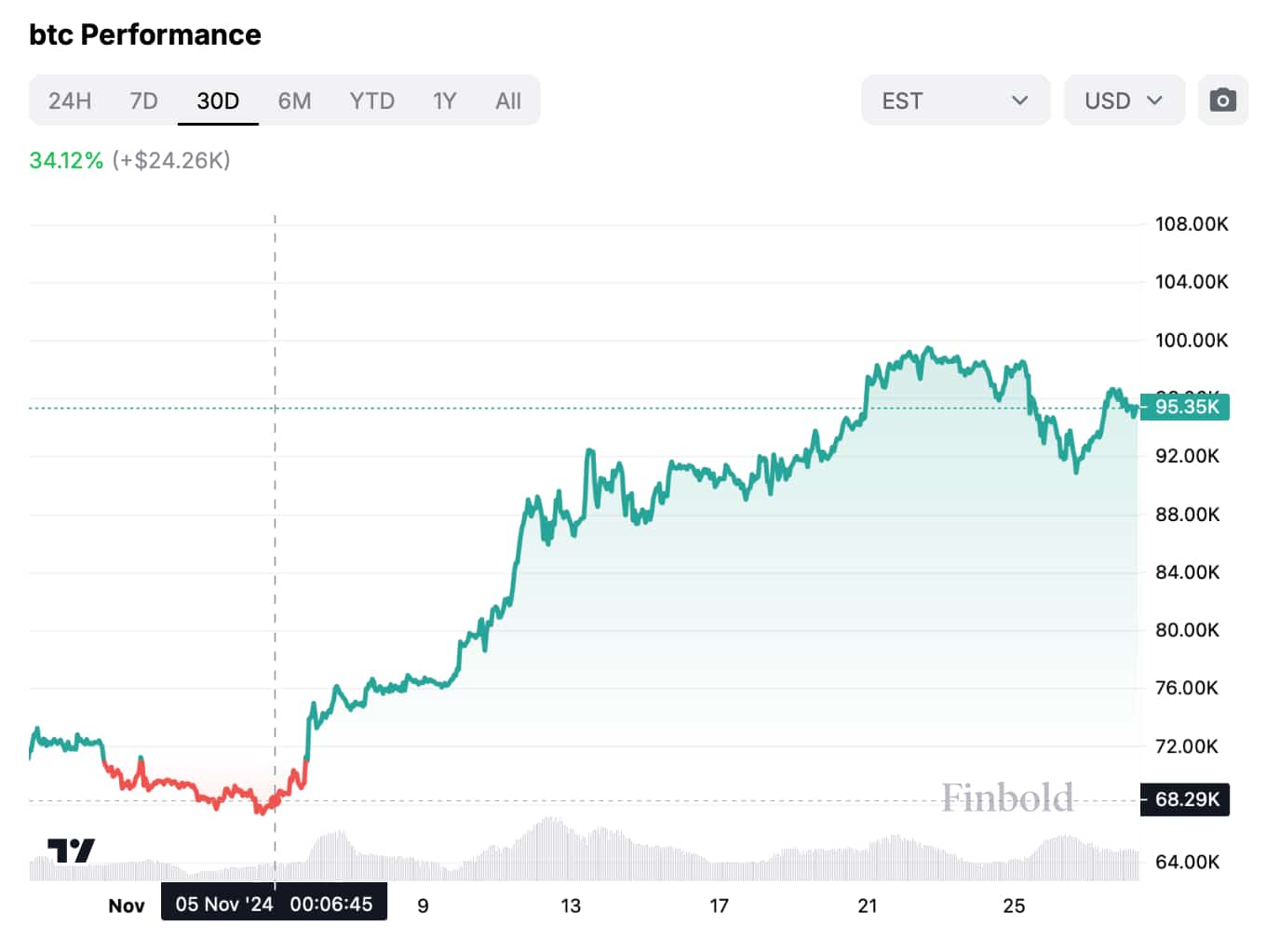
At press time, one Bitcoin is trading at approximately $95,530 — a mark which represents a 40.22% increase compared to November 5 prices. Accordingly, a $1,000 investment made on November 5 would be worth $1,398 at the time of publication. This offers an interesting backdrop to reflect on entry points.
For comparison’s sake, if you invested in $BTC exactly six months ago, you would have made a negligibly better return of over 40% — or $1,404. If, however, you had bought $1,000 worth of Bitcoin on January 1, your gains would currently stand at 125% — in other words, $2,252.
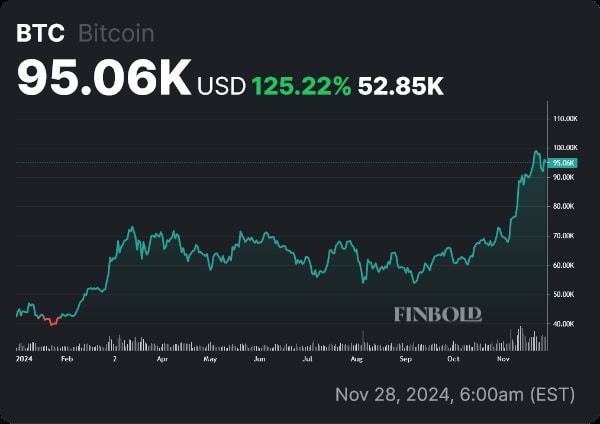
While some entry points are obviously superior to others, for now, $BTC seems to be acting in accordance with one of the most widely-held maxims governing traditional financial assets — time in the market outperforms timing the market, and is much easier to accomplish. Although Bitcoin has hit a roadblock on its path to $100,000, dollar-cost-averaging purchases are still likely to outperform attempts to buy a potential upcoming dip.
Featured image via Shutterstock