beldex.io
Key Issues for Compliance
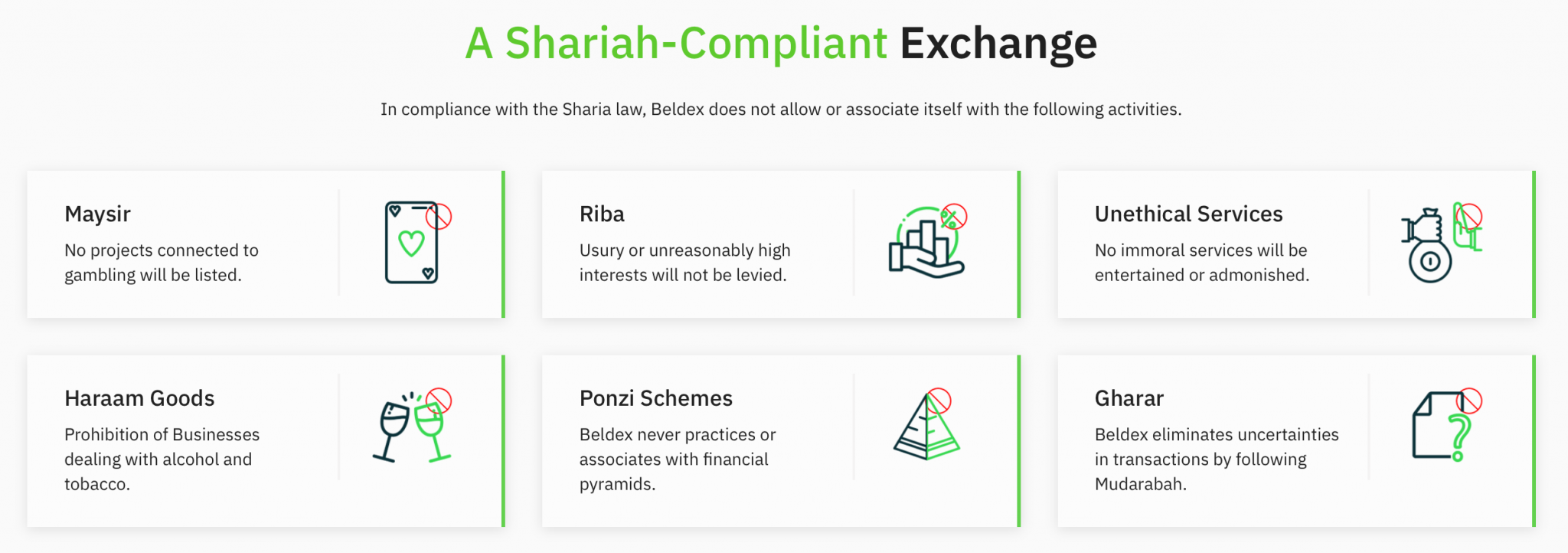
Exchanges billing themselves as Sharia compliant focus on key issues such as usury (unreasonable interest rates/profiting from debt), gambling, drug use, perceived sexual immorality, scams, and economic uncertainty. One exchange, Estonia-based Beldex, notes that it “does not allow or associate itself” with the aforementioned activities. Another service, crypto brokerage Rain, boasts it is officially certified by the Bahrain Central Bank-licensed Shariyah Review Bureau.
When deciding if bitcoin use is “halal” (lawful) or “haram” (forbidden) in Islam, there’s not a clean-cut consensus. Blossom Finance founder Matthew J. Martin clarified to news.Bitcoin.com’s Jamie Redman in 2018: “Contrary to popular myth, Shariah law is not a single set of rules; it’s is a scholarly field subject to differing interpretations and opinions on various matters.” Martin’s startup seeks to help investors navigate this ambiguity, by offering investments that are “end-to-end shariah compliant using fully approved shariah structures such as profit-sharing (mudarabah).”

Where ICOs and potential scams are concerned, it’s no wonder Muslims are sometimes hard-pressed to find clarification. The idea of “garar” (uncertainty) requires that the faithful steer clear of overly uncertain investments and other financial practices which could be deemed irresponsible. Those navigating the crypto space know all too well it’s a veritable asteroid field of snake oil pitches, shitcoins, and empty promises. However, there are other principles in the religion that have some seeing bitcoin as Halal, and highly beneficial to Muslim finance.

Sharia and Bitcoin’s Common Ground: Peer-to-Peer Consensus
While Sharia is typically understood to be superseded by governmental law — thus rendering crypto activity haram where the state has deemed the same activity illegal — the nature of bitcoin yet has some interesting overlap, and creates potential gray areas, where Sharia law is concerned. For example, when there is ambiguity which cannot be settled by reference to the religion’s holy book, the Quran, social consensus is one of the tools by which Muslims can deem something acceptable.
“A large group of scholars say cryptocurrencies are permitted because of the social concurrence concept,” Dr. Ziyaad Mahomed, from the International Centre for Education in Islamic Finance, has noted, “But they also say this does not necessarily mean that cryptocurrencies can be recognised as a legitimate form of currency.” What is interesting is that although bitcoin may be viewed as an unstable, non-official currency, it is simultaneously a widely utilized consensus network, so on these grounds it may be acceptable.
Ziyaad also stated that “digital coins can represent various sustainable development projects through a cooperative scheme,” emphasizing:
From a shariah perspective, I think this is the ultimate goal — leveraging new technologies to benefit all parties in a legitimate, halal manner.
Though the debate about compliance will likely continue as long as religious sects disagree on aspects of their various doctrines, one thing is certain: billed as “Sharia compliant” or not, in a crypto space full of irresponsible parties, one should always do their homework before investing.

 news.bitcoin.com