The halving does not directly impact the price of $BTC and is not like a stock split.
Instead, it fulfills and showcases Bitcoin’s scarcity, its ever-decreasing rate of inflation and its steady climb to a maximum supply of 21 million $BTC.
This cycle, crypto advocates have adopted the phrase “quantitative tightening” when referring to the halving, highlighting the ways in which $BTC is hard, predictable, transparent and scarce in an era of quantitative easing, money printing and monetary debasement.
Whether it’s coincidence, correlation or the macro business cycle playing out, Bitcoin’s price jumped in the months following its first three halvings.
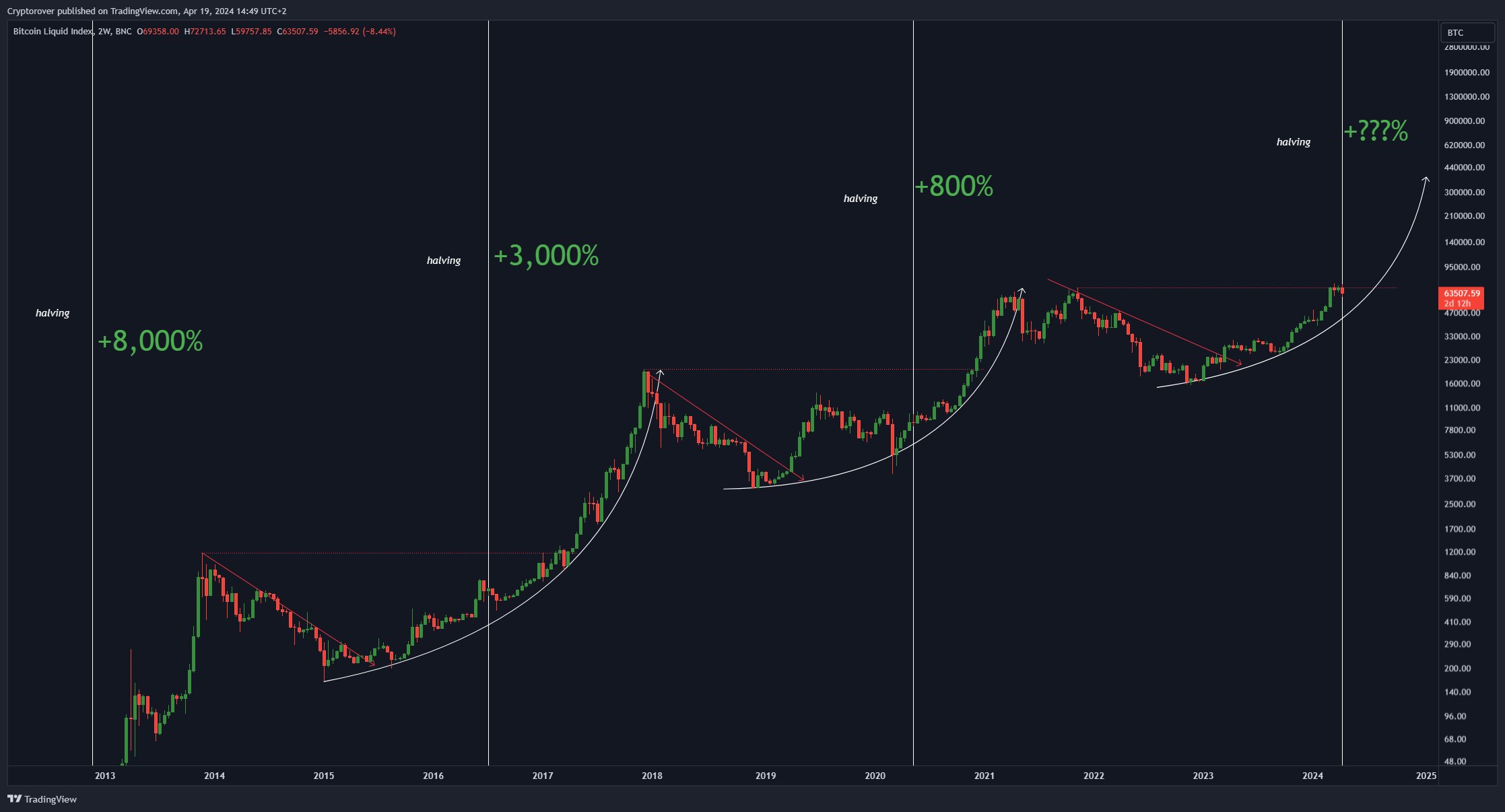
Source: Crypto Rover/X
This year, in a first, $BTC surpassed its previous all-time high before the halving, reaching $73,737 on March 14th due in part to the rapid rise of Bitcoin ETFs in the US.
In the last week, Bitcoin has significantly retraced along with traditional assets in a de-risking event triggered by tensions between Israel and Iran.
$BTC is trading at $63,811 at time of publishing, up 0.7% in the last 24 hours.

 dailyhodl.com




