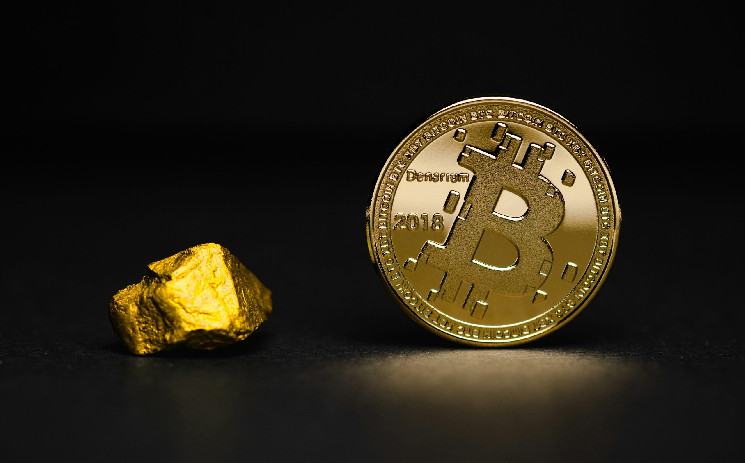
Data from TradingView revealed that spot gold broke its all-time high record at $2,130, surpassing its previous highs of around $2,000 set at the beginning of December. The simultaneous ascent of these two diverse assets underscores a shared sentiment of economic uncertainty and the increasing attractiveness of non-traditional investment vehicles.
$BTC, the digital currency renowned for its decentralised nature and finite supply, surged past $100,000, eliciting awe and excitement among investors worldwide. This remarkable rally reflects $BTC’s growing acceptance as a legitimate store of value and a hedge against inflation in an era of unprecedented monetary expansion.
Meanwhile, gold, the age-old haven asset, also experienced a surge, surpassing its previous peak and reaffirming its status as a timeless store of wealth amid economic turbulence.
Head of research at StoneX Global, Matthew Weller, said: “From elevated risk appetite to sticky inflation to record debt levels to ongoing geopolitical tensions in the Middle East and Eastern Europe, there are plenty of reasons that traders are seeking out alternatives to traditional fiat currencies in the current environment.”
Weller suggested that $BTC’s ongoing rally is contributed mainly by the excitement about the upcoming quadrennial halving event and the massive inflows in spot Bitcoin exchange-traded funds (ETFs) in the United States.
Economic Uncertainty and Inflationary Pressures
The synchronised surge of $BTC and gold can be attributed to certain factors, chief among them being the prevailing economic uncertainty and inflationary pressures plaguing traditional financial markets. Central banks’ aggressive monetary policies, characterised by near-zero interest rates and massive quantitative easing programs, have fuelled concerns about currency debasement and runaway inflation, prompting investors to seek refuge in alternative assets. With its fixed supply and decentralised nature, $BTC has emerged as a compelling hedge against inflation and fiat currency devaluation.
Institutional investors and corporations’ recent adoption of $BTC as a store of value and a portfolio diversifier has further bolstered its appeal, driving demand and prices to record highs. Similarly, with its millennia-long history as a store of wealth, gold has attracted renewed interest amid fears of currency depreciation and financial instability. Moreover, geopolitical tensions and uncertainties surrounding the global economic recovery have amplified investors’ appetite for safe-haven assets, propelling $BTC and gold to new heights. The ongoing geopolitical conflicts, supply chain disruptions, and rising commodity prices have fuelled concerns about stagflation and economic stagnation, prompting investors to seek refuge in assets perceived to retain their value over time.
Implications for the Financial Landscape
The surge of $BTC and gold underscores the shifting dynamics of the global financial landscape and the growing importance of diversification and digitalisation in investment strategies. Once dominated by stocks and bonds, traditional portfolios are increasingly being augmented with alternative assets like $BTC and gold to hedge against systemic risks and preserve wealth during economic uncertainty. The convergence of technology and finance has facilitated the mainstream adoption of cryptocurrencies like $BTC, enabling investors to access novel investment opportunities and diversify their portfolios beyond conventional assets.
The rise of digital asset platforms and investment vehicles has democratised access to Bitcoin and other cryptocurrencies, empowering retail investors to participate in the burgeoning crypto economy. Furthermore, the surge in $BTC and gold prices highlights the evolving role of non-traditional assets in wealth preservation and portfolio management. As central banks continue to pursue expansionary monetary policies and governments grapple with mounting debt burdens, the appeal of assets with finite supply and intrinsic value will likely endure. $BTC and gold are poised to play an increasingly significant role in wealth preservation and capital allocation strategies, offering investors a hedge against inflation and currency depreciation.

 coininsider.com