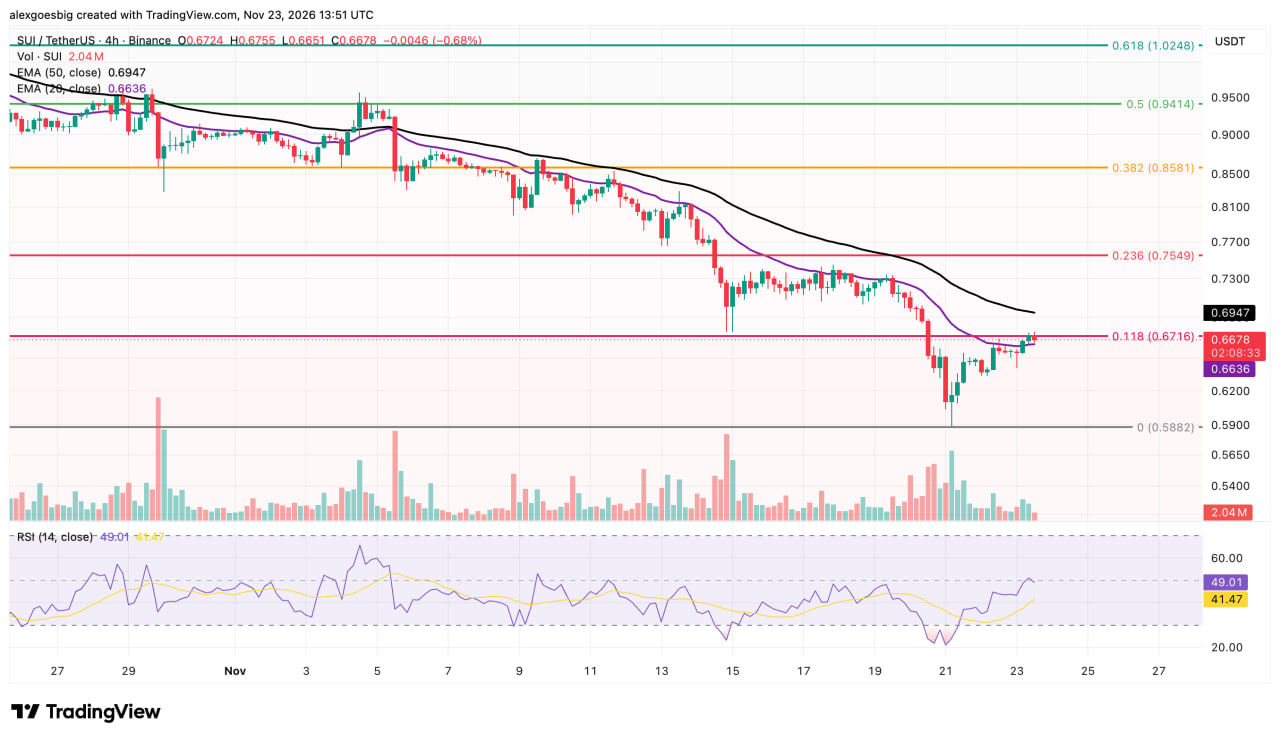
$SUI’s rebound from its November low has hit resistance just above the current price.
Momentum has recovered from oversold levels, but buying volume is still thin.
Samsung Wallet users in the US can now send $USDC over Sui without paying network fees.
Galaxy users never have to buy $SUI, so the integration doesn’t directly create demand for the token.
The $SUI price traded near $0.668 on Monday afternoon, held below the $0.6716 Fibonacci level on the four-hour chart after recovering about 13% from Saturday’s low of $0.5882. On the same day, Samsung Wallet started $USDC transfers on the Sui network for eligible Galaxy users in the United States. The rollout puts Sui behind one of the most widely distributed mobile wallets in the US while the token still trades almost 30% below where it changed hands in early November, and the design of the integration explains why the two stories have moved separately so far.
Starting tomorrow, 82 million eligible U.S. Galaxy devices can send $USDC on Sui with Samsung Wallet. pic.twitter.com/aBL1KPyXE1
— Sui (@SuiNetwork) November 22, 2026
Know when your coins move
Alerts, real-time prices, and market news — all in one app
Point your phone camera to install
4.8 based on 40K reviews in the App Store and Google Play
UPDATE (November 23, 15:35 GMT+1):$SUI jumped about 9% in an hour to $0.7278 after Nvidia’s board reinstated Jensen Huang as president and CEO, 11 days after he resigned. The news lifted US stock futures and pushed the Bitcoin price back above $63,000. The move carried $SUI through the $0.6716 ceiling and the 50-period EMA near $0.695 and into the $0.72 to $0.73 zone where it traded sideways in mid-November, leaving the 0.236 Fibonacci level at $0.7549 as the next test. None of these levels has been confirmed by a four-hour close yet, so the technical section below describes the setup before the jump.
A 13% bounce runs into $0.6716
Since the start of November, the four-hour chart has made a steady run of lower highs and lower lows. $SUI fell from above $0.90 around November 5 to just under $0.59 on November 21, and the RSI dropped below 30 during that last sell-off. A reading under 30 usually means selling has gone further than the market can keep up for long.
The bounce that followed pushed the price above the 20-period exponential moving average at $0.6636. That line tracks roughly the last three days of trading, so holding above it means short-term buyers are paying more than they did over that stretch. The 50-period average, which covers a little more than eight days, sits higher at $0.6947 and is still falling. $SUI has stayed below it for most of the month.
The current four-hour candle shows how heavy the $0.6716 level is. It rose to $0.6755 and then slipped back to $0.6678, with about two hours left before it closed when the chart was captured.
$SUI tests key resistance near $0.67. Chart: Alexander Stefanov / TradingView.
RSI back at 49, volume lagging
The RSI has climbed back to 49, almost exactly in the middle of its range, and stays above its own moving average at 41.5, which points to momentum slowly building back. Trading volume points the other way, since the drop toward $0.59 came on the heaviest trading of the week, while the recovery has run on noticeably lighter activity, so the buyers haven’t yet shown the conviction the sellers had a few days earlier.
A four-hour close above $0.6716 would put the 50 EMA near $0.695 in play, with the $0.72 to $0.73 zone where $SUI traded sideways between November 15 and 19 as the next hurdle. If the rejection holds instead, the 20 EMA is the first support, then the $0.64 to $0.65 area where the price paused over the weekend.
Sui joins Solana inside Samsung Wallet
Sui said on November 22 that eligible US Galaxy devices could start sending $USDC over its network from Monday, November 23, but it didn’t give a time. The partnership itself dates back to October 8, when Samsung named Sui and Solana as its blockchain partners, and $USDC on Solana has been live in the wallet since November 2.
●
Oct 8|Samsung names Sui and Solana as $USDC partners
●
Nov 2|$USDC on Solana goes live in Samsung Wallet
●
Nov 22|Sui confirms the Monday start date
●
Nov 23|$USDC transfers on Sui begin for eligible users
Owning a Galaxy phone is not enough on its own, as users must be US residents aged 18 or older, on Android 13 or newer, with a Samsung Account, a completed identity check and biometric authentication turned on. The 82 million figure Sui promotes counts compatible devices. Samsung hasn’t said how many people have actually turned the feature on.
Zero fees built into Sui’s protocol
The fee waiver comes from gasless stablecoin transfers, which Sui launched on mainnet in May 2026 as a protocol-level feature for peer-to-peer payments in supported stablecoins. Sui describes the waiver as a permanent part of how these transfers work on the network. The rules are narrow, and the network does not execute transfers below a minimum of 0.01 units. Samsung doesn’t charge for transfers to external crypto wallets either, although exchanges or wallets on the receiving end can add their own fees.
Custody is split between two partners: Bastion provides the stablecoin accounts, compliance checks and money movement, and Coinbase acts as Bastion’s sub-custodian, keeping the $USDC in Coinbase Prime Vault. Users never manage private keys, which makes Samsung Wallet a custodial account where the partners hold the funds on the user’s behalf. Transfers to bank accounts in more than 60 countries run through a separate channel: the recipient gets local currency, and Samsung shows the fees and estimated delivery time before the user confirms.
On-chain $USDC flows will show it first
Samsung Wallet doesn’t support $SUI at launch, so more people using the wallet won’t directly push the $SUI price higher. The useful signals are transfer volumes, active users and the $USDC balances that build up on Sui. Because these transfers settle on a public blockchain, the flows can be tracked on Sui itself before Samsung publishes any figures. Pooled custodial accounts will make it hard to tie individual transfers to Galaxy users.
Sui says its network has handled more than $1 trillion in stablecoin transfers since August 2025, which gives Samsung traffic a sizeable base to be measured against. Native $USDC has been on Sui since 2024, and the network supports Circle’s Cross-Chain Transfer Protocol, which moves $USDC between blockchains by destroying it on one and creating it on the other, without wrapped copies.
Samsung has listed stablecoin payments for online shopping and contactless $USDC payments at physical stores as next steps, along with more countries once regulators approve, but it hasn’t given dates for any of them. Adeniyi Abiodun, co-founder and chief product officer of Mysten Labs, the company that developed Sui, has reportedly talked about expanding to 20 to 30 countries and working together on decentralized finance. Neither Samsung nor Sui has confirmed those plans.

 crypto-news-flash.com