Rethinking crypto risk — Here’s why ONE factor doesn’t tell the whole story
ambcrypto.com
3 h
Investors have a habit of gauging crypto by a single risk framework. However, currently, that framework no longer captures how the market works.
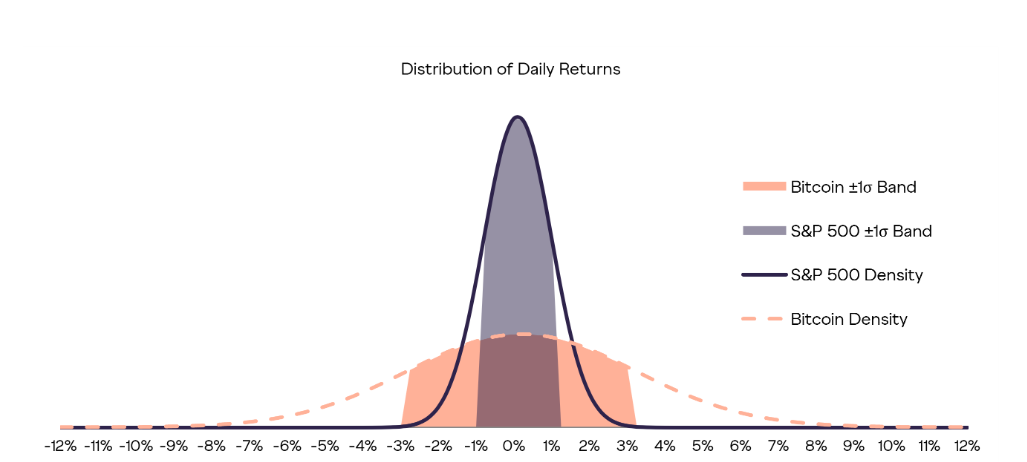
Bitcoin’s [BTC] daily price fluctuations are about three times wider than the S&P 500’s, with far more extreme moves in both directions. However, the realized volatility of Bitcoin has declined over time to the level of individual large-cap U.S stocks.
Source: Grayscale
Know when your coins move
Alerts, real-time prices, and market news — all in one app
Point your phone camera to install
4.8 based on 40K reviews in the App Store and Google Play
So, investors should be aware of three things — where returns come from, how they fit inside a portfolio, and how crypto has grown far beyond Bitcoin.
Big swings work both ways
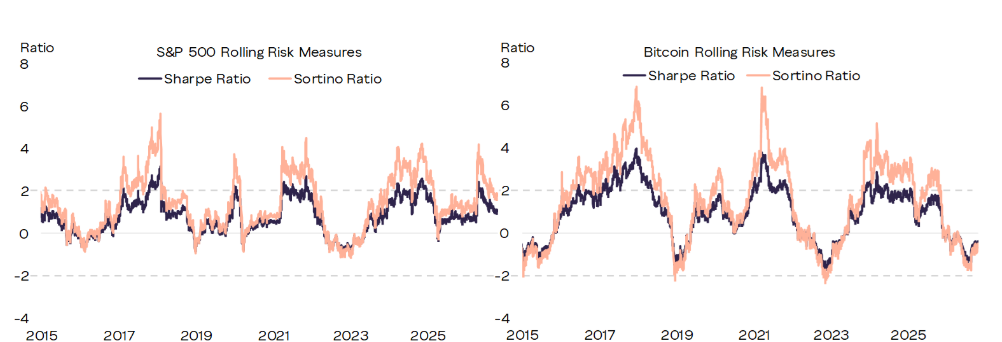
The standard risk tools like the standard deviation or the Sharpe ratio don’t care how much money you make or lose. That leaves a blind spot for Bitcoin as most of its long-term gains come from just a handful of trading days.
Source: Grayscale
Bitcoin has averaged 60% per year over the last three years. If you take away its ten best days, that number drops to 7%. If you take away its ten worst days, the number jumps to 197%. That’s because big drops are often followed by big rebounds, so investors who try to avoid bad days can easily miss the best ones.
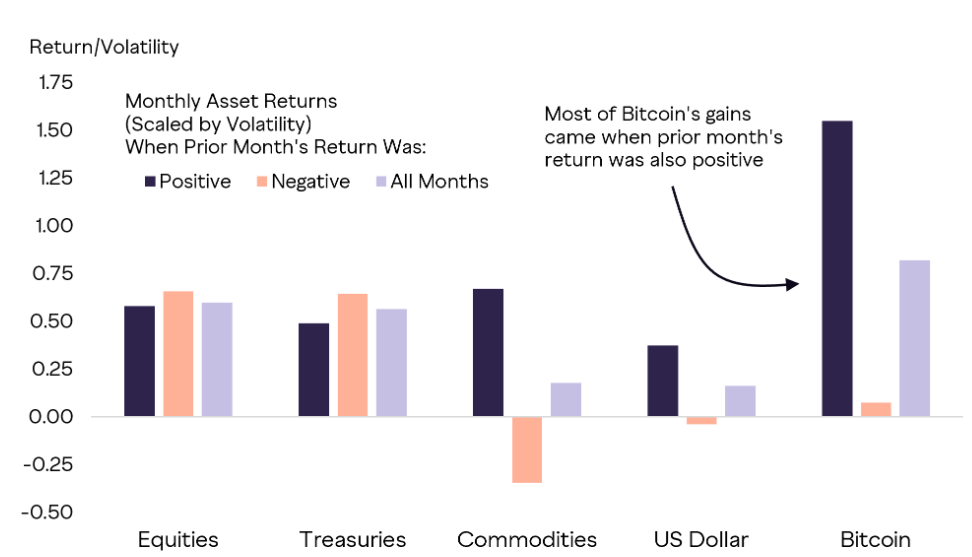
Momentum counts as well. Bitcoin’s gains tend to pile on top of each other, and Bitcoin runs far better after months of winning than months of losing. During strong rallies, the Sortino ratio can rise well above normal risk scores. Mostly because it only measures returns against downside volatility, not upside volatility.
Notably, Bitcoin has dropped by 50% or more seven times since 2011. But when you include the volatility of starting, Bitcoin’s falls look more like stocks and bonds.
Source: Grayscale
In fact, even “low risk” bonds have been falling for a while in recent years.
Why crypto could be a portfolio fit?
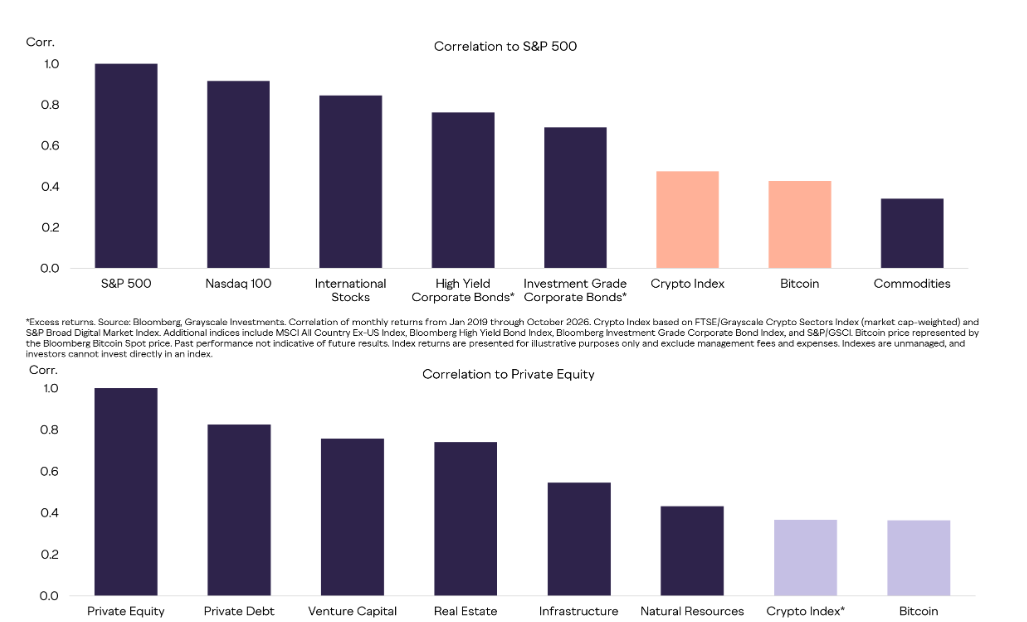
While big price moves can be alarming on their own, portfolio managers care most about how an asset behaves when put together with the other assets they own. Changes in stocks, bonds, and the private market are mostly driven by common economic factors. However, these factors explain the changes in Bitcoin much less.
Cryptocurrencies, including Bitcoin, have historically shown low correlation with traditional measures than with each other. This is the case, even though correlations can increase during periods of market stress.
Source: Bloomberg
Large organizations have taken this into account too. For instance, J.P. Morgan Asset Management, an organization with $5 trillion in assets, introduced Bitcoin into its 2027 outlook, estimating a 10% per year return in the coming ten years. This correlates by only 33% with major U.S. equities, even less than international equities, corporate bonds, and hedge funds, even when there is 55% volatility.
This provides a unique combination of both high expected returns and little correlation with core equities. History proves that including a small portion of Bitcoin in an average institutional portfolio can increase returns and efficiency without increasing overall risk or maximum losses.
Notably, Mike Belshe, CEO of BitGo, recently pointed out JPMorgan’s changing perspective on crypto. He said,
Let that sink in. The world’s largest bank, long crypto-skeptical, is now publicly supporting crypto market structure legislation. This is a different ballgame.
Crypto is not just Bitcoin
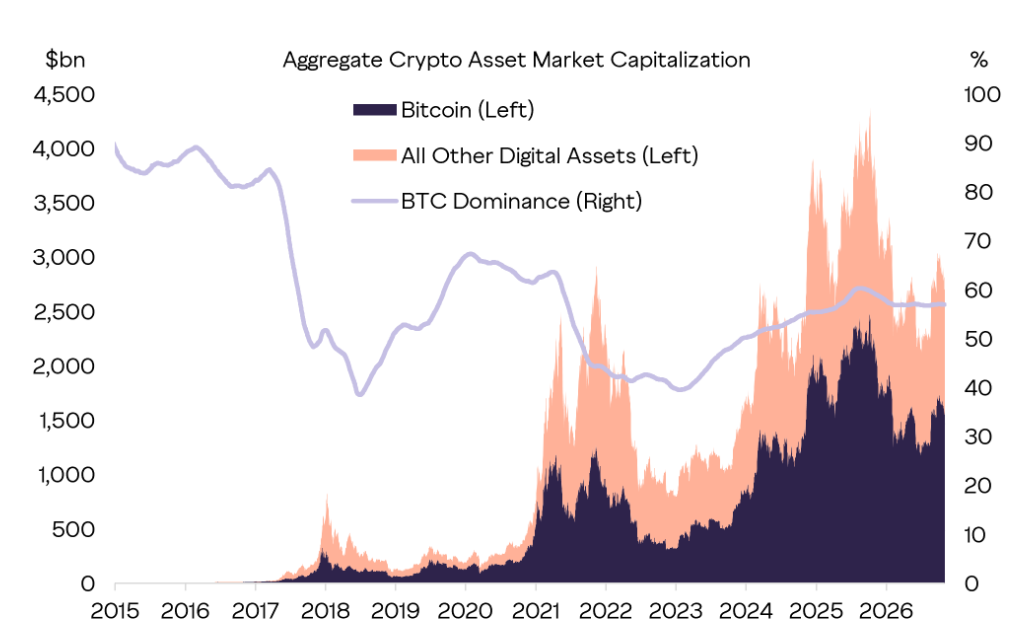
Another mistake is treating crypto as a single Bitcoin bet. The modern landscape of crypto includes smart contract platforms, decentralized finance, consumer applications, and artificial intelligence. Each having its own unique users and economics.
Source: Grayscale
Over the last three years, Bitcoin has accounted for just about 50% of volatility in returns on all major crypto sectors, while correlations among sectors have decreased.
Out of the top 10 biggest non-stablecoin crypto assets by market cap, six different tokens have been leading returns on a quarter-by-quarter basis over the last two years. Bitcoin has never led once.
Why risk shouldn’t be the only factor
None of this implies that crypto is risk-free though. Especially since a rally could unwind quickly. On the contrary, risk is not something that can be boiled down to one simple figure.
A uniform know-how about crypto implies understanding of multiple factors — volatility of the asset, distribution of returns, correlation with the rest of a portfolio, and the performance of various sectors separately.
Therefore, in reality, instead of trying to overlook any price fluctuations, it is important to view them with a proper perspective.
Rather than discussing the volatility of crypto per se, one should think of what kind of risks it introduces, what risks from one’s portfolio it offsets, and what additional sources of profit appear outside of Bitcoin.
Final Summary
Standard risk tools misrepresent Bitcoin since its returns rely on key days despite stabilizing volatility.
Crypto has expanded beyond Bitcoin into DeFi and AI, showing lower cross-sector asset correlation.

 ambcrypto.com