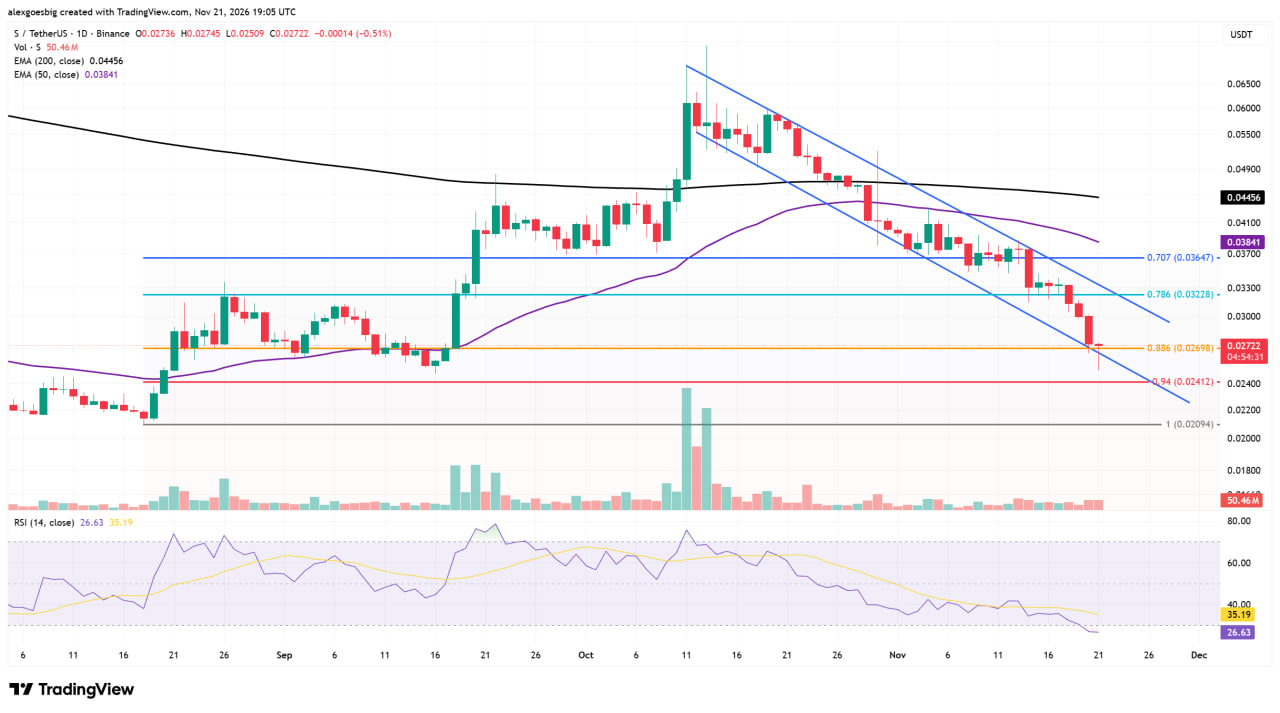
A daily close below $0.02698 and the channel floor would open the way to $0.02412. Below that is $0.02094, the August low where the rally began and about 23% under the current price. On the way up, sellers are likely to appear first at $0.03228 and then near $0.03647, close to the upper edge of the channel.
The 50-day EMA at $0.03841 and the 200-day EMA at $0.04456 are both pointing down, and S would need to rise about 41% just to reach the shorter one. Daily volume of around 50 million S is still a fraction of the October spikes. At 26.63, the RSI sits below the oversold mark of 30, a sign that sellers have controlled almost every session of the past two weeks. Bounces often start from readings like this, but the indicator is still making lower lows along with the price, so a relief move toward $0.03228 is possible while a real trend change would require a close above the channel on stronger volume.
1.47 billion FTM nobody locked
The audit produced by Ledgity puts the exact supply at 4,701,361,519 S, checked on-chain at block 82,118,136. It traces issuance back to the FTM contract that Fantom deployed on Ethereum in 2018. The problem started in December 2019, when Fantom launched its Opera mainnet and created about 2.12 billion native FTM. The matching ERC-20 tokens on Ethereum should have been locked or burned so the same supply did not exist on two chains. Only 646 to 647 million were locked, and roughly 1.47 billion stayed free.
When the 1:1 FTM-to-S migration opened, holders could convert either version. Those conversions created about 3.96 billion S, some 786.5 million more than the entire supply announced at launch. Sonic says it has not found out why the 2019 gap happened, and the audit does not conclude that tokens were minted in a single hidden event or that fraud took place.
Teal: legacy FTM conversions. Amber: issued by Sonic. Source: Ledgity audit, November 2026.
The audit came after a change in leadership. Sonic Labs co-founder Andre Cronje and two other directors left the company’s board in June. In September, chief executive Matt Visser cancelled all manual mints in his Day 100 letter and ordered the review. Price trackers had already been showing totals anywhere from 3.175 billion to 3.885 billion S, so part of the dilution was visible before Friday. If total market value stays the same, a supply that is 48.07% larger works out to about 32.5% less value per token. Market data still values S at about $78 million, which implies roughly 2.9 billion tokens in circulation. Based on the audited supply of 4.70 billion, the fully diluted value (the price multiplied by every token that exists) comes to about $127 million.
Burns erase only 6% of the excess
Sonic plans to burn 91.7 million unused airdrop S on December 15, which cuts supply by about 1.95%. On January 31, 2027 it will destroy around 1.33 billion legacy FTM held in the Ethereum bridge. That second burn leaves the S count unchanged, because the matching S were issued long ago. A contract upgrade will remove manual minting, and about 7.6 million S that were already burned will be taken out of the reported total. Even after all of that, supply would stand near 4.602 billion S, about 45% above the launch figure.
428 million FTM still waiting to convert
About 428 million FTM have not been bridged yet: 160 million on Ethereum and 268 million on Fantom Opera. Converting all of it would add another 9.1% to supply. Sonic plans to close both bridges and has promised holders advance notice, but has not named a date. After that, validator rewards of about 70.07 million S a year will be the only source of new tokens. The audit estimates net issuance at 1.48% a year, with 25.5% of supply staked. Since December 2025, rewards left unclaimed under Fee Monetization (FeeM), the program that pays app developers a share of the fees their apps generate, have been burned automatically.
The December 15 burn will be the first step holders can check on-chain. The bridge closing date is still the figure they are missing. Sonic’s separate review of the 2019 issuance is also still open, so nobody has yet said who was responsible for the original gap.

 crypto-news-flash.com



