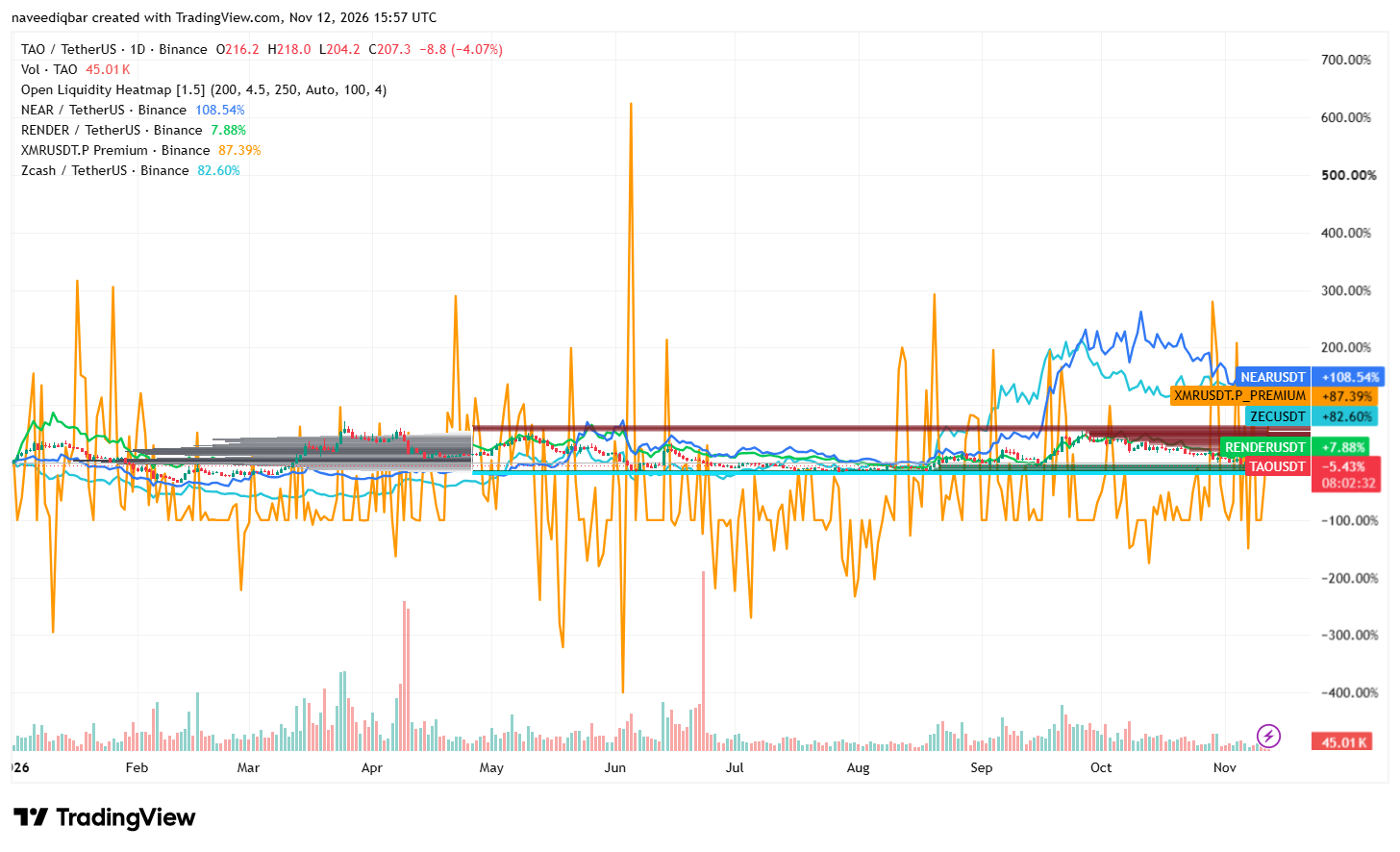
Although the privacy-coin average exceeds that of the three selected AI assets, $NEAR’s performance shows that the AI category still contains strong individual performers. Render’s modest gain and $TAO’s decline further highlight the difference in returns across the group.
$NEAR Keeps AI Tokens in the Race
Despite uneven returns, AI tokens span several developing markets, including decentralized computing, model inference, agent payments, and GPU marketplaces. Bittensor organizes independent subnets where miners provide digital services and validators assess their output. Its documentation lists compute, inference, storage, and prediction among the network’s digital commodities. $TAO therefore has exposure to a broader ecosystem than one AI application.
Meanwhile, $NEAR is building infrastructure for autonomous agents, confidential execution, and private AI inference. Its platform describes hardware-secured inference designed to isolate sensitive data. Render operates a GPU network for rendering and compute workloads. These developments provide adoption indicators but do not guarantee token appreciation.
Follow us on X for real-time crypto updates.
MiCA Raises the Stakes for Privacy Coins
Privacy coins address another concern: limiting exposure of financial activity. Monero uses ring signatures, RingCT, and stealth addresses to conceal transaction senders, amounts, and recipients. Privacy is enabled by default. Zcash instead supports shielded transactions alongside transparent addresses. Its July 28 NU6.3 upgrade introduced the Ironwood shielded pool and changed how funds move from the older Orchard pool.
However, regulation presents a major risk. Article 76(3) of the European Union’s MiCA regulation requires trading platforms to prevent the admission of crypto-assets with built-in anonymization unless their holders and transaction histories can be identified. This is not a blanket ban on privacy technology. Nevertheless, it can restrict exchange listings where identification requirements cannot be met, potentially weakening liquidity and fiat access.
Which Narrative Could Finish 2026 Stronger?
The longer-term performance of AI tokens and privacy coins will depend on whether their underlying networks attract sustained demand. For AI-related projects, adoption can be assessed through Bittensor’s subnet activity and Render’s GPU workloads. These indicators offer insight into network usage, although increased activity does not automatically translate into higher token value.
Privacy coins face a different test. Monero and Zcash offer transaction privacy, but regulatory requirements could limit their availability on major exchanges. Their future performance will depend partly on whether demand for financial privacy can translate into sustained network activity and market access.
Ultimately, AI tokens and privacy coins represent different investment narratives. AI projects need to demonstrate demand for their computing and infrastructure services, while privacy coins must navigate the balance between transaction confidentiality and regulatory compliance. Their ability to address these challenges could shape their performance into 2027.
Frequently Asked Questions
1) How have privacy coins performed compared to AI tokens in 2026?
The average privacy coins are around 85% compared to about 37% for the three AI assets. $NEAR, however, is the top token among the five tokens, posting a 108.54% increase.
2. Is MiCA in line with the EU Cryptocurrency Standards?
No. Article 76 contains the conditions for listing crypto-assets that are equipped with anonymization. The trading platform must be capable of recognizing and tracking the transactions of the holders prior to accepting their assets.
3. What are the things investors should watch for in the AI tokens?
Bittensor subnet activity, Render network workloads, and $NEAR agent infrastructure can give insights into the measurability of development to usage.
Subscribe to our YouTube channel for the latest crypto news.
Related: Zcash Price Analysis: $ZEC Risks Bearish Breaker Block Rejection and Drop Toward $854

 coinedition.com