HYPE Price Sinks to Key $68 Support Despite Record Q3
crypto-news-flash.com
24 m
$HYPE price is testing a support zone where a major Fibonacci level meets the 200-day moving average.
The token has traded in a falling channel since early November.
Hyperliquid’s third-quarter report shows record open interest and higher revenue.
The Assistance Fund’s average buying price last quarter sits above where $HYPE trades now.
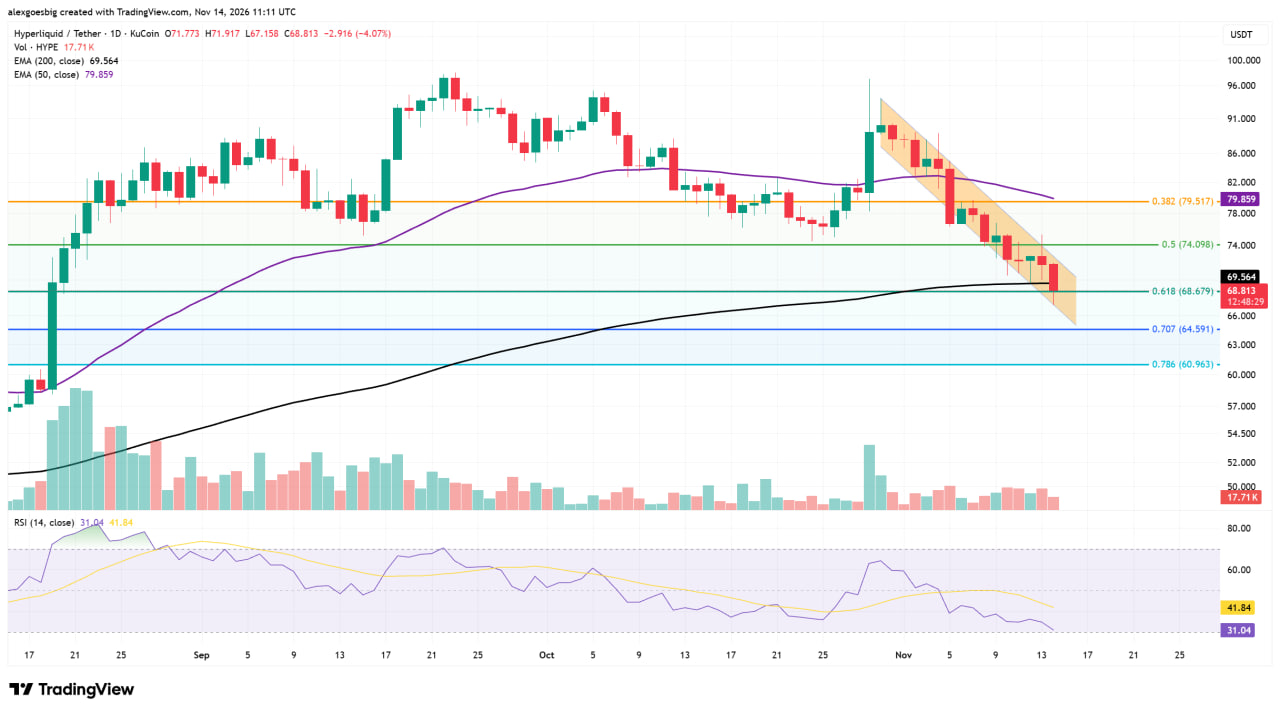
Hyperliquid’s $HYPE token fell 4.07% to about $68.81 on Saturday, November 14. The drop took it into a support zone where the 0.618 Fibonacci retracement at $68.68 sits just below the 200-day exponential moving average (EMA) at $69.56. It extends a two-week decline from above $90 and comes days after the Hyperliquid Research Collective’s third-quarter report credited the exchange with record open interest and $190.9 million in protocol revenue, which leaves the token weaker than the business behind it.
$HYPE Slips Under Its 200-Day Average
Since $HYPE was rejected above $90 in late October, it has traded inside a descending channel, which is a pair of parallel downward-sloping lines that contain a run of lower highs and lower lows. Every rebound this month stalled at the upper line. Saturday’s candle dipped below the 200-day EMA, the long-term average that many traders use to tell a broader uptrend from a downtrend, and the 50-day EMA at $79.86 now caps the price from more than $11 above.
Know when your coins move
Alerts, real-time prices, and market news — all in one app
Point your phone camera to install
4.8 based on 40K reviews in the App Store and Google Play
$HYPE price analysis. Source: TradingView / Alexander Stefanov.
61.8% of the Rally Already Erased
The Fibonacci levels on the chart measure how much of the climb from the low $50s to the $97 peak $HYPE has given back. At $68.68 the token has lost 61.8% of that advance, which is roughly where pullbacks inside a healthy uptrend tend to stop. With the 200-day EMA less than $1 higher, the two levels form one support zone. A daily close below $68.68 would point to $64.59, close to where the channel’s lower boundary will sit in the coming days, and $60.96 would come next if selling deepens.
The 14-day RSI, a momentum gauge that runs from 0 to 100, reads 31.04. That is just above the 30 mark usually read as oversold and means losses have far outweighed gains over the past two weeks. The RSI also sits below its own average of 41.84, so momentum is still weakening. Volume through the November decline has stayed well below the late-October burst, which points to steady selling rather than panic, and a jump in sell volume at this support would weaken that reading.
Level
Price
Role
0.382 Fib + 50-day EMA
$79.52-$79.86
Major resistance
0.5 Fib
$74.10
First recovery target
0.618 Fib + 200-day EMA
$68.68-$69.56
Support under test
0.707 Fib
$64.59
Next support
0.786 Fib
$60.96
Deeper support
Key $HYPE levels on the daily chart.
Hyperliquid Passed OKX and Bybit in Q3
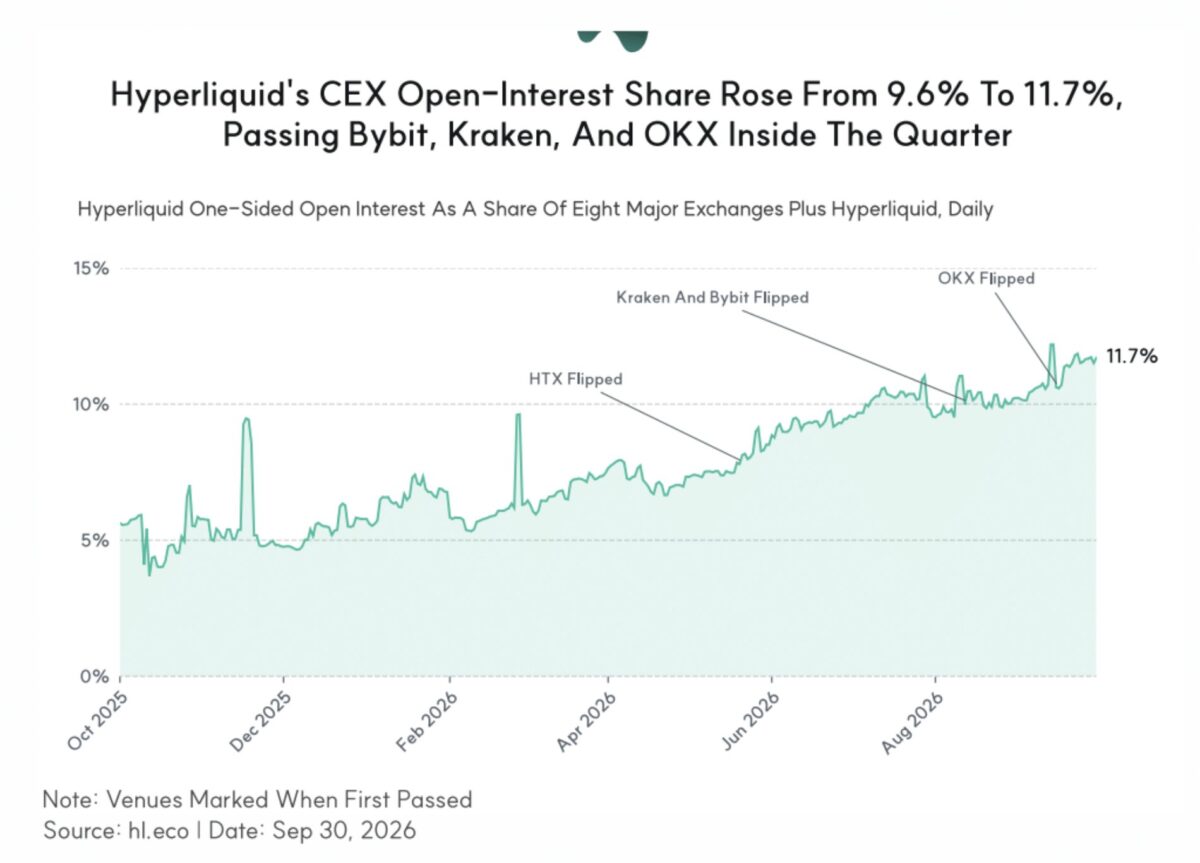
According to the Hyperliquid Research Collective’s third-quarter report, open interest on Hyperliquid rose 79.9% during the quarter to $16.7 billion on September 30, up from $9.31 billion at the end of June, after peaking at $18.1 billion on September 22. Open interest is the value of derivatives positions that are still open. In the report’s comparison, Hyperliquid passed Kraken and Bybit on August 12 and OKX on September 17, and it ended the quarter with 11.7% of tracked open interest, although Binance still held almost four times as much. Part of that gain came from a wider rise in leverage: CoinGecko’s third-quarter industry report found that open interest on centralized perpetual futures exchanges rose 40.6% to above $100 billion.
Hyperliquid’s open interest share vs. eight major exchanges. Source: Hyperliquid Research Collective, hl.eco data
Matched trading volume reached $730.6 billion, up 9.3% from the second quarter but 30.5% below the same period of 2025. The fastest growth came from stock-linked contracts on HIP-3, the framework that lets outside developers launch their own perpetual futures markets, where volume rose 160.8% to $153.8 billion. Protocol revenue increased 21.7% to $190.9 million, and $17.3 million of that was interest on USDC reserves, which started accruing on August 27.
Assistance Fund Paid $72.93 per $HYPE
Revenue reaches $HYPE holders mainly through the Assistance Fund, which uses protocol fees to buy the token on the open market. In Q3 the fund spent $148.7 million, 5.7% more than in Q2, yet it bought 26.4% fewer tokens because its average price rose to about $72.93. $HYPE now trades below that level, so each dollar of fees buys more tokens than it did over the summer, although the amount of buying still depends on how much trading the platform attracts. The report also counted about $953 million in net bridge outflows, meaning more money was moved off the platform than onto it, after two straight quarters of inflows. It attributed part of that to profit-taking.
The $16.7 billion figure describes the end of September, before $HYPE’s late-October rejection and the November sell-off, so it says little about how many positions traders hold today. Readings on DefiLlama can differ from Hyperliquid’s own figures because trackers count open interest in different ways.
Kraken’s Parent Waits on US Approval
On the chart, a daily close back above $69.56 would put $74.10 and the channel’s upper boundary in play. A close below $68.68 would point to $64.59. Saturday’s candle is still forming, so the close will show which of the two is more likely.
On September 16, Payward, Kraken’s parent company, announced plans to bring onchain perpetual futures to US clients through Hyperliquid. Under the plan, its CFTC-regulated Bitnomial exchange would deploy, clear and settle the contracts, subject to regulatory approval. On October 26, Hyperliquid named Payward as the planned first CFTC-regulated deployer under HIP-3*, an optional layer for permissioned markets that is still in testing. US users currently cannot access Hyperliquid’s front end, so an approval would give American traders their first regulated route to the platform, and that volume is missing from every Q3 figure.

 crypto-news-flash.com