INJ Price Bounces Ahead of Injective’s Wall Street Makeover
crypto-news-flash.com
20 m
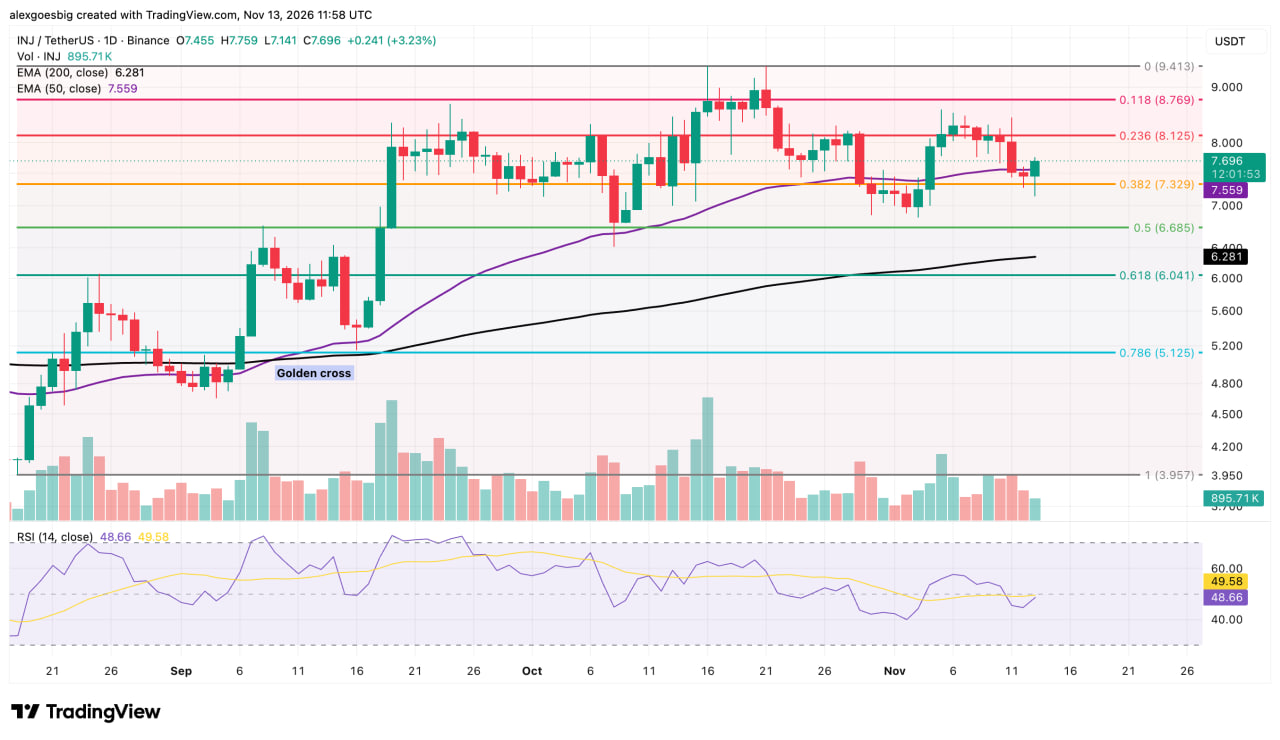
$INJ bounced off a key Fibonacci support and reclaimed its 50-day moving average.
The golden cross between the 50-day and 200-day averages is still in place.
Injective’s Veyra upgrade vote has broad support but has not yet reached quorum.
Veyra adds institutional trading tools without changing $INJ’s supply or staking rewards.
$INJ price climbed about 3.2% to $7.70 on Binance on November 13, with Injective’s native token recovering its 50-day exponential moving average after buyers stepped in near $7.33 during the session. The rebound comes as Injective’s community votes on IIP-717, the Veyra network upgrade that adds request-for-quote trading, expanded atomic swaps and new cross-chain functions aimed at institutional users. Voting closes on November 16, and turnout is still marginally below the 33.4% quorum the proposal needs before a planned mainnet activation on November 24.
Dip Buyers Return at $7.33
The $INJ price fell to $7.14 intraday, slipping below the 0.382 Fibonacci retracement at $7.33, and was trading well back above it by midday UTC, which shows buyers were waiting at that level. The Fibonacci grid runs from the August low near $3.96 to the mid-October high of $9.41, and $7.33 did not hold in late October, when $INJ closed below it for several sessions and dipped toward $6.85 before buyers took the level back.
Know when your coins move
Alerts, real-time prices, and market news — all in one app
Point your phone camera to install
4.8 based on 40K reviews in the App Store and Google Play
The 0.236 retracement at $8.13 is the harder problem, having rejected several daily candles through the first half of November. A daily close above it would open the way toward $8.77 and then the October peak around $9.41. If $7.33 breaks on a closing basis, the next support sits at $6.69, the midpoint of the whole August to October rally, with $6.04 below that.
$INJ/USDT daily technical analysis. Source: TradingView, chart by Alexander Stefanov.
RSI Parks at 48 as Volume Fades
The 50-day EMA at $7.56 still sits well above the 200-day EMA at $6.28, a golden cross that has held since mid-September, so the two-month average price remains far above the longer-term one. Short-term momentum is flat, though. The 14-day RSI reads 48.66, almost exactly the midpoint of its range, meaning buying and selling pressure over the past two weeks have roughly cancelled each other out. Volume on the latest bounce, around 896,000 $INJ with half the session still to go, is also well below the spikes seen during the September breakout and the October run to $9.41.
Abstentions Carry Veyra Toward Quorum
Early tallies on November 13 showed about 60% support but turnout of only around 24%, well short of the threshold. The latest snapshot from the governance tracker shows participation at 33.03%, only 0.37 percentage points short of the threshold.
IIP-717 vote
Share
Progress
Turnout vs quorum
33.03%
98.9% of the 33.40% required
Yes
70.91%
13.16 million $INJ
Abstain
28.65%
No
0.43%
Snapshot from November 13, figures may change before the vote closes.
The large abstain share works in the proposal’s favor. Under the Cosmos SDK governance model Injective runs on, abstentions count toward quorum but are left out when yes and no votes are compared, so abstaining validators help clear the participation bar without diluting approval. With fewer than half a percent against, Veyra’s remaining risk is mostly turnout.
Firm Quotes Before Large Trades
The core of Veyra is a request-for-quote (RFQ) system. On a normal order book, a fund selling a large tokenized bond position pushes the price down as its order eats through available bids, a cost traders call slippage. RFQ lets that fund ask several market makers for a firm price on the full size and execute only once it accepts a quote, which is how much of the bond and currency market already trades off-chain.
Expanded atomic swaps tie both legs of an exchange together, so a transfer of tokenized securities and the matching stablecoin payment either complete at the same moment or both fail. The upgrade also adds Inter-Blockchain Communication (IBC) functions to Injective’s MultiVM setup, easing asset movement between its Ethereum-compatible environment and other connected chains, though each new asset still depends on individual integrations. IIP-717 contains no burn mechanism, supply cut or staking reward change, so any effect on $INJ would have to come through higher usage and fees.
A $724 Million Token on $20 Million of TVL
If the vote passes, validators will halt the chain at block 193,145,000 around November 24, switch to software version v1.21.0 and resume block production. The harder test comes afterwards. DeFiLlama put Injective’s TVL near $20.35 million on November 13 against a market capitalization of roughly $724 million, a gap institutional trading products would need to start closing before Veyra shows up in on-chain numbers. Canary Capital’s staked Injective ETF, which began trading on Nasdaq as INJC on November 5, held about $16.12 million in net assets a day later.
Veyra also lays the groundwork for CypherOS, a privacy layer meant to let trading firms keep positions and order sizes off the public ledger, though Injective has not set a launch date. Institutional Rail, the dedicated validator access service Injective launched on November 2, is the most obvious channel for early RFQ activity, given that its wider enterprise validator group already includes Google Cloud, Deutsche Telekom, Kraken and BitGo.

 crypto-news-flash.com