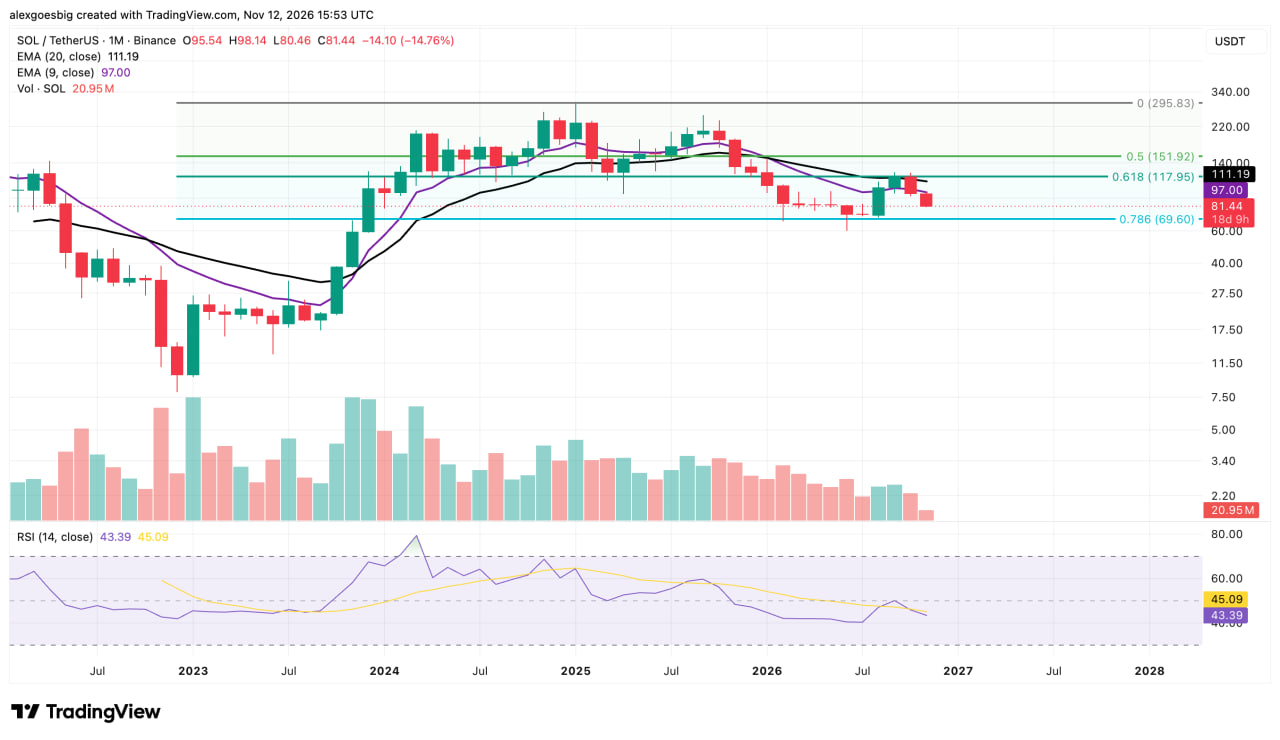
Solana trades below both of its key monthly moving averages.
DTCC plans to connect its tokenization service to Solana in the second half of 2027.
Solana is the second public blockchain on DTCC’s roadmap after Stellar.
The November monthly close will show whether $SOL’s last major Fibonacci support holds.
Solana ($SOL) traded near $81 on Thursday. That puts it almost 15% lower since November opened, down about 11% over the past seven days, and roughly $11 above the support level that has held its price up through 2026. The drop came on the same day the Depository Trust & Clearing Corporation (DTCC), the company behind the settlement and custody of most U.S. securities, said it plans to connect its tokenization service to Solana in the second half of 2027. The announcement did nothing to slow the sell-off. $SOL has now lost most of the rebound it made over the summer.
Sellers Still Run the Monthly Chart
On the monthly timeframe, $SOL sits below the 9-month exponential moving average (EMA) at $97 and the 20-month EMA at $111.19. An EMA is an average of past prices that gives more weight to recent months. When the price stays under both lines and the faster line has crossed below the slower one, the trend has favored sellers for a long time, and that has been true here since early 2026. The summer rally pushed $SOL back up to the 9-month line before October and November wiped out the gains.
Know when your coins move
Alerts, real-time prices, and market news — all in one app
Point your phone camera to install
4.8 based on 40K reviews in the App Store and Google Play
The monthly Relative Strength Index (RSI) reads 43.39, below the neutral 50 mark and below its own average at 45.09. That reading shows downside momentum is still stronger than upside momentum, but it is well above the 30 zone where sell-offs have often run out of steam. The summer recovery also stalled right at the 50 line. Trading volume has fallen steadily through 2026 compared with the 2024 rally. November’s candle still has more than two weeks to run, so its volume can’t yet be compared with completed months.
$SOL/USDT monthly chart. Source: TradingView / Alexander Stefanov
Why $69.60 Is the Line to Watch
Fibonacci retracement levels split the rally from the 2022 low to the $295.83 peak into ratios where traders expect the price to react. The 0.786 level at $69.60 has been the floor for $SOL this year. A wick in mid-2026 dropped into the low $60s, but no monthly candle has closed below the level. A November or December close under it would break that pattern and expose the $60 area.
Any rebound runs into resistance quickly. The first barrier is the 9-month EMA at $97, followed by a tighter cluster between $111 and $118, where the 20-month EMA sits close to the 0.618 Fibonacci level at $117.95. A move back to the 0.5 level at $151.92 would be the first sign that the 2026 downtrend has actually ended.
Level
Indicator
Role
$111 – $118
20-month EMA, 0.618 Fib
Resistance
$97
9-month EMA
Resistance
$69.60
0.786 Fib
Support
$60
Round number
Support
What DTCC Is Bringing to Solana
DTCC’s subsidiary, The Depository Trust Company (DTC), services more than $114 trillion in securities. Its DTCC Tokenization Service (DTS) went live on October 28 with connections to the Canton Network and DTCC’s own private Hyperledger Besu network. Twenty DTC participants had signed up at launch, including JPMorgan, Citi, Fidelity Investments and Citadel Securities. The securities eligible for the service are select Russell 1000 stocks, ETFs that track major U.S. indices, and U.S. Treasury bills, notes and bonds.
Brian Steele, president of DTCC Clearing & Securities Services, said assets issued on Solana will keep the same ownership rights and investor protections as their traditional versions. DTCC CEO Frank La Salla described the move as giving institutions more choice over where they hold tokenized securities. Solana is not first in line. Stellar, which DTCC announced in May, is set to become the service’s first public blockchain in the first half of 2027.
How a Tokenized Share Reaches Solana
Under this model, the security itself stays in DTC’s custody. A participant tells DTC to convert a position, and DTS mints a token that represents the participant’s claim on that position into a registered wallet. Tokens can move between registered wallets around the clock. To convert back, the token is burned and DTC credits the traditional position. Anonymous wallets can’t take part, and DTC keeps control over who is allowed in.
This design limits the direct effect on $SOL. Every transfer pays a network fee in $SOL, but those fees usually come to a fraction of a cent, so the token would only see real demand if volumes were very large. DTCC hasn’t said which securities will go to Solana first, how much value it expects to move there, or which of its 20 participants plan to use the network. That lack of detail may explain why the market shrugged off the news.
Stellar Goes First in 2027
The Stellar rollout in the first half of 2027 will be the first time participants can move DTC-backed securities onto a public network, and it will show whether banks actually use that option for collateral and settlement. Solana’s launch window comes after that, so early activity on Stellar is the closest preview Solana holders will get. On the chart, a monthly close above $97 would be the first sign of strength, while a close below $69.60 would break the support that has held all year.
Timing adds another constraint. The SEC no-action letter that DTC received on December 11, 2025 covers a three-year authorization period, which ends in December 2028. If Solana goes live in the second half of 2027, it would have between one year and 18 months of operation before that authorization expires. Whatever volume Solana handles in that time will be part of the record DTC brings to regulators when it asks to extend the service.

 crypto-news-flash.com