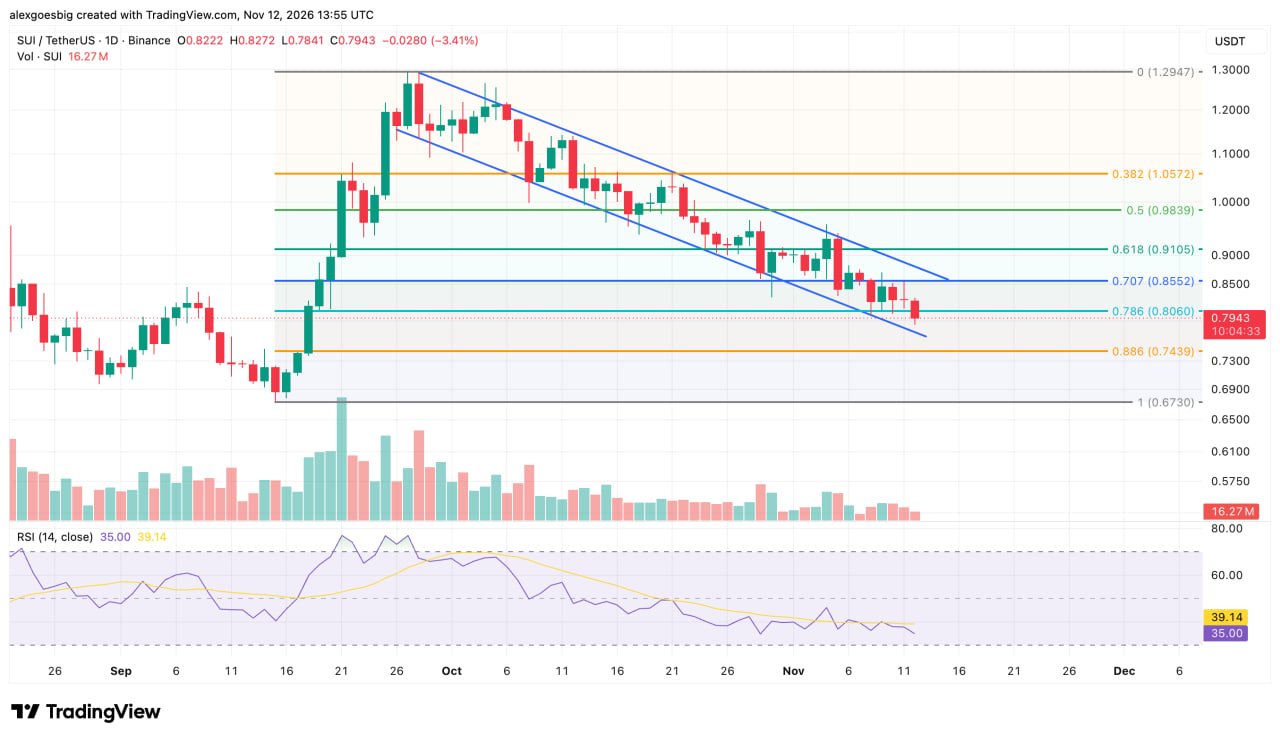
$SUI has slipped below a major Fibonacci support inside a two-month descending channel.
Suiet is ending its wallet service, though user funds stay safely on the Sui blockchain.
Suiet joins Phantom and Suiball on a growing list of wallet providers leaving Sui.
Falling active users and DeFi liquidity contrast with sharply higher transaction counts.
$SUI fell 3.41% to around $0.7943 on Binance on November 12, slipping beneath the $0.8060 support that had held through most of November, in the same week that Suiet, one of the longest-running wallets built specifically for Sui, confirmed it will stop maintaining its service after November 14. The token has lost roughly 39% since its late-September peak near $1.29, and the wallet’s exit raises a question the chart alone cannot answer: whether companies building user-facing tools on Sui can still cover their costs.
Four-Fifths of the Rally Already Gone
Since the late-September top, $SUI has printed lower highs and lower lows inside a descending channel, and an early-November rebound was sold within days at the channel’s upper boundary. The Fibonacci levels on the chart run from the September low at $0.6730 to the $1.2947 high, so the 0.786 retracement at $0.8060 marks the point where the token has handed back almost four-fifths of that rally. Thursday’s drop took the price under that line, although a daily close below it would carry more weight than an intraday move.
Know when your coins move
Alerts, real-time prices, and market news — all in one app
Point your phone camera to install
4.8 based on 40K reviews in the App Store and Google Play
$SUI tests key support at $0.806. Chart: Alexander Stefanov / TradingView.
If the break holds, the 0.886 level at $0.7439 is the next support, about 6.3% lower, followed by the $0.6730 low where the September advance began. Buyers first need to reclaim $0.8060, which now acts as resistance, before $0.8552 and $0.9105 come into view.
The 14-day RSI reads 35, under its own average of 39.14, which means closing prices over the past two weeks have leaned clearly toward sellers. A drop to 30 would put $SUI in territory that has often come before short relief bounces, though inside a downtrend those bounces tend to stall at the first resistance. Daily volume of about 16.27 million $SUI is a fraction of September’s levels, so the slide has come on thin trading, without the panic-driven selling that often marks the end of a decline.
Suiet Pulls Its Servers on Saturday
In a statement titled “Sunsetting Suiet” on its official website, the team says it is ending development and support, with API services running through November 14 and the Chrome extension to be withdrawn at a date not yet given. Because the wallet is self-custodial, meaning users hold their own private keys, no $SUI or other assets will be frozen or moved, but once the APIs go dark the extension may stop showing balances or sending transactions.
Importing the recovery phrase into another Sui wallet restores the same address with no on-chain transfer or fee. The team advises checking that staking and DeFi positions appear before uninstalling, and warns about fake support agents and fraudulent migration sites. The official Sui account and Slush, the wallet developed by Mysten Labs, both addressed Suiet users on November 11. Suiet has been on the receiving side of a shutdown before, since its documentation still carries a migration guide for users of Ethos Wallet, written when that Sui wallet closed.
Third Wallet Exit Since September
Phantom ended Sui support in September 2026, although it dropped Monad around the same time, and the Suiball hardware wallet project announced its closure on November 10-11. The DeFi project Full Sail also shut down after a Switchboard-related security incident that reportedly cost about $91,000.
Suiet has given no reason for its decision. A non-custodial wallet usually charges nothing to hold assets, so its income comes from in-app swap fees and partnerships that rise and fall with user numbers, while its bills for node access, data indexing and upgrade work stay largely fixed. Kadan Stadelmann, former chief technology officer of Komodo Platform, has argued that Sui’s problems look more economic than architectural, with high engineering costs and too few users to justify infrastructure support. That is his reading, and Suiet has not endorsed it.
Users Down 79%, Transactions Tripled
Token Terminal data shows average daily active users fell to about 128,000 in October from roughly 601,000 in November 2025. DefiLlama puts total value locked across Sui DeFi protocols at about $413 million, more than 22% lower than a month earlier, partly because the metric is counted in dollars and $SUI itself fell.
Monthly transactions climbed from 101 million to 324 million over the same year. By our rough estimate, that is about six transactions per active user per day a year ago and close to 80 now, a pattern that fits automated trading better than retail growth, although the data cannot confirm the mix. Bots sign transactions directly, so their activity brings browser wallets neither users nor fees. Network reliability has been a separate weak spot, with Sui Foundation reports citing four outages in 2026 totaling about 22 hours, though nothing links them to Suiet’s decision.
No Word on Suiet’s Developer Kit
Holders with staked $SUI or open DeFi positions have until Saturday to confirm access elsewhere, and the November active-user and TVL figures due in early December will show whether usage is still falling alongside the price. Suiet also built an open-source Wallet Kit, a code library that Sui applications can use to connect to any Sui wallet, Slush included. The code is MIT-licensed, so projects can copy and maintain it themselves, but without upkeep they will need to handle future Sui protocol changes on their own or move to Mysten Labs’ tools, and Suiet has not said what happens to the kit after November 14.

 crypto-news-flash.com