STX Price Retreats to Key Support as Stacks Posts Its Best Quarter
crypto-news-flash.com
2 h
Stacks brought its first institutional Bitcoin into staking during Q3 after the PoX-5 hard fork.
Almost all liquid staked Bitcoin on the network now sits as lending collateral on Zest Protocol.
$STX has handed back a large part of its August-October rally despite the stronger network data.
The token is testing a support zone where a key moving average and a retracement level overlap.
$STX, the native token of the Bitcoin smart contract layer Stacks, trades near $0.35 on Tuesday after losing roughly 19% over seven days, even though the $STX Ecosystem Report for Q3 2026 shows the network pulled about 735 $BTC into its new Bitcoin Staking product across the first two bonding periods. That gap between improving on-chain numbers and a weakening price has pushed $STX back into the area that needs to hold if the rally that began in mid-August is to survive.
735 $BTC Across Two Bonds
The quarter turned on the PoX-5 hard fork, which went live on July 30 at Bitcoin block 960,230 and unlocked every staked $STX token, forcing holders to restake under the new contract. They restaked 392M $STX almost immediately, the figure climbed to 448M by the end of September, and it reached 493M once Bonding Period 2 opened on October 8.
Know when your coins move
Alerts, real-time prices, and market news — all in one app
Point your phone camera to install
4.8 based on 40K reviews in the App Store and Google Play
The Genesis Bond opened on September 10 and filled all 230 $BTC of its capacity, with ETP issuer 21shares, HashKey Cloud, Nakamoto Inc. subsidiary UTXO Management and Sypher Capital among the first participants. Stacks Labs sized that bond deliberately small so institutions could test the product live. The second bond doubled it to 505 $BTC, and 483 $BTC of that came through liquid staking on Stacking DAO.
Metric
Latest figure
Change in context
$STX staked
493M $STX
Up 25%+ from 392M after the fork
$BTC bonded
~735 $BTC
230 $BTC, then 505 $BTC
sBTC supply
2,487 $BTC
End of Q3
stBTC supply
636 $BTC
97% posted on Zest
Weekly DEX volume
$16.7M
12-month high, week of Sept. 28
Source: Stacks Labs, Q3 2026 ecosystem report
Why Bitcoin Staking Locks Up $STX
The mechanism explains why $STX holders care about Bitcoin deposits at all. PoX-5 introduced protocol bonds, which pair $BTC timelocked on the Bitcoin base layer with $STX locked on Stacks as staking capacity, so every new tranche of Bitcoin needs $STX sitting beside it. Bonding Period 2 alone required 6.7M $STX alongside its 505 $BTC, and the yield those bonds generate is paid in $BTC, which Stacking DAO currently estimates at about 2.3% a year for stBTC holders.
With a market capitalization of $627.55M at $0.3458, $STX has roughly 1.81B tokens in circulation, which puts the 493M staked figure at around 27% of supply. Much of that stake is returning capital that the fork had temporarily unlocked, so the recovery above 392M is the part that reflects fresh demand.
Where the Staked Bitcoin Ends Up
Liquid staked Bitcoin on Stacks has one dominant destination. Of the 636 $BTC in stBTC supply, 97% is posted as collateral on Zest Protocol, the network’s largest lending market, which reports more than $122M in deposits, $42M in borrows and 800 $BTC of Bitcoin-denominated collateral. Zest also runs a levered staking vault that loops stBTC for extra yield, and it has processed over 1,500 liquidations since launch without bad debt. That record matters more as concentration grows, because a single liquidation engine now carries nearly all of the network’s staked Bitcoin.
$STX Price Tests the $0.33 Zone
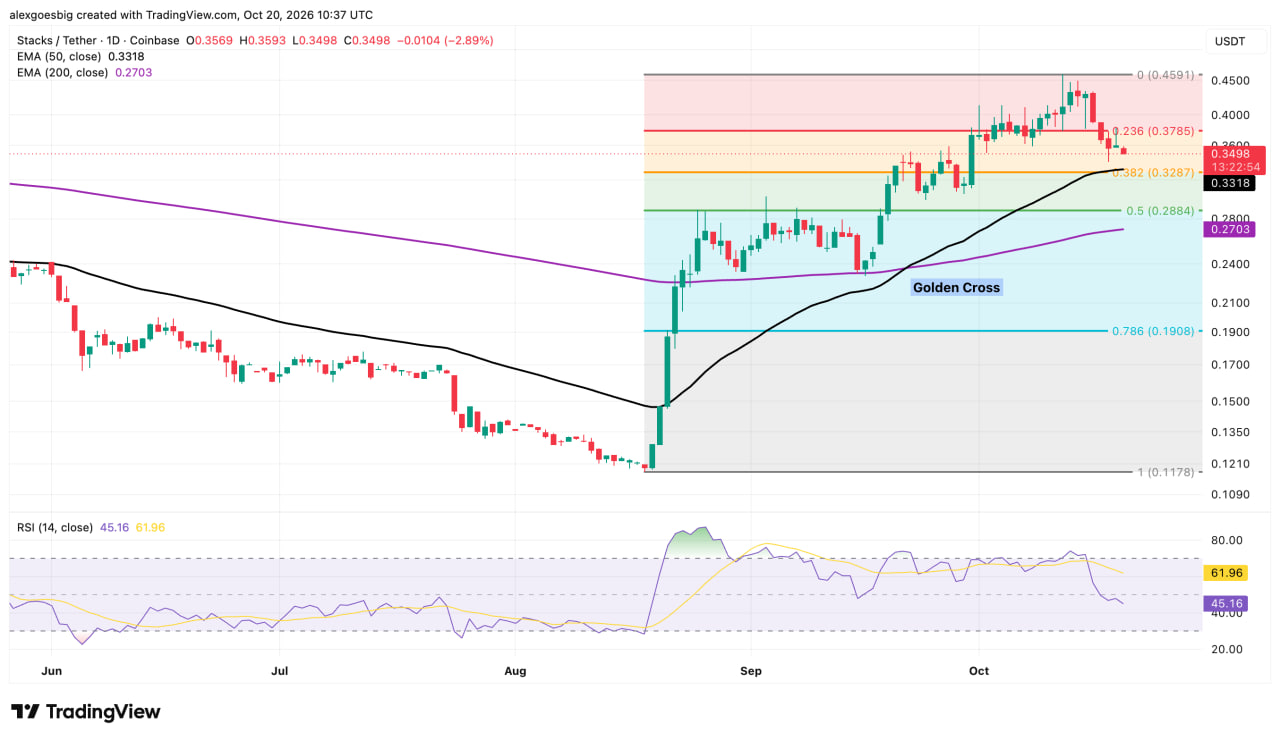
$STX/USDT daily chart. Source: Alexander Stefanov/TradingView
$STX climbed from about $0.118 in mid-August to a $0.459 high in mid-October, a gain close to 290%. During the first leg of that move the 14-day RSI pushed above 80, a reading that signals buyers were paying up at an unusually stretched pace, and it then held between roughly 60 and 75 while price ground higher through September. The index has now dropped to 45, below the 50 midline and well under its own average of 62, which means short-term momentum has passed to sellers.
The longer trend still leans positive. In mid-September the 50-day EMA crossed above the 200-day EMA, a golden cross that marks the point where the average price of recent weeks overtook the longer-term average. Price has already lost the 0.236 Fibonacci retracement at $0.3785 and now trades just above $0.3318, where the 50-day EMA meets the 0.382 retracement at $0.3287. Fibonacci retracements measure how much of a rally has been given back, and this overlap makes $0.33 the first area where buyers tend to defend a trend.
A daily close below $0.3287 would leave $0.2884 as the next support, with the 200-day EMA at $0.2703 below it. A move back above $0.3785 would put the October high back in play.
Monthly Bonds Set the Q4 Test
Stacks Labs plans to open a new bonding period every month through the end of 2026 with larger capacity each time, so each bond will show whether Bitcoin demand keeps pace with supply and how much additional $STX gets locked. Epoch 4.1, the next network upgrade, targets activation in early December and makes Clarity 7 the default language version for new smart contracts, with the activation block height due at least 30 days in advance. Muneeb Ali, the Stacks co-founder, took over as CEO of Stacks Labs on October 15.
The Stack Sats incentive program pays out 1 $BTC a month to Bitflow traders and Zest lenders until December 10, and the Stacks Endowment intends to use its participation data to design a longer-term DeFi rewards framework. Bitflow, the main exchange on the network, also plans to ship a new concentrated-liquidity design in Q4 that it says will handle at least ten times more swap throughput, which would matter if bond sizes keep doubling.

 crypto-news-flash.com