Starknet Price Jumps as Layer 1 Speculation Drives STRK Rally
crypto-news-flash.com
55 m
$STRK reached $0.1194 amid speculation over a Layer 1 transition.
StarkWare is exploring faster quantum-security upgrades.
Approximately 127 million $STRK are scheduled to unlock on October 15.
Starknet’s $STRK token rallied sharply on October 11 after comments from StarkWare CEO Eli Ben-Sasson fueled speculation that the Ethereum scaling network could become an independent Layer 1 blockchain.
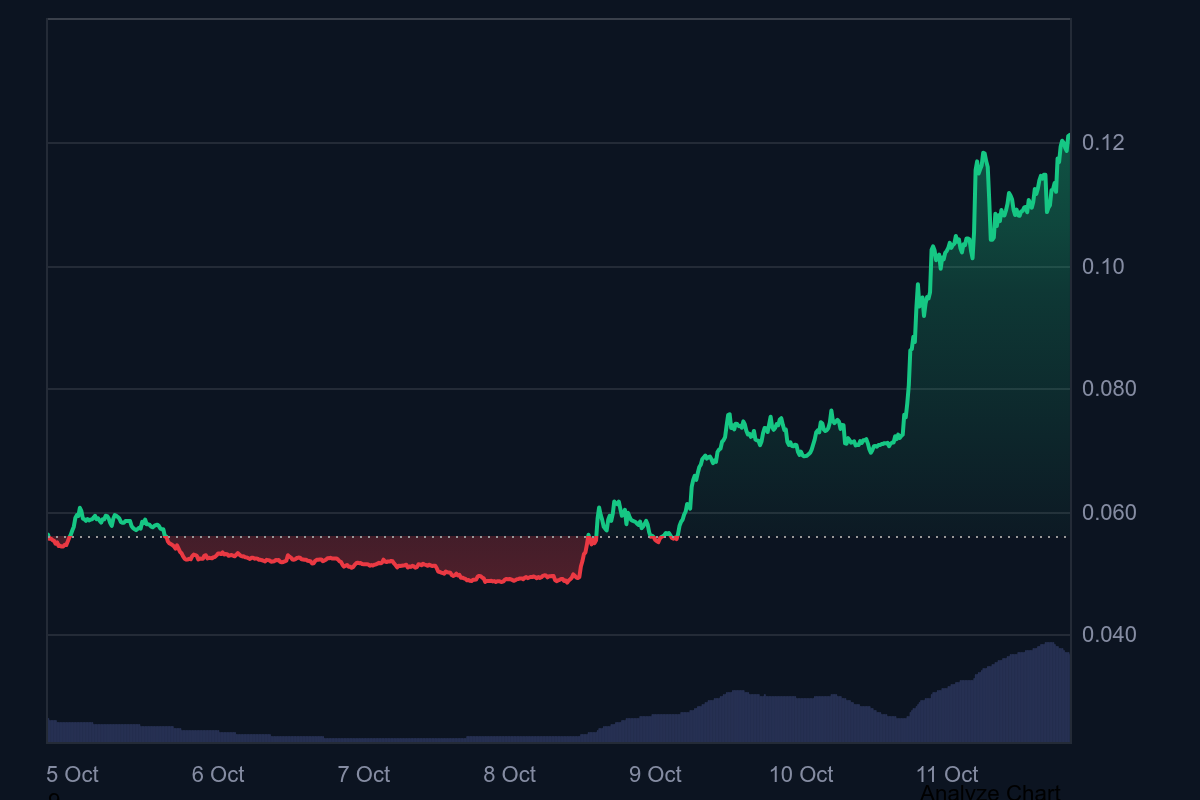
At the time of writing $STRK trades at $0.11941, gaining 17.41% in the past 24 hours and reaching a session high of $0.12346. According to CoinMarketCap the token has gained 118% over the past 7 days as buying pressure mounted ahead of the architectural discussion.
Know when your coins move
Alerts, real-time prices, and market news — all in one app
4.8 based on 40K reviews in the App Store and Google Play
Starknet extends its seven-day rally.
Open interest has increased 34.74% over 24 hours to $196.8 million, adding approximately $50.8 million in outstanding positions.
The buying followed a debate over Starknet’s future architecture, with quantum-resistant security emerging as a possible reason to reduce the network’s dependence on Ethereum.
Quantum Security Pushes Starknet Toward a Bigger Decision
On October 8, Ben-Sasson raised the prospect of Starknet operating as a sovereign Layer 1, arguing that the growing threat from quantum computing could require faster security upgrades than Ethereum’s development schedule permits.
We are actively considering becoming an L1.
This would enable Starknet to become the first fully quantum-resistant network, with 2027 as our target.
— Starknet (@Starknet) October 8, 2026
Starknet subsequently confirmed that it was actively considering the transition, with an ambition to achieve full quantum resistance by 2027.
The proposal would represent a fundamental change in how the network operates.
Starknet currently functions as an Ethereum Layer 2 validity rollup. It executes transactions separately and submits cryptographic proofs to Ethereum, relying on the underlying blockchain for settlement and data availability.
This structure provides access to Ethereum’s security but also creates dependencies.
StarkWare’s post-quantum roadmap identifies bridge messaging and data availability as areas where Starknet cannot complete its cryptographic migration independently.
The network already uses STARK proofs, which rely on hash-based cryptography. Its account-abstraction model also gives developers flexibility to introduce alternative signature schemes.
Those advantages do not eliminate vulnerabilities inherited from the systems connecting Starknet to Ethereum.
Operating as a standalone Layer 1 could give developers greater control over security upgrades, but it would also require a new approach to settlement, validator coordination and network security.
No approved transition plan has been published.
For $STRK holders, the economic consequences are equally unresolved. An independent architecture might change staking incentives, transaction fees and the token’s role in securing the network. None of those outcomes follows automatically from becoming a Layer 1.
Hyperliquid Leads a $196.8 Million Derivatives Market
Trading activity expanded alongside the price increase, with the largest concentrations of $STRK open interest appearing on Hyperliquid, Binance and Bybit.
Market concentration: Hyperliquid and Binance together account for approximately 63.3% of reported $STRK open interest.
Source: $STRK open-interest-data from Coinalyze, October 11, 2026. Market shares are rounded and calculated against total reported open interest.
The four platforms account for approximately 99% of the reported total, leaving $STRK’s derivatives activity heavily concentrated among a small number of exchanges.
Such concentration can amplify short-term volatility if traders unwind positions simultaneously.
The increase in open interest indicates that outstanding derivatives exposure is growing. It does not establish whether traders are predominantly bullish or bearish, since every contract involves both sides of a trade.
Funding rates and liquidation data would provide a clearer picture of directional positioning.
For now, the combination of higher prices and expanding exposure shows that speculation is intensifying, rather than proving that a sustained trend has developed.
$STRK Breaks Above Long-Term Averages, but RSI Signals Excess
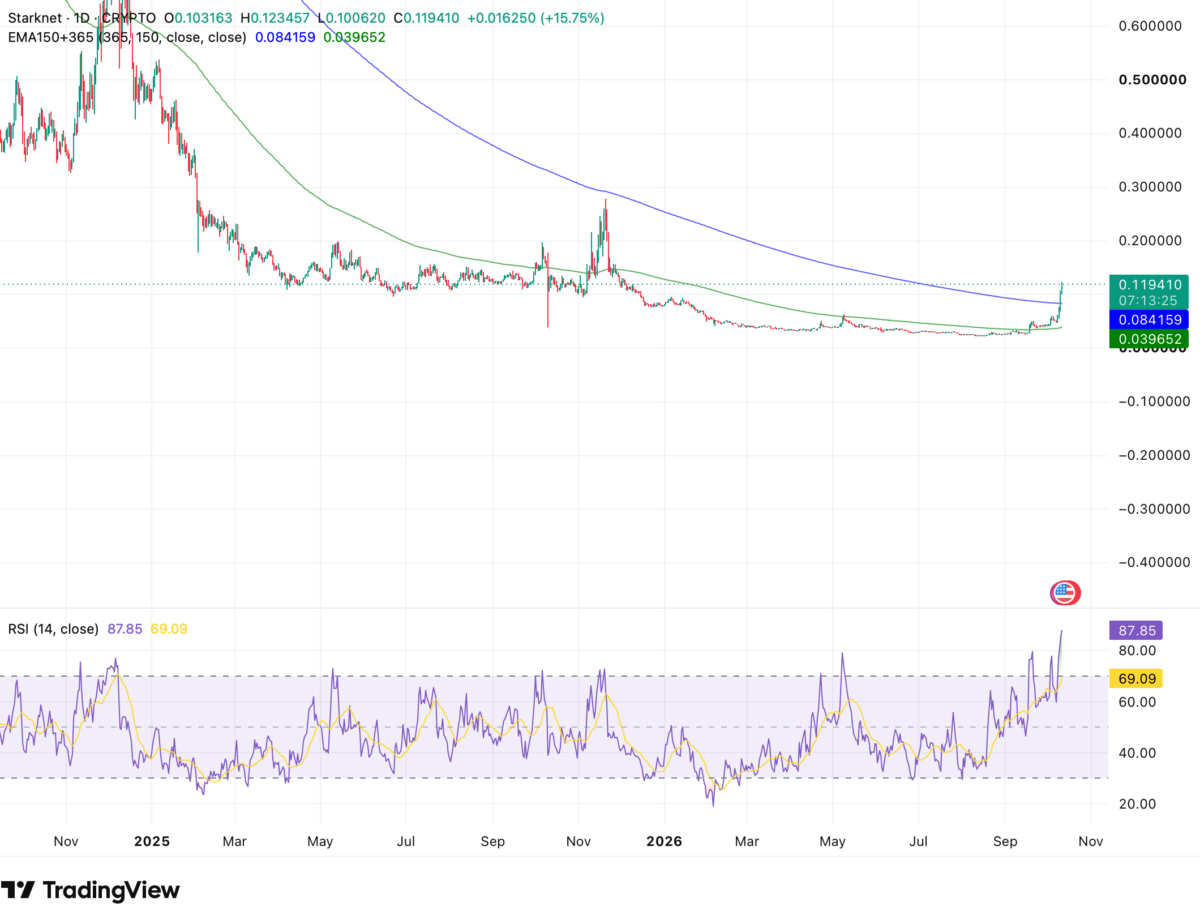
The daily TradingView chart shows$STRK recovering above two long-term exponential moving averages after an extended period of weakness.
Starknet surges above its long-term moving averages.
Its 365-day EMA stood near $0.08416, while the 150-day EMA was approximately $0.03965. At $0.11941, $STRK traded roughly 42% above the 365-day average, reflecting the scale of the recent acceleration.
The Relative Strength Index presents a more immediate warning.
$STRK’s 14-day RSI reached 87.85, substantially exceeding the conventional overbought threshold of 70.
That reading reflects unusually strong recent momentum. It can persist during an aggressive rally, but it also leaves the token exposed to sharp profit-taking when buying pressure weakens.
The latest intraday high around $0.1235 is the first resistance reference. A sustained move beyond it could bring the $0.14–$0.15 region into focus.
On the downside, $0.11 is an initial level to monitor, followed by the psychological $0.10 threshold.
A retreat below those levels would suggest that the breakout is losing momentum, particularly if accompanied by falling open interest or increased selling volume.
October 15 Unlock Could Test Demand
The next scheduled token release introduces a separate challenge for $STRK’s recovery.
Approximately 127 million $STRK are expected to unlock on October 15, according to CoinGecko’s tokenomics data.
At the latest chart price, the allocation would be worth roughly $15.2 million.
The release is divided between early contributors and investors, adding tokens equivalent to approximately 1.27% of $STRK’s maximum supply.
Unlocks do not necessarily translate into immediate exchange sales. Recipients can retain their allocations, stake them or sell gradually.
The relevant consideration is how much additional supply reaches the market relative to available buying liquidity.
$STRK’s recent trading activity suggests substantial speculative interest, but the open-interest increase also means that leveraged positions could magnify a reversal if spot demand weakens.
The timing creates a particularly sensitive setup: a large price advance, an elevated RSI and a scheduled supply increase within the same week.
The Market Is Pricing a Transition Before Its Details Exist
Starknet’s architectural debate could eventually reshape how the network secures transactions and interacts with Ethereum.
But investors have yet to see the technical specifications, governance arrangements or token-economic changes that would determine the practical consequences.
That leaves two different timelines driving $STRK.
Developers are discussing a security transition potentially extending into 2027. Traders are reacting to that possibility today, while a measurable increase in token supply is scheduled within days.
The gap between those timelines explains much of the current market risk.
$STRK has broken above important long-term price averages, and derivatives activity has expanded substantially. Whether that momentum survives the October unlock will offer a more immediate measure of demand than speculation about the network’s eventual architecture.

 crypto-news-flash.com