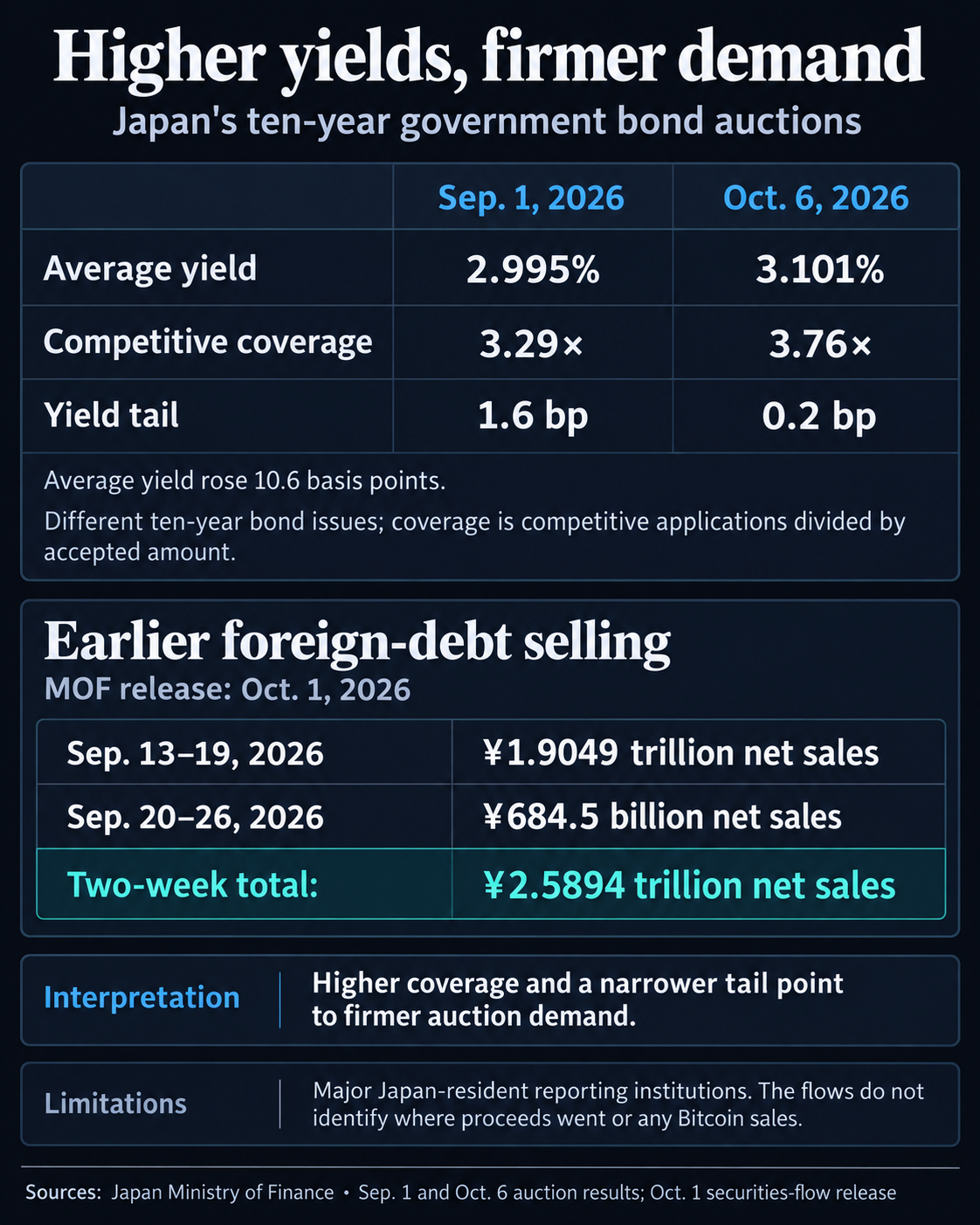
The backdrop is two earlier weeks of foreign-debt selling. MOF’s October 1 flow release recorded net long-term debt sales of ¥1.9049 trillion during September 13–19 and ¥684.5 billion during September 20–26. Together, those weekly observations amount to net sales of ¥2.5894 trillion.
The series covers designated major Japan-resident reporting institutions and classifies foreign securities by issuer residence. It does not identify US Treasury sales, currency conversion, reinvestment into Japanese government bonds or Bitcoin transactions.
The potential financing pressure on Bitcoin
If Japanese institutions persistently prefer domestic bonds over overseas debt, reduced foreign bond demand could raise borrowing costs and weigh on capital available for risk-taking.
The authors of a Bank for International Settlements working paper identify global funding conditions and speculative motives as important drivers of cross-border Bitcoin and Ether flows. Their 2017 to mid-2024 sample supports the relevance of funding conditions to crypto flows.
Institutional portfolio allocation also differs from leveraged yen carry trades, which involve positions financed with borrowed yen. A ten-year auction yield does not measure the short-term cost of that borrowing. In their August 2024 analysis, BIS researchers described how deleveraging and margin increases amplified that month’s market turbulence. It illustrates how financing stress can spread across markets, without demonstrating a current unwind.
The next useful evidence is whether foreign-debt selling continues alongside independently observed funding stress. That pattern would be consistent with the proposed Bitcoin financing channel; renewed buying and calm funding would weaken the interpretation.

 cryptoslate.com