Zcash price holds $1,400 as holders approve $8.4M grants
crypto.news
3 h
Zcash holders have approved $8.39 million in retroactive grants for completed work, including $1.5 million tied to the researcher who uncovered the critical Orchard vulnerability during an AI-assisted security audit.
OpenZcash shows that 17 of 37 proposals in the Q3 2026 Coinholder-Directed Retroactive Grants round were funded, representing 93.1% of the $9.01 million requested. The largest single vote involved roughly 2.18 million $ZEC, equal to 10.4% of Zcash’s maximum 21 million supply.
Zcash co-founder Zooko Wilcox wrote on Oct. 1 that the grants rewarded people who worked on the network during this year’s security crisis. He described the vote as evidence for Zcash’s system of coinholder-directed funding and governance, though his assessment of the model’s strength represents his own view.
Know when your coins move
Alerts, real-time prices, and market news — all in one app
4.8 based on 40K reviews in the App Store and Google Play
Zcash just gave away more than $8m in retroactive grants, including millions of dollars of retroactive grants to a lot of people who selflessly worked to protect all users during the AI bug crisis this year.
But that’s not even the best thing about what just happened… ⤵️ pic.twitter.com/yRtVUvkt5y
— zooko🛡🦓🦓🦓 ⓩ (@zooko) October 1, 2026
Zcash holders approved $1.5M for the Orchard bug discovery
Among the largest approvals were two $750,000 grants tied to Taylor Hornby’s discovery of the Orchard counterfeiting vulnerability. One covered the original bug bounty, while a second community nomination increased the total award to $1.5 million.
Shielded Labs disclosed in June that Hornby found the flaw on May 29 while reviewing Orchard with traditional security techniques and Anthropic’s Opus 4.8 model. The bug affected Orchard’s zero-knowledge proof circuit and could have allowed an attacker to create counterfeit $ZEC inside the shielded pool without leaving an obvious onchain trace.
Hornby immediately disclosed the issue to Zcash Open Development Lab engineers. Developers, miners, exchanges and infrastructure providers then coordinated an emergency response.
The Zcash Foundation said the network first temporarily disabled Orchard transactions before activating NU6.2 with a corrected circuit. Its analysis found no evidence of unauthorized value creation, and Zcash’s total supply remained intact under the network’s turnstile accounting.
The $1.5 million approval is retroactive compensation for the completed security work. Large grants still pass through the program’s administration process, which includes compliance checks for awards above $50,000 before keyholders coordinate payouts.
Security work took most of the largest grants
The Q3 vote extended well beyond Hornby’s bounty. Several of the largest funded proposals covered security research, audits, protocol development and work completed during Zcash’s response to vulnerabilities earlier this year.
Coinholders approved $1.95 million for ZODL’s Q1 and Q2 core protocol development and $1.203 million for ValarGroup’s Ironwood work. A further $738,942 went toward formal verification of the Ironwood zk-SNARK circuit, while $599,000 covered external audit costs.
Other funded security work included $425,000 covering five critical Zebra consensus-divergence vulnerabilities, a $400,000 award connected with a temporary detectable unlimited-mint-and-sell exploit, and a $150,000 Zebra vulnerability bounty.
Ironwood itself followed the Orchard incident. The Zcash Foundation released Zebra 6.0.0 in July with support for the NU6.3 Ironwood upgrade, which introduced a new shielded pool using Orchard’s Action and Halo2 proof system while maintaining separate accounting data.
Coinholders did not approve every request. Twenty proposals were rejected or otherwise failed to receive funding, while the approved projects captured most of the dollars because the largest security and protocol-development proposals received strong support.
Coinholders directly decided where the money goes
The grant system pays for work after it has already been completed. Funding comes from the Coinholder-Controlled Fund established through Zcash’s network funding structure.
Under the current rules, at least 420,000 $ZEC must participate in a proposal for the vote to qualify. A simple majority then determines approval, excluding abstentions from the majority calculation.
Shielded Labs and the Zcash Foundation act as keyholders for the fund’s 2-of-3 multisignature arrangement. They process approved payments but retain limited veto powers defined by the program, including legal grounds. They cannot reverse a proposal rejected by coinholders.
Participation increased sharply this quarter. OpenZcash records the largest Q3 vote at approximately 2.18 million $ZEC, compared with around 500,608 $ZEC during Q1. Q2 voting was postponed after the Orchard vulnerability, pushing several proposals into the Q3 round.
Zooko said the round involved Valar, ZODL, Vizor, the Financial Privacy Foundation and coinholders voting privately with billions of dollars in $ZEC. His claim that the process proves Zcash is “capture-resistant” is an interpretation of the governance outcome, not a measurable property established by the vote.
The next grant round is scheduled to accept proposals from Oct. 30 through Nov. 13, followed by a review period and voting from Dec. 17 through Dec. 29.
How is Zcash price doing after the grants vote?
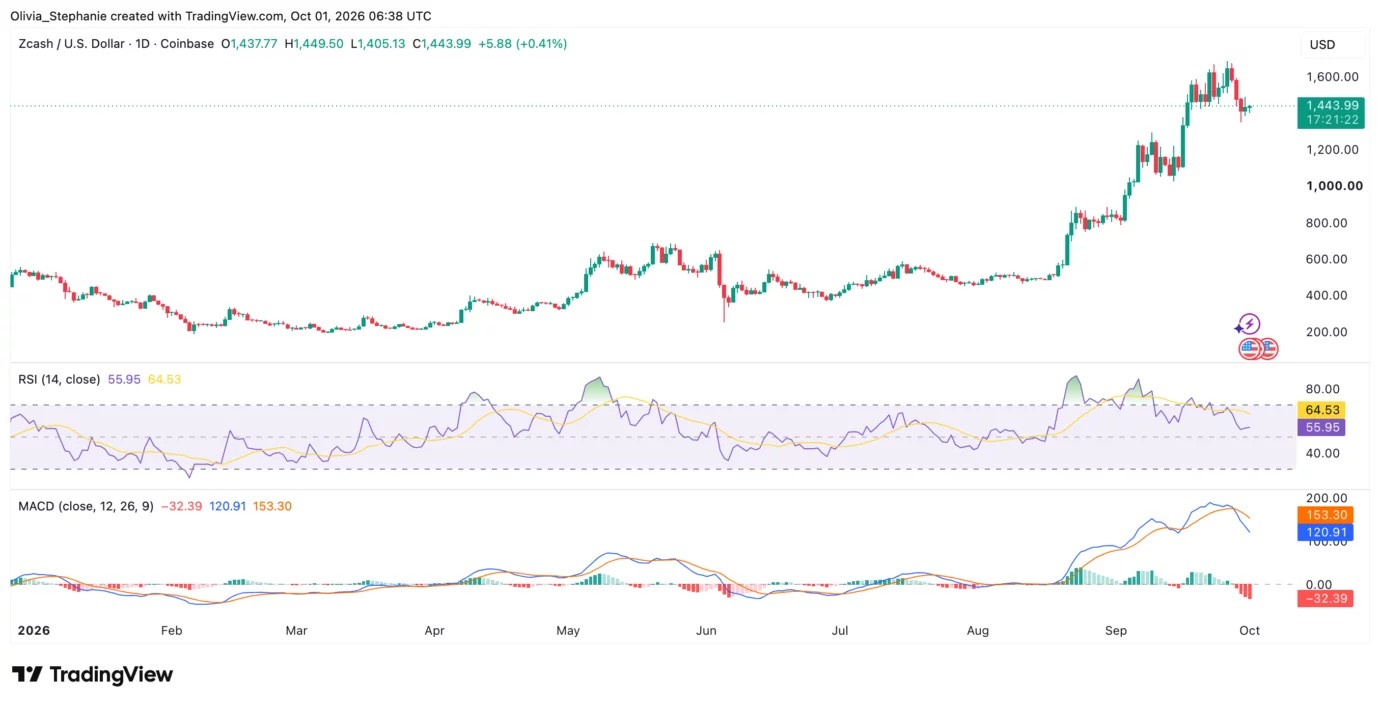
Zcash is trading near $1,407 at the time of research, with CoinGecko showing a 24-hour range between roughly $1,382 and $1,458. $ZEC remains below the $1,600-$1,700 area reached during its September rally but far above the levels seen before the month’s breakout.
The daily chart supplied for this analysis places the 14-day RSI at 55.45, below its moving average near 64.49. Momentum has therefore cooled from the overbought readings reached during the rally, although RSI remains above the neutral 50 level.
Zcash ($ZEC) price chart, source: TradingView
MACD is weaker in the short term. The MACD line stands around 120.13 compared with a signal line near 153.14, leaving the histogram negative at roughly -33.01. The configuration points to fading bullish momentum while $ZEC consolidates below its September highs.
The pullback follows a strong run that carried $ZEC above $1,600 late last month. In recent analysis of Zcash’s leverage reset, open interest on one major derivatives venue fell quickly as price retreated, showing traders reducing exposure after the rally.
Onchain Lens reported that a whale withdrew another 2,000 $ZEC, worth roughly $2.82 million at the time, from Binance through two wallets before consolidating the coins into a primary address. The tracker put that wallet’s $ZEC holdings near $66.19 million.
Exchange withdrawals alone do not show whether a holder intends to keep or later sell the coins. The transaction nevertheless occurred while $ZEC was consolidating below recent highs.
WHALE ACCUMULATES $66M WORTH OF $ZEC
A whale withdrew 2K $ZEC (~$2.82M) from Binance across two wallets, then consolidated the funds into its main accumulation wallet.
The main wallet now holds ~$66.19M worth of $ZEC. pic.twitter.com/nQ8aUNTMOq
— Onchain Lens (@OnchainLens) September 30, 2026
Trader that1618guy wrote that $ZEC was testing its daily 21-day EMA for the first time since August after climbing from above $400 to around $1,700. The analyst identified the 55-day EMA, then near $1,100, as a deeper area to watch if the correction extends.
At current levels, $1,400 remains the nearest price area for buyers to defend, while a recovery toward $1,500-$1,600 would return $ZEC toward the zone where sellers emerged during September. The current RSI and MACD readings show the rally has cooled, but neither indicator by itself confirms that Zcash’s larger uptrend has ended.

 crypto.news