If you used Uniswap just once before September 2020, even for a failed transaction, you woke up exactly six years ago today to 400 $UNI sitting in your wallet, worth about $1,200.
Fourteen months after that $450 million airdrop, total crypto market capitalization had surged from roughly $350 billion to a whopping $3 trillion. Meanwhile, the total value locked (TVL) in decentralized finance (DeFi) protocols skyrocketed from just $10 billion to nearly $180 billion.
Crypto Market Performance after $UNI Airdrop
Know when your coins move
Alerts, real-time prices, and market news — all in one app
Point your phone camera to install
4.8 based on 40K reviews in the App Store and Google Play
Of course, $UNI didn't cause that bull market. Global monetary stimulus measures in response to the COVID-19 pandemic did the heavy lifting, and DeFi Summer was already in full swing when the airdrop landed. But it's no accident that the cycle that minted the most on-chain wealth in history opened with the biggest airdrop DeFi had ever seen. Free money in the hands of people who live on-chain doesn't sit still. Even the 2017 mania ran partly on house money, after every $BTC holder was handed free Bitcoin Cash (BCH) that August.
If history repeats, we might be about to run this experiment again, but at a much larger scale.
Stimulus Cheques for the On-Chain Economy
Let's first look at how the mechanism actually works.
An airdrop lands. Some recipients dump their tokens, some hold, but everyone starts hunting for the next one. The windfall gets recycled and attention floods in behind it.
In the weeks after the Jito (JTO) airdrop in December 2023, SOL surged as recipients rotated their windfall into the ecosystem, and Solana's activity and inflows spiked as farmers piled in looking for the sequel.
Hyperliquid perfected the playbook a year later. The $HYPE genesis drop distributed 31% of the token’s supply to early users in November 2024, with no VC unlocks hanging overhead. Then something unusual happened; instead of the usual insta-dump, many recipients held, while a fee-funded buyback provided a constant bid underneath the token. Ecosystem tokens soared, the exchange added thousands of users in days, and Bitcoin cleared $100,000 within a week.
So does free money actually start bull markets? Let's be honest about the size of this lever. The biggest airdrops inject a billion dollars or two, while total crypto market cap is measured in the trillions.
But that's not how bottoms are made. The low itself prints on capitulation volume, and then comes the boring part: the basing range, weeks of apathy, shrinking volume, and thin order books, where a modest bid moves price disproportionately because nobody else is bidding. An airdrop manufactures thousands of marginal buyers with house money, all on the same day. Hyperliquid's airdrop was worth roughly $1.2 billion at launch. Within a year, it had seeded an ecosystem worth more than $15 billion.
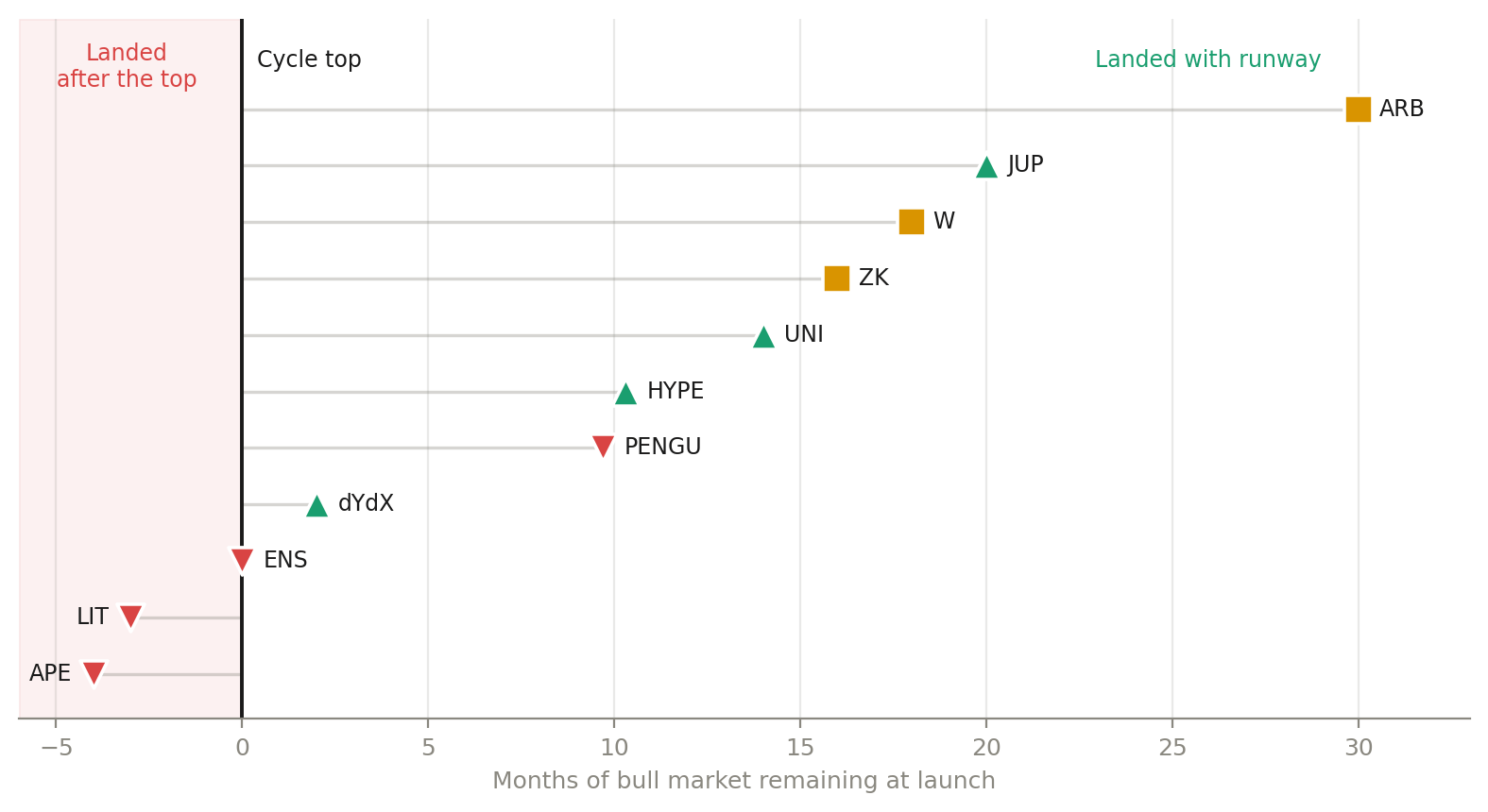
And while most airdropped tokens tend to bleed after launch day, it doesn't matter, because a farmer dumping ARB for ETH is still recycling free money into the market.
Since $UNI, eleven airdrops worth roughly $500 million or more have been distributed, measured as tokens distributed at launch multiplied by first-day prices, using CoinGecko data. Every one that launched at or after a peak bled, as one might expect, while the ones that preceded rallies landed with runway.
Which brings us to the clock.
Right on Schedule
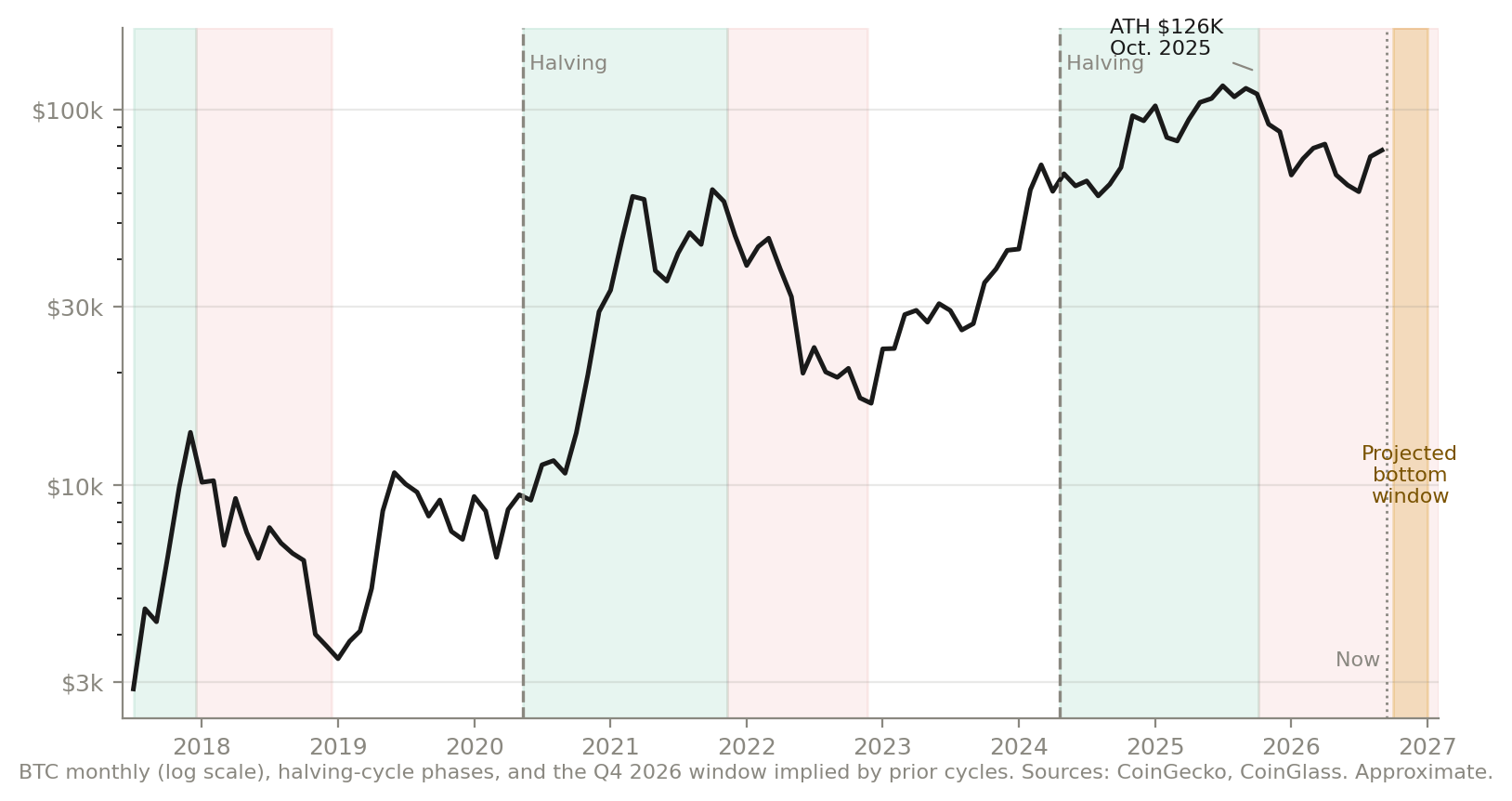
Bitcoin topped at $126,210 on Oct. 6, 2025, fell 52% to a low near $60,000 in early February, and is changing hands around $76,000 at the time of writing, some 40% off the high.
There are two ways to interpret the chart.
The bearish view calls this bounce the classic mid-cycle fakeout. Both prior bear markets exhibited similar moves before a final flush. Both also bottomed 12 to 13 months after the top. If the cycle holds again, the final low lands in Q4 2026. That window opens in two weeks.
The bullish take says February was the bottom. A 52% drawdown is shallow compared to 84% in 2018 and 77% in 2022, and the difference is a post-ETF institutional buyer base that didn't exist last cycle.
$BTC 4-year Cycle Phases
In both cases, the recovery phase should be around the corner.
Washington is Already Blinking
Now for the fuel.
The problem with $40 trillion of national debt is the interest bill. The U.S. government paid $963 billion in net interest in the first ten months of this fiscal year, and with 30-year yields at two-decade highs above 5%, every refinancing makes it worse. At some point, high yields stop being a market reality and start being a political emergency.
That point, apparently, was August. The Treasury doubled its buybacks of long-dated bonds to $4 billion per operation, and Secretary Scott Bessent went on CNBC to say the number "could be more." The market didn’t believe him, and yields rebounded within a day.
However, a government that can't tolerate 5% long yields will keep escalating until something does work, and it’s no secret that President Trump would prefer lower rates. We've seen this before; prior recoveries were ignited by liquidity backstops arriving under duress.
So the fuel is coming. The question is what provides the spark, and that's where the pipeline gets interesting.
Airdrop Pipeline
To start, let's clear out the mythical ones.
OpenSea's SEA token has been dangled before us for years and was shelved indefinitely in March after its second delay, with no new date. MetaMask's $MASK saga has gone on even longer, and Polymarket bettors price the chances of a 2026 $MASK launch in single digits.
The most promising candidate is Polymarket. The POLY token is confirmed, the U.S. relaunch is complete, and the CFTC registration is done. The open question is whether ICE's $2 billion investment pulls Polymarket toward an IPO instead.
Perhaps it will do both, like Circle, which published the whitepaper for its ARC chain token in May and presold $222 million of it at a $3 billion valuation, showing a public company can run equity and a token side by side. Arc’s mainnet went live today with BlackRock, DTCC, Visa, Mastercard, and ICE as founding validators. No airdrop has been announced, but the whitepaper's 60% ecosystem bucket leaves the door open.
Base is the wildcard. Coinbase has been ‘exploring’ a network token since last year, and a Base token would likely be the largest retail distribution surface ever assembled.
This brings us to the red-hot perpetual exchange sector. In May, the CFTC issued a landmark policy statement recognizing perpetual futures as a valid contract structure and cleared the first perp on a regulated US exchange.
And just today, Payward, the parent company of Kraken, unveiled plans to offer U.S. clients access to perpetual futures leveraging Hyperliquid’s HIP-3 markets.
Last month, Trump himself told a White House crypto gathering that the CFTC chair is working to bring Hyperliquid onshore "in a fully compliant and legal fashion." $HYPE jumped 11% that day and went on to hit an all-time high above $89 on Sept. 6. $LIT rose to a record $5.29 on Sept. 9, driven by the same regulatory hopes along with significant traction on Robinhood Chain.
RWA Share of Perpetual DEX Volume
As RWA perps continue to grow, plenty of tokenless perp DEXs are vying for market share, such as Variational, which raised a $50 million Dragonfly-led Series A in May and is set to end its points program this month. Other contenders include Extended, built by an ex-Revolut team and fresh off a $12.5 million eToro-led round, and Paradex, incubated by Paradigm.
Of course, none of this is guaranteed. If nothing in this pipeline drops by early 2027, or Polymarket opts for a pure IPO, this thesis missed. But if the cycle holds, the next wave of free money lands just as the recovery begins, with the Treasury priming the pump and regulators waving the sector onshore.
Every cycle, the bottom gets bought by whoever has dry powder when nobody else wants to deploy. This time, the market is about to hand out the dry powder.
Disclaimer: The author holds $LIT and has farmed points on Variational and Extended.

 thedefiant.io