Inflows by themselves, however, do not indicate that holders plan to sell. Outflows continue to be significant and provide crucial context. The seven-day moving average of mean exchange outflows increased by 62.69% to approximately 734.49 million $SHIB, while total exchange outflows increased by 1.77% to approximately 438.71 billion $SHIB.
At the same time, exchange reserves dropped by 0.2% to 87.23 trillion $SHIB. At about -170.57 billion $SHIB, the resulting exchange netflow is still very negative. As a result, the increase in inflow does not yet indicate a clear net distribution. Despite a recent increase in deposits, more $SHIB is still leaving exchanges than entering them. However, there has been less price action.
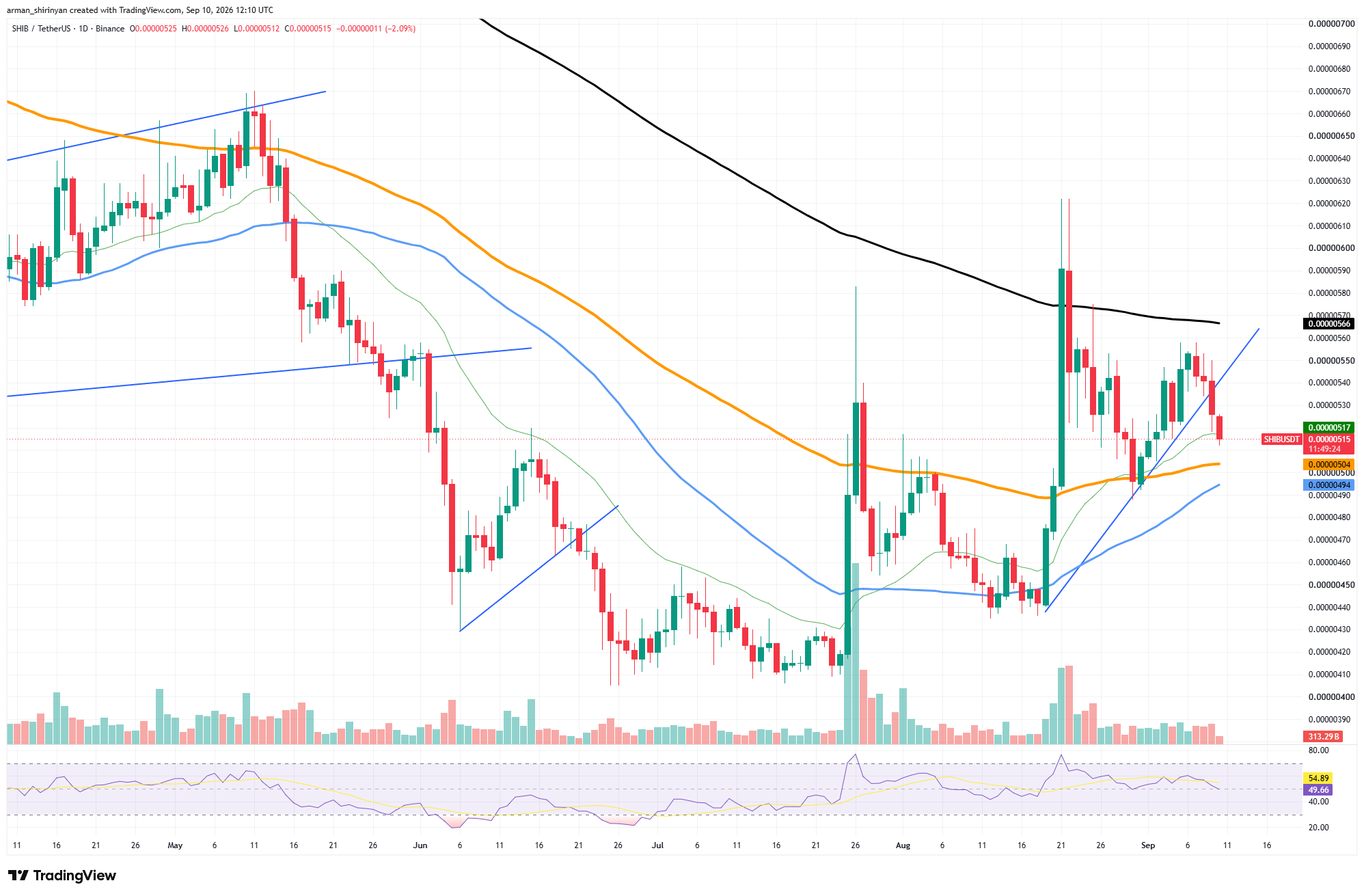
$SHIB is currently down about 2% and is trading close to $0.00000515. More significantly, the token has broken below the short-term rising trendline that helped it recover from the low in August. Around $0.00000517, the price is currently testing the 20-day moving average.
Next key support
The next significant support cluster is formed by the 50-day average around $0.00000494 and the 100-day average around $0.00000504. Moreover, momentum has declined. The RSI has dropped to about 49.7, returning to neutral territory and below its signal average.
Recovering $0.00000540–$0.00000550 would repair a portion of the short-term structure for bulls. The 200-day moving average around $0.00000566 continues to be the biggest barrier.
Therefore, the 468 billion $SHIB inflow figure merits consideration; however, the more comprehensive exchange data does not yet support significant selling. The more pressing issue is price: $SHIB is currently testing whether its moving-average support can stop a deeper retracement after losing its rising trendline.

 u.today