
 invezz.com
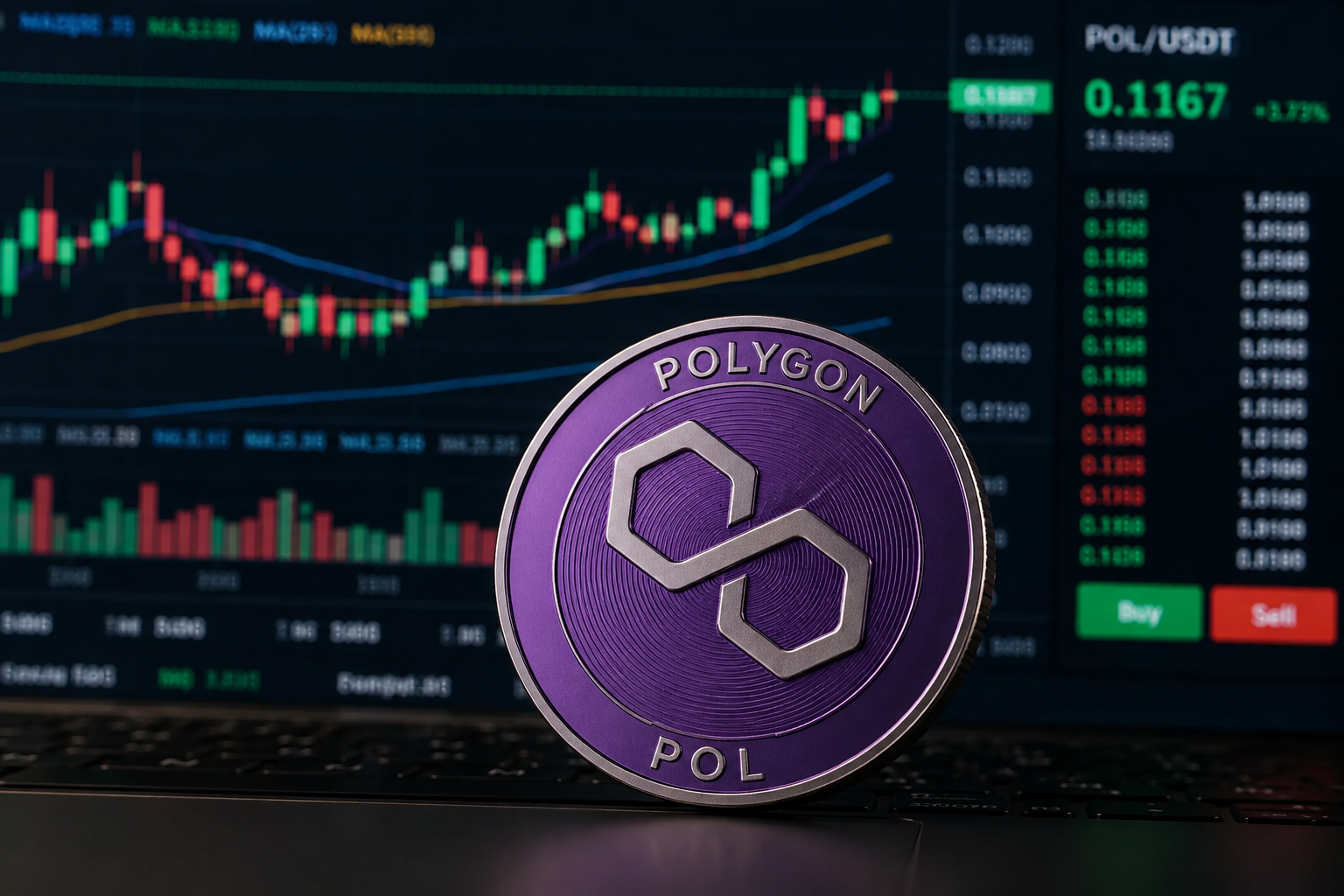
$POL has rallied more than 50% over the past seven days, finally breaking out of the multi-month consolidation range that had kept the Polygon token pinned near its 2026 lows.
The token was trading around $0.12 on Aug. 25 after rising from roughly $0.08 a week earlier.
The latest leg of the rally pushed $POL above the $0.09-$0.10 region that had repeatedly capped its recovery since June, while trading activity increased sharply during the breakout.
Part of the move has come from a broader recovery across the crypto market.
Bitcoin climbed from around $65,000 before the latest rally to a three-month high above $79,000 on Aug. 21, triggering billions of dollars in short liquidations as bearish positions were forced out of the market.
That move provided a favorable backdrop for higher-beta altcoins, with $POL responding more aggressively after months of depressed prices.
An earlier stage of $POL's breakout was also accompanied by short covering as the wider crypto market rallied.
However, Polygon-specific developments have added another source of demand behind the move.
Polygon co-founder Sandeep Nailwal disclosed plans for a major overhaul of $POL staking and tokenomics following community requests.
The proposal would introduce native staking directly on Polygon PoS alongside the existing Ethereum staking setup and route transaction priority fees to $POL stakers.
The changes could nearly double staking rewards, with much of the additional yield coming from network fees rather than additional token inflation.
Other incentives under consideration include gas discounts for $POL stakers, while sPOL would allow staked tokens to remain liquid and participate in DeFi.
The proposal comes as Polygon's network economics have improved. Nailwal said Polygon's revenue had increased tenfold this year, while the network had reached roughly 5,000 transactions per second and cut block times by 25%.
Polygon Labs plans to develop the required code before putting the changes before the community.
Polygon's payments strategy has also provided another catalyst. The network published additional details on Aug. 24 about its Private Mempool and how the system can be used for confidential transaction submission across payments, payroll, settlement, commerce, and trading.
Private Mempool prevents pending transactions from being exposed in the public mempool before confirmation, protecting users from frontrunning and sandwich attacks.
Polygon originally launched the service in April as a private transaction endpoint that can be integrated by changing the transaction submission RPC.
$POL price action
$POL's daily chart shows a decisive change in market structure after the token spent much of June through mid-August trading between roughly $0.07 and $0.085.
The breakout started when $POL cleared $0.085 and accelerated after price moved through the high-volume region around $0.09-$0.093 shown by the Volume Profile Visible Range. See below.
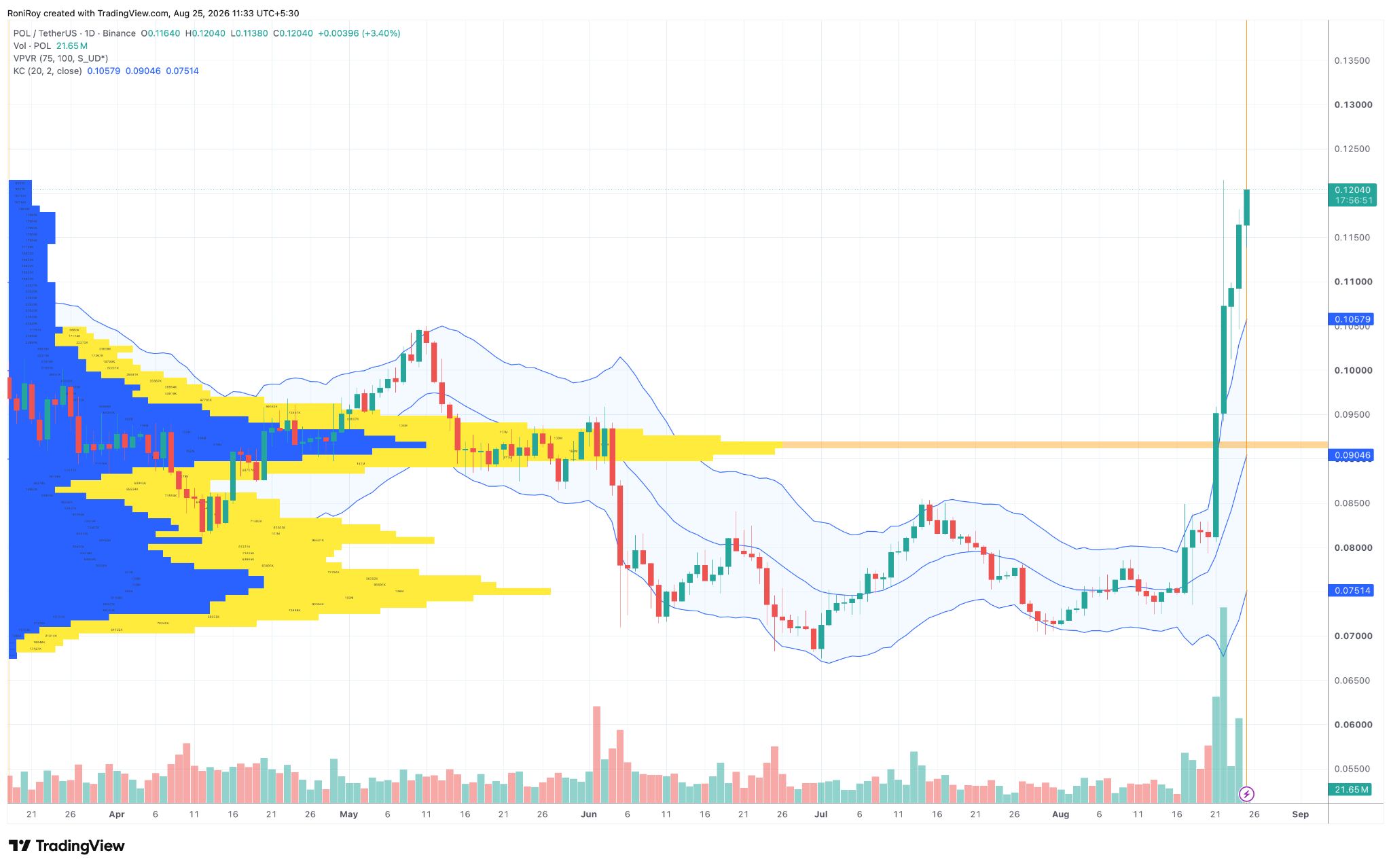
$POL/$USDT 1-day price chart. Source: TradingView.
This area had previously attracted substantial trading activity and acted as resistance during May and June.
$POL is now trading around $0.12, leaving the largest visible volume clusters well below the current price.
The move into a comparatively thin volume area means there is less historical trading activity immediately above price, which could allow the rally to extend quickly if buyers continue to control the market.
The same setup also creates downside risk. If the breakout loses momentum, the lack of substantial volume between the current price and the former value area could produce a sharper retracement.
The $0.105-$0.106 region is the first area to watch, followed by the previous breakout zone around $0.09-$0.093.
Keltner Channels show how stretched the daily move has become. $POL is trading near $0.12 while the upper channel sits around $0.1058, putting price substantially above the upper boundary.
The channel midpoint is near $0.0905 and the lower band around $0.0751.
A move this far outside the upper Keltner Channel confirms unusually strong upside momentum, but it also leaves $POL extended from its short-term mean.
Holding above $0.105 could keep the breakout intact, while a return inside the channel would increase the chances of consolidation before another attempt higher.
The 4-hour chart remains bullish despite the stretched daily setup as Supertrend sits around $0.103, well below the current price, and remains in bullish territory. See below.
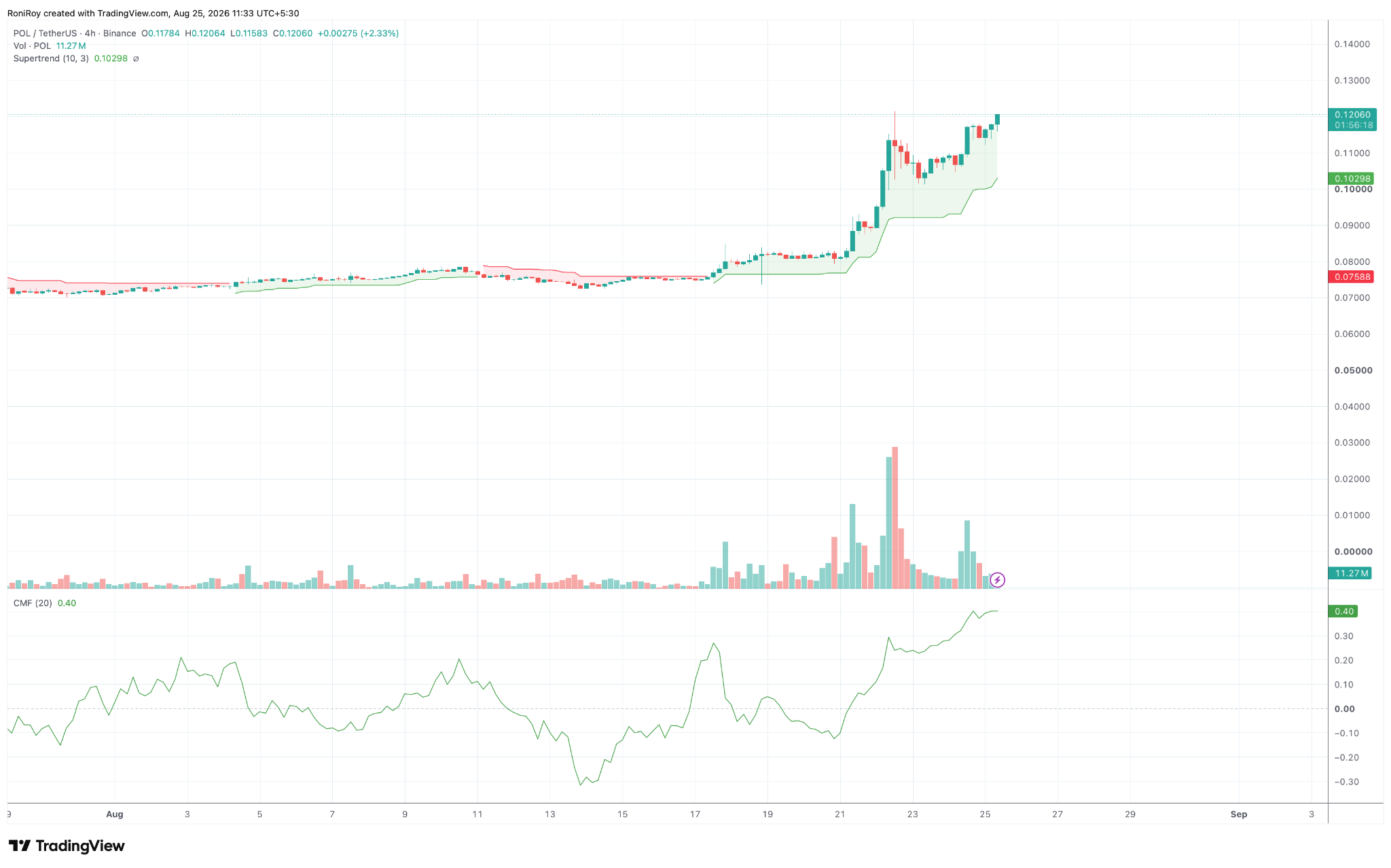
$POL/$USDT 4-hour price chart. Source: TradingView.
$POL has also continued producing higher highs and higher lows since its Aug. 21 breakout.
As long as price stays above the $0.103-$0.105 region, the shorter-term trend remains favorable for buyers.
The 4-hour CMF has climbed to around 0.40, well above the zero line. This shows strong buying pressure, with money continuing to flow into $POL as the price rallied.
$POL is now testing the $0.12-$0.121 area. A sustained breakout above this zone could open a move toward $0.125, followed by $0.13. If momentum remains strong, $0.135-$0.14 becomes the next higher technical area to watch.
Failure to hold the breakout would put $0.105-$0.103 back in focus as the first meaningful support zone.
A deeper correction could retest $0.095 and eventually the high-volume $0.09-$0.093 region, which now represents the most important support for the wider breakout structure.