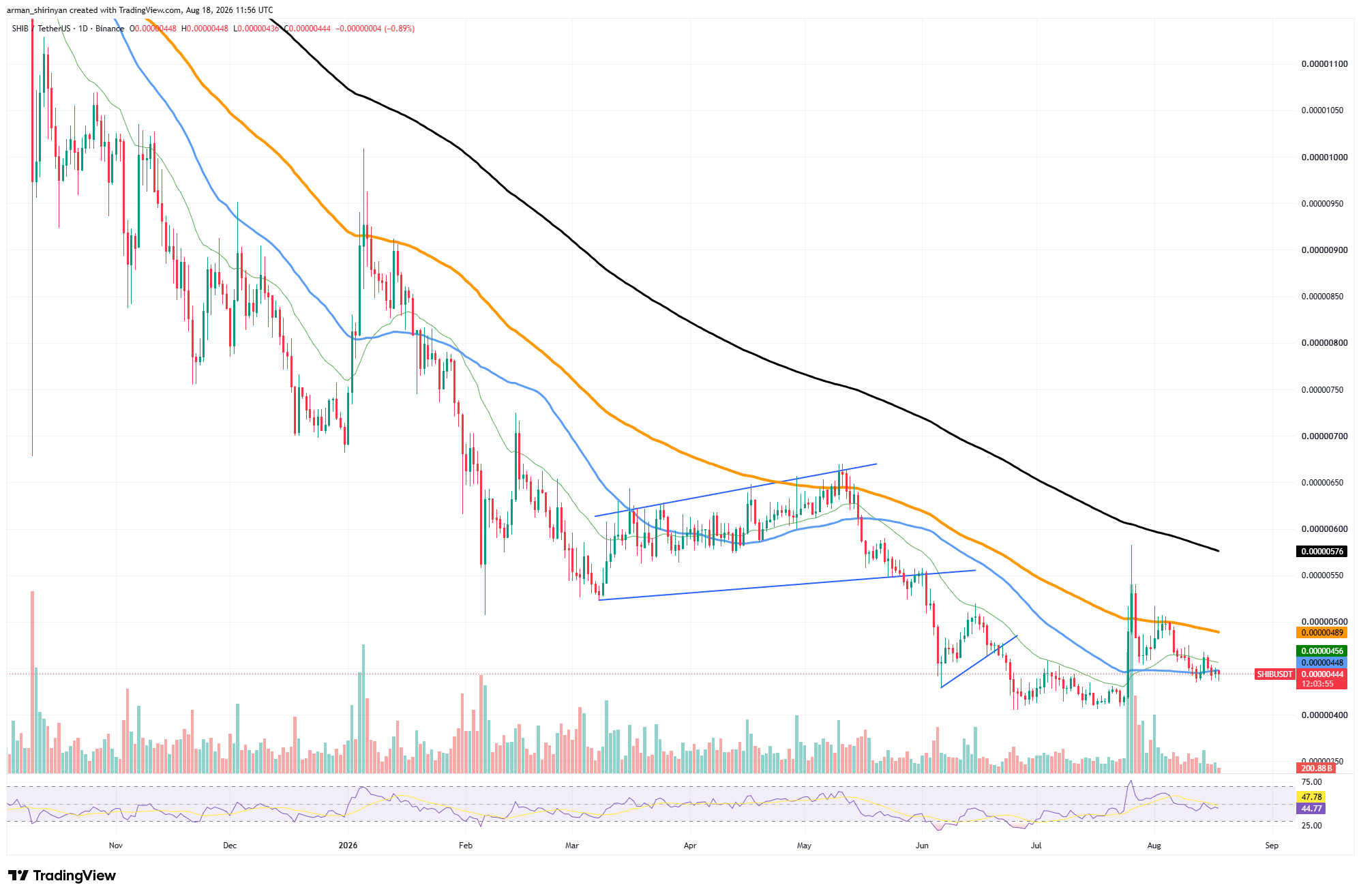
Thus, a contraction of 66.52% shows that this potential source of supply reduction has become much weaker. The situation is less clear-cut, though, due to the wider exchange data. At the same time, exchange inflow decreased by 40.42 percent to about 935.48 million $SHIB.
Put differently, there was a decline in activity in both directions. While aggregate netflow stayed negative at about -49.82 billion $SHIB, total exchange reserves also slightly decreased by 0.06%. That's an important distinction. The 66% decrease in outflow does not imply that 66% more $SHIB is now on the market. It mainly demonstrates that, in comparison to the prior measurement, the average withdrawal pace has collapsed.
Inflows stay modest
There is no evidence of an immediate large-scale migration of $SHIB onto exchanges, as inflows are also significantly declining and reserves are not growing. However, price action is still lacking. After losing about 1% for the day, $SHIB is currently trading at $0.00000443. It is still below its short-term moving averages at $0.00000448–$0.00000456, with $0.00000489 serving as stronger resistance.
At $0.00000576, the long-term moving average is still much higher. The neutral-to-bearish picture is reinforced by an RSI close to 44, which does not signify extremely oversold conditions. The immediate technical challenge for $SHIB is still to recover $0.0000045–$0.0000046.
A more significant recovery signal would be given by a move above $0.0000049. On the other hand, $SHIB might return to the $0.0000041–$0.0000042 support area in the event of another rejection. One potentially bullish exchange dynamic is eliminated by the 66.52 percent outflow collapse, but this does not necessarily mean that selling is accelerating. For the time being, it mainly indicates a significant slowdown in token movement while $SHIB is still stuck close to its most recent lows.

 u.today