Crypto loans decline 16% in Q2 – Is the lending market resetting?
ambcrypto.com
17 August 2026 23:02, UTC
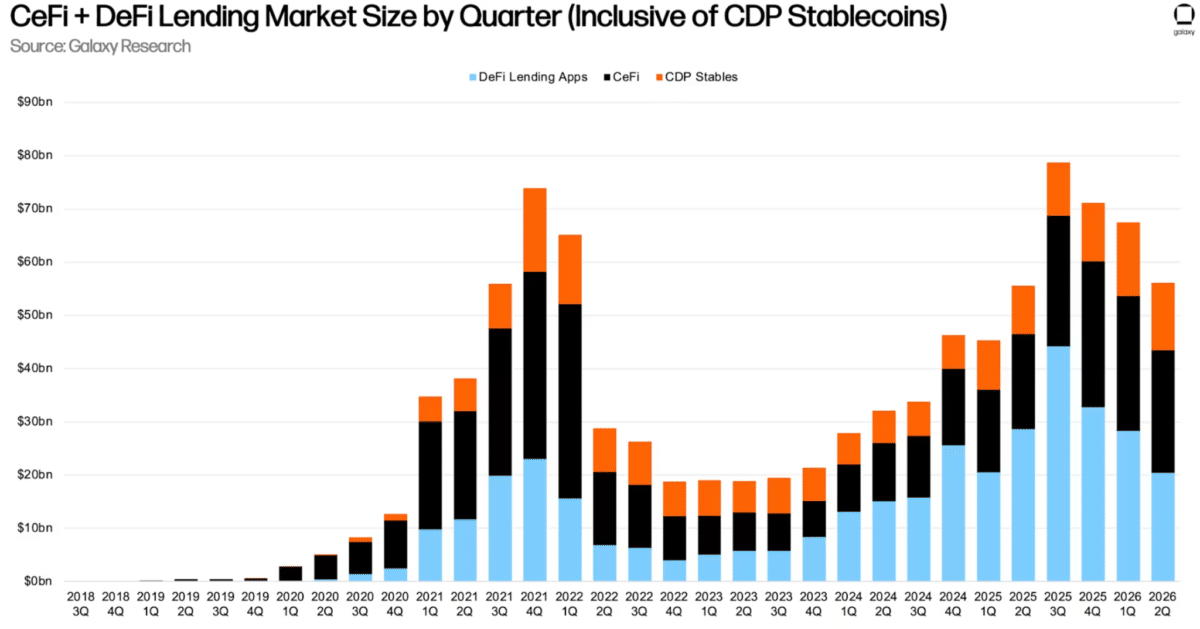
Crypto lending is undergoing a reset as borrowers are reducing their exposure against collapsing markets. According to a report by Galaxy Research, that trend was apparent in Q2 with all categories of lending down collectively for the first time since 2022.
Total crypto-collateralized loans fell 16.78%, shedding $11.33 billion to reach $56.16 billion. Notably, the current total represents a decline of 40.13% compared with its peak of $78.69 billion, indicating the interest in borrowing has decreased significantly.
Source: Galaxy Research
Know when your coins move
Alerts, real-time prices, and market news — all in one app
Point your phone camera to install
4.8 based on 40K reviews in the App Store and Google Play
DeFi shows this transition even more clearly. Outstanding loan amounts were at $21.94 billion in July after having dropped from $47.13 billion in April. Still, that trend differs greatly from 2025, when DeFi lending decreased by over 80%.
Therefore, borrowing continues to decline in phases, even amid market stress and the $200 million rsETH exploit. Therefore, the sector is deleveraging through reduced credit demand rather than widespread liquidation, leaving a smaller but more orderly lending market.
Stablecoin volume reveals lending activity
That lending contraction becomes more significant when looking at how stablecoins are actually moving through crypto markets.
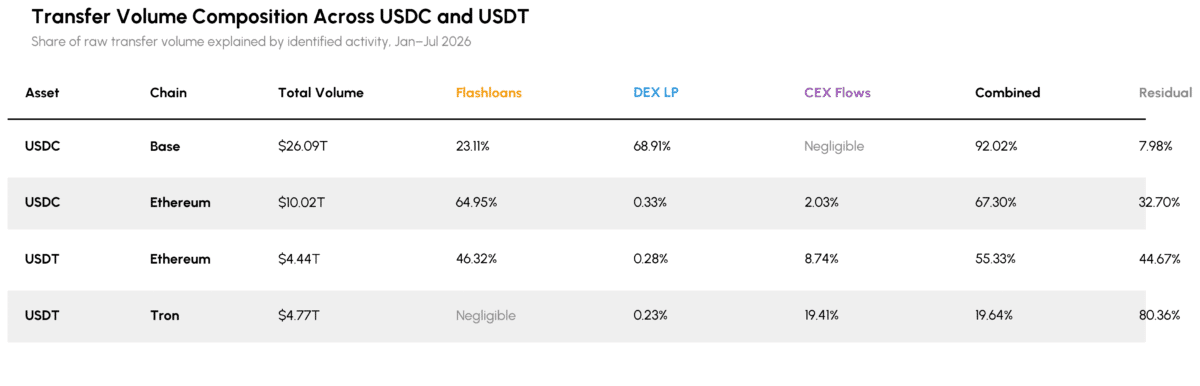
With fewer outstanding loans, stablecoins have been used for an estimated $41.7 trillion in adjusted transfers on their respective exchanges for 2026, led by USD Coin [$USDC].
However, much of this movement still comes from lending and liquidity operations rather than payments. Flash loans account for approximately 65% of all $USDC volume traded on the Ethereum [ETH] blockchain.
Therefore, stablecoin trading is significantly tied to auto-borrowing transactions.
Source: Coinmetrics
Although Base exhibits similar financial uses, 68.91% come from DEX liquidity rebalancing, while 23.11% come from flash loans.
In fact, it’s worth noting that falling loan balances do not mean lending infrastructure is becoming inactive. Instead, stablecoins continue circulating heavily through short-term borrowing and liquidity strategies, even as longer-term leverage contracts.
DeFi loan demand rebounds
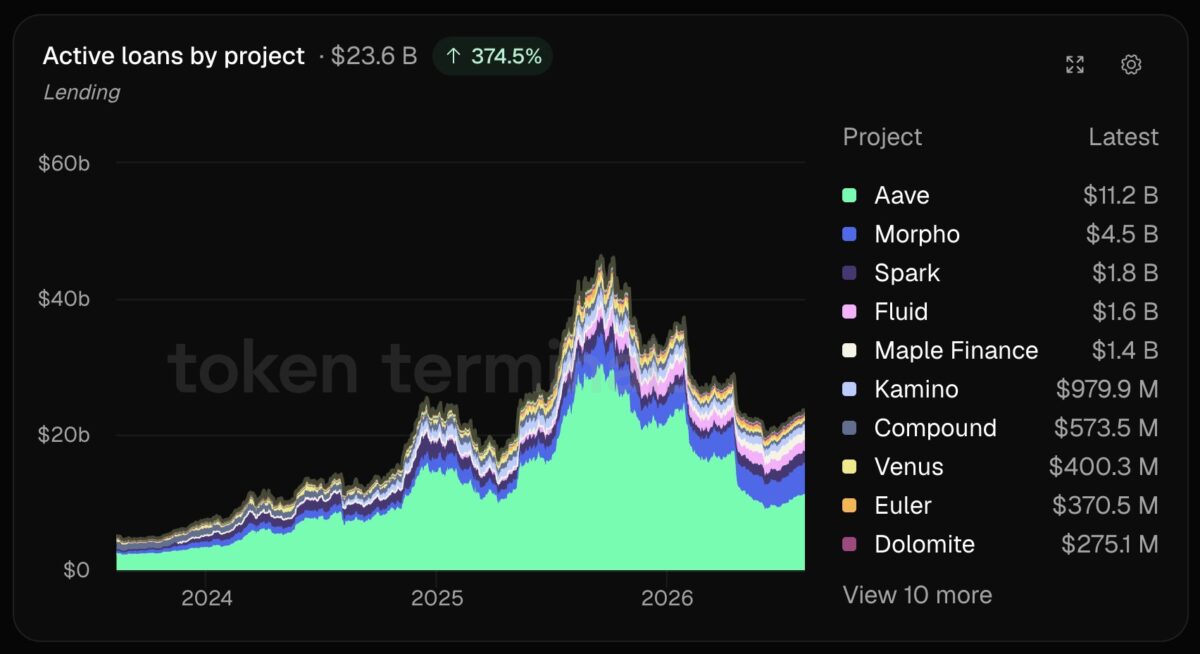
The bigger question is whether heavy lending activity is translating into borrowers taking on more credit. Active DeFi loans stand at $23.6 billion, showing meaningful demand remains despite the broader lending contraction.
However, nearly half sits on Aave [$AAVE], where $11.2 billion represents 47.7% of outstanding loans. This concentration means a recovery in headline lending could still rely much on activity within one protocol.
Source: Token Terminal
Encouragingly, according to Token Terminal data, average monthly lending through $AAVE has increased to $10.3 billion for the first time since it started decreasing. Yet that improvement alone does not confirm broader participation.
That being said, if borrower numbers rise alongside outstanding credit, lending demand is widening. However, with 47.7% of active loans concentrated on Aave, the recovery remains concentrated rather than equally distributed.
Final Summary
Crypto lending is deleveraging, while $USDC activity shows liquidity remains active.

 ambcrypto.com