
 invezz.com

Avalanche has rallied more than 7% over the past 24 hours after Kenya launched a blockchain-based academic certificate verification platform that will secure more than 30 million education records on the Avalanche network.
According to an announcement from Ava Labs, the Kenya National Examinations Council (KNEC) has introduced a nationwide digital credential verification system built on Avalanche, placing between 30 million and 35 million historical academic records on-chain.
The rollout also covers examination records dating back to 1989, while nearly one million students each year are expected to receive blockchain-backed digital certificates beginning with the 2025–2026 graduating classes.
The development has attracted attention because it represents one of the largest government-backed blockchain deployments announced to date.
Investors responded by pushing $AVAX above $6.88 during Tuesday's session, extending its daily gain to roughly 7% after the token traded near $6.40 a day earlier.
Kenya moves academic records onto Avalanche
Working with Ava Labs, KNEC has developed an electronic certificate verification platform designed to replace slow, paper-based authentication procedures with blockchain-backed digital verification.
Historical examination records dating back more than three decades have already been digitized and anchored to Avalanche.
Once uploaded, every credential receives a cryptographic record that can be verified without altering the original data.
Employers, universities, scholarship providers and credential verification agencies can validate certificates almost instantly instead of contacting educational institutions individually, a process that has often taken days or weeks.
KNEC said the platform also addresses a longstanding problem of forged academic certificates.
Because records written to the blockchain cannot be modified without detection, altered grades and fabricated qualifications become significantly more difficult to present as genuine.
Rather than serving only future graduates, the initiative also digitises decades of legacy examination records, giving former students access to verifiable credentials without relying solely on physical documents.
Beginning with graduates from the 2025–2026 academic period, roughly one million new candidates each year are expected to receive native digital credentials issued through the system.
Why the announcement matters for Avalanche
Beyond the immediate use case, the rollout gives Avalanche another real-world application supported by a government institution.
Public-sector blockchain projects remain relatively uncommon compared with decentralized finance or gaming applications.
The KNEC deployment therefore adds an institutional example of blockchain infrastructure operating outside traditional crypto markets.
Ava Labs said the platform runs on Avalanche's C-Chain, allowing the system to leverage the network's Ethereum-compatible infrastructure while maintaining immutable records for long-term verification.
Market participants often treat government-backed blockchain implementations as evidence that distributed ledger technology is finding practical uses outside speculative trading.
While such announcements do not directly determine token prices, they can influence investor sentiment by demonstrating continued institutional adoption.
During most of the previous 24 hours, $AVAX traded within a relatively narrow range before buyers entered aggressively as news surrounding the deployment gained wider attention.
The token climbed from around $6.40 to nearly $6.90 in a sharp upward move, with trading volume also increasing during the breakout.
After reaching the intraday high, the price remained close to those levels instead of giving back most of the gains, indicating buyers continued supporting the rally.
Holding gains following a news-driven breakout is often watched by traders because it suggests demand persists after the initial reaction.
In $AVAX's case, the market continued trading around the new range near $6.85–$6.90 through the latest session.
The rally also arrives after $AVAX has spent much of the past several months below key long-term moving averages, making the latest breakout one of its stronger short-term recoveries in recent weeks.
$AVAX price analysis
The daily chart shows Avalanche strengthening its short-term trend after reclaiming both the 20-day and 50-day exponential moving averages.
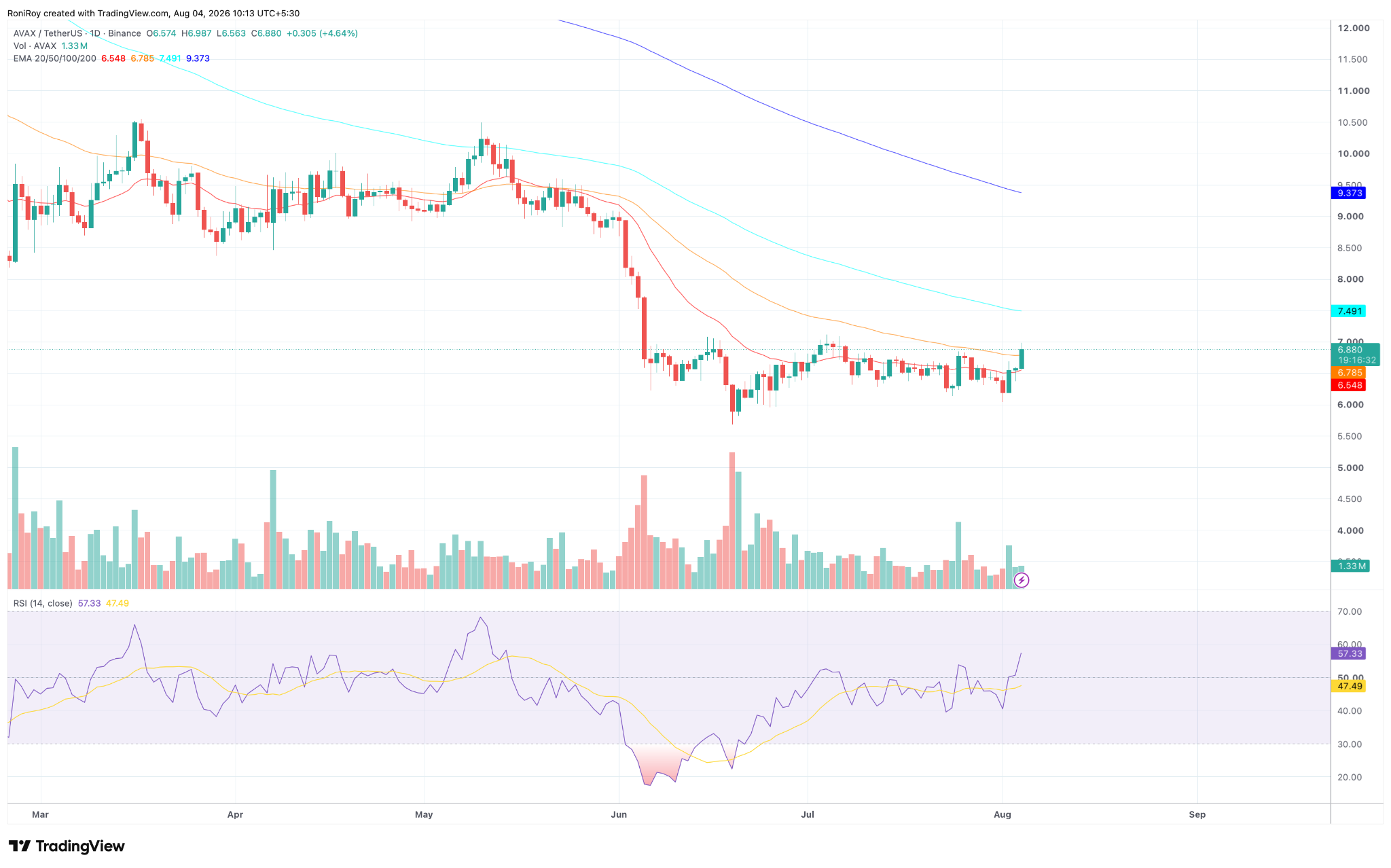
$AVAX/$USDT 1-day price chart. Source: TradingView.
At the time of publication, the 20 EMA sits near $6.55, while the 50 EMA is around $6.79. Price has moved above both averages, indicating improving momentum following weeks of range-bound trading.
The Relative Strength Index has climbed to approximately 57, moving above its signal line while remaining below the overbought threshold of 70.
The indicator suggests buying momentum has improved without yet reaching levels typically associated with an overheated market.
The longer-term trend, however, has not fully turned bullish. $AVAX continues to trade below the 100-day EMA near $7.49 and the 200-day EMA around $9.37, leaving those levels as the next major technical barriers if buying pressure continues.
The 4-hour chart supports the improving short-term outlook as price has broken above the 20-period volume-weighted moving average, while the Moving Average Convergence Divergence indicator has produced a bullish crossover.
See below:
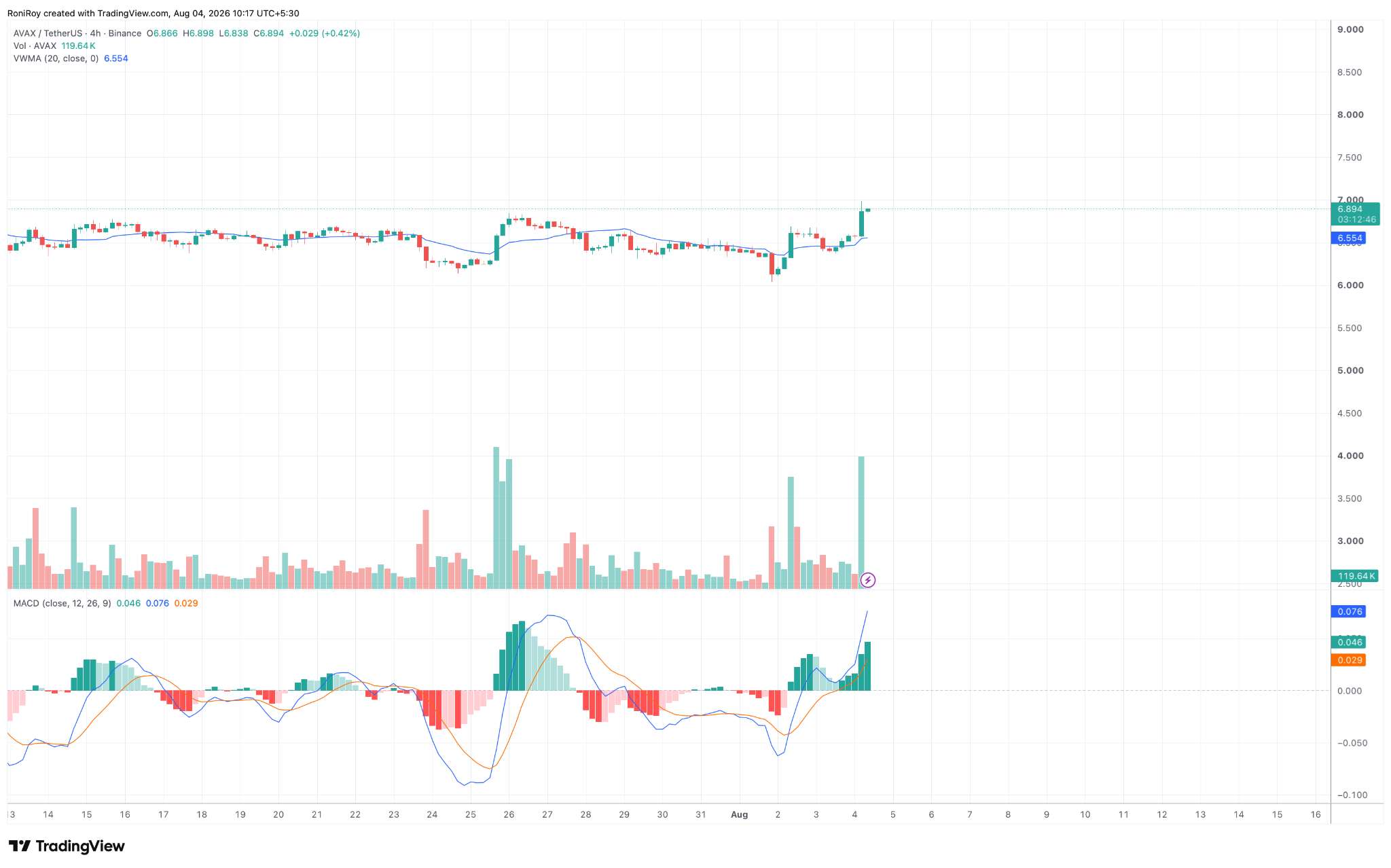
$AVAX/$USDT 4-hour price chart. Source: TradingView.
The MACD line remains above the signal line, and the expanding positive histogram indicates strengthening upside momentum over the shorter timeframe.
Volume also increased alongside the breakout, adding confirmation that the latest advance attracted active participation rather than occurring on thin trading.
As long as $AVAX remains above the $6.75–$6.80 region, the recent breakout structure remains intact.
The first resistance lies near the $7.00 psychological level, followed by the 100-day EMA around $7.49, where sellers could become more active.
A move above that level would strengthen the technical picture and could open the path toward higher resistance levels, although the 200-day EMA near $9.37 continues to represent the dominant longer-term hurdle.
On the downside, losing the 20-day EMA around $6.55 would weaken the current recovery and place recent gains under pressure.