Additionally, exchange reserves stayed essentially unchanged at about 87.26 trillion $SHIB during the period, indicating that exchanges are not building up noticeably larger balances despite the increased transfer activity. Reserves would probably start trending noticeably higher over a few sessions rather than staying flat if investors were racing to sell their positions. The network's overall activity has also somewhat improved.
Over the previous day, active sending addresses increased by 0.79% and active receiving addresses increased by 0.83%. Instead of a decline in user engagement, this indicates steady participation on the network.
Breaking out of the trend
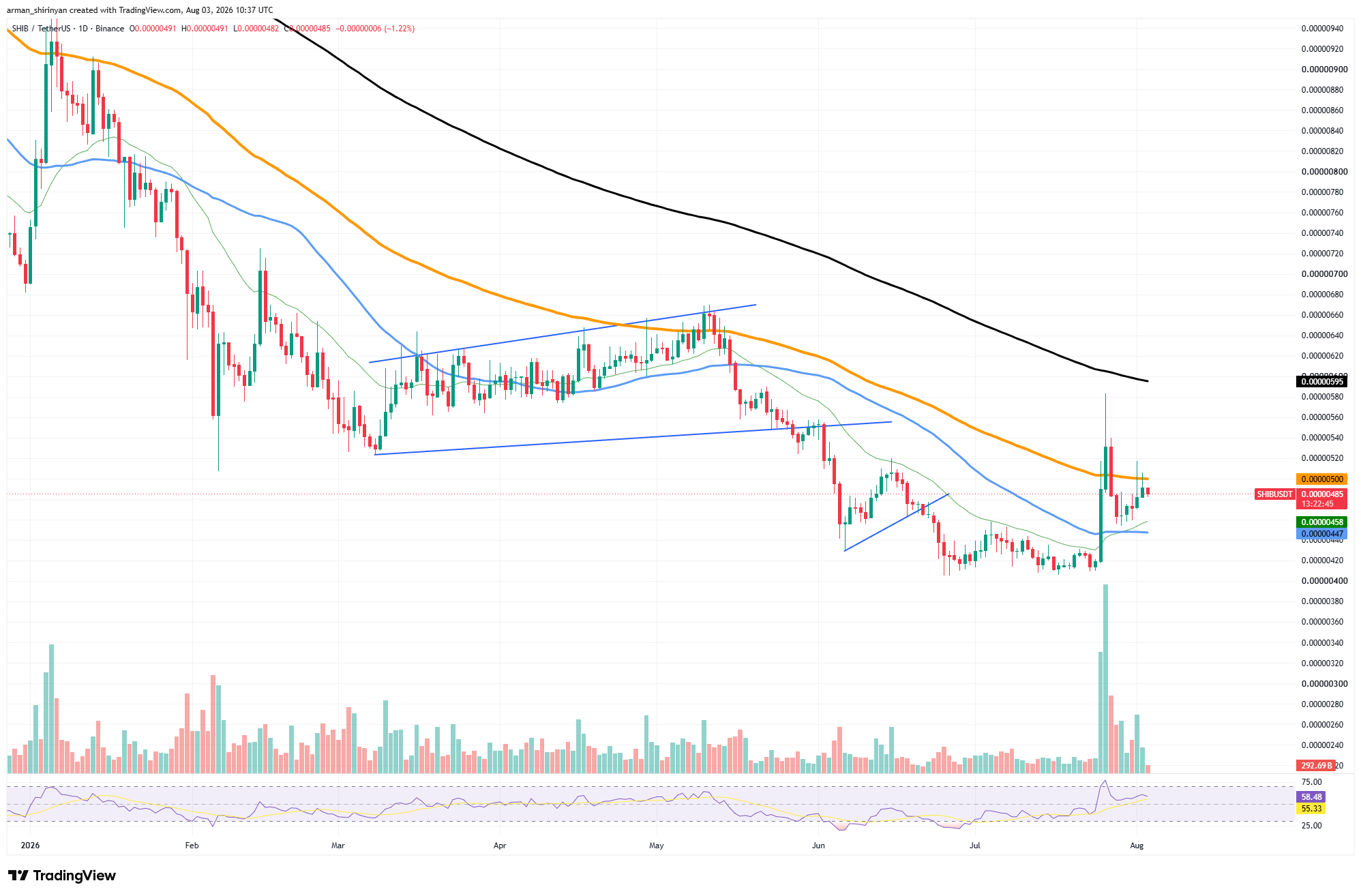
Supported by a spike in trading volume, $SHIB recently broke out of a protracted downtrend, but the rally soon lost steam after encountering resistance close to the 200-day moving average. Since then, the token has stabilized at $0.00000485, just below the 100-day EMA, with the 50-day EMA still offering close support.
card
After reaching overbought territory during the breakout, the Relative Strength Index has cooled to about 58. This suggests that the market is in a consolidation phase, as buying pressure has decreased without becoming overtly bearish. The next major goal for bulls is still to recover the 200-day moving average at $0.0000050.
The argument that the recent breakout has legs would be strengthened by a successful move above that threshold. On the other hand, a deeper decline toward the $0.0000045 area could result from losing support close to the 50-day EMA. All things considered, the most recent 251 billion $SHIB exchange inflow should not be interpreted as investors giving up on the asset.
The data suggests increased repositioning rather than a widespread wave of selling, because inflows and outflows are still roughly balanced and exchange reserves have hardly changed. As they await $SHIB's next significant move, traders seem to be modifying their exposure for the time being.

 u.today