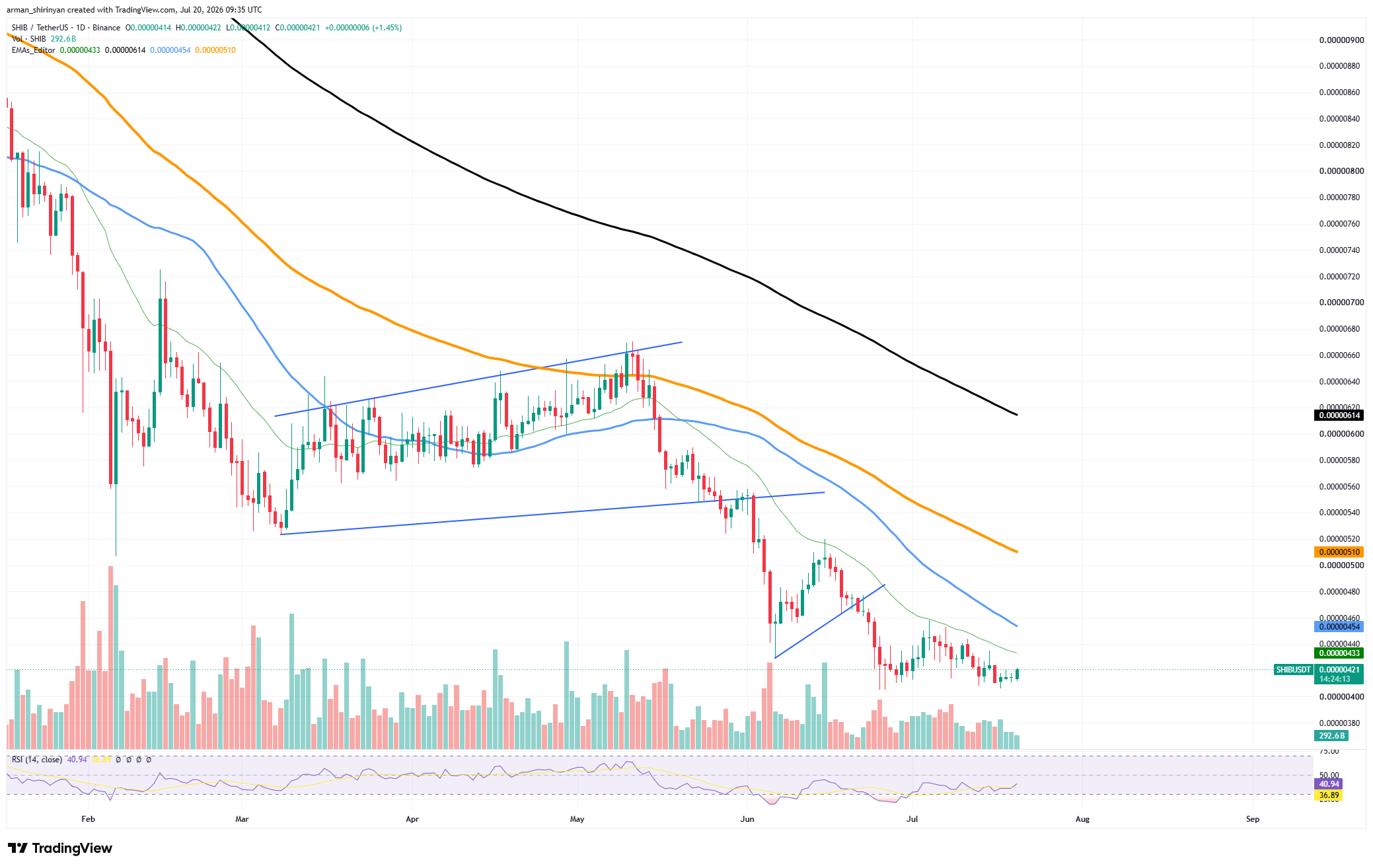
Even though a single day of high inflows does not always indicate a market downturn, it frequently indicates that investors are getting ready for more trading. Large holders frequently transfer assets to exchanges prior to taking profits, especially when the price gets close to significant resistance levels. The timing of the inflow spike is particularly intriguing. $SHIB is currently trading close to $0.0000114 following weeks of persistent bearish pressure.
The asset is still far below its major moving averages, and the first significant barrier is the 50-day EMA at $0.0000118. The 100-day and 200-day moving averages continue to support the overall downward trend above that. Following a protracted decline, the chart indicates that $SHIB recently stabilized, establishing a short-term base around the $0.0000110 area. Additionally, momentum indicators have started to rebound from oversold conditions.
Selling pressure may not be as strong as it was in June and early July, as indicated by the RSI's return to above 40. Bulls now have to overcome a challenging obstacle, though. Any attempt at a recovery will probably run into resistance close to the 50-day EMA, where sellers have frequently reclaimed control over the previous few months.
Exchange reservers are descending
Because more supply might become available just when $SHIB reaches that technical barrier, the rise in exchange inflows creates an additional degree of uncertainty. The fact that exchange reserves are still trending downward over the long run is one positive development, suggesting that the general accumulation trend has not entirely vanished.
However, compared to longer-term reserve dynamics, short-term flows frequently have a greater influence on immediate price action. As of right now, $SHIB seems to be getting close to its first significant resistance test.
When the asset challenges the $0.0000118-$0.0000120 area in the upcoming sessions, it will probably become evident whether the recent 160 billion $SHIB deposited onto exchanges represents preparation for profit-taking or simply repositioning ahead of volatility.

 u.today