The new motto of the blockchain is “Built by many, owned by all.”
Founder Charles Hoskinson called it the final push of the Voltaire era, the governance and decentralization phase Cardano has been building toward since 2024. "Our partners are ready, and the ecosystem now has many diverse options," he said in the IOGroup announcement.
Cardano's protocol and governance are already decentralized. Now its engineering is too.
“The last stage of the Voltaire era is full decentralization of node and reference blueprint development. Since 2024, IOG and its partners have carefully managed a process that will conclude… pic.twitter.com/zCCgu6ahco
— Input Output Group (@IOGroup) July 17, 2026
Tomorrow—July 18 at 21:44 UTC—the Van Rossem hard fork goes live on mainnet. Ratified on July 13 with 77.63% approval from delegated community representatives, the upgrade takes Cardano to Protocol Version 11 and introduces new Plutus built-in functions designed to cut smart contract execution costs.
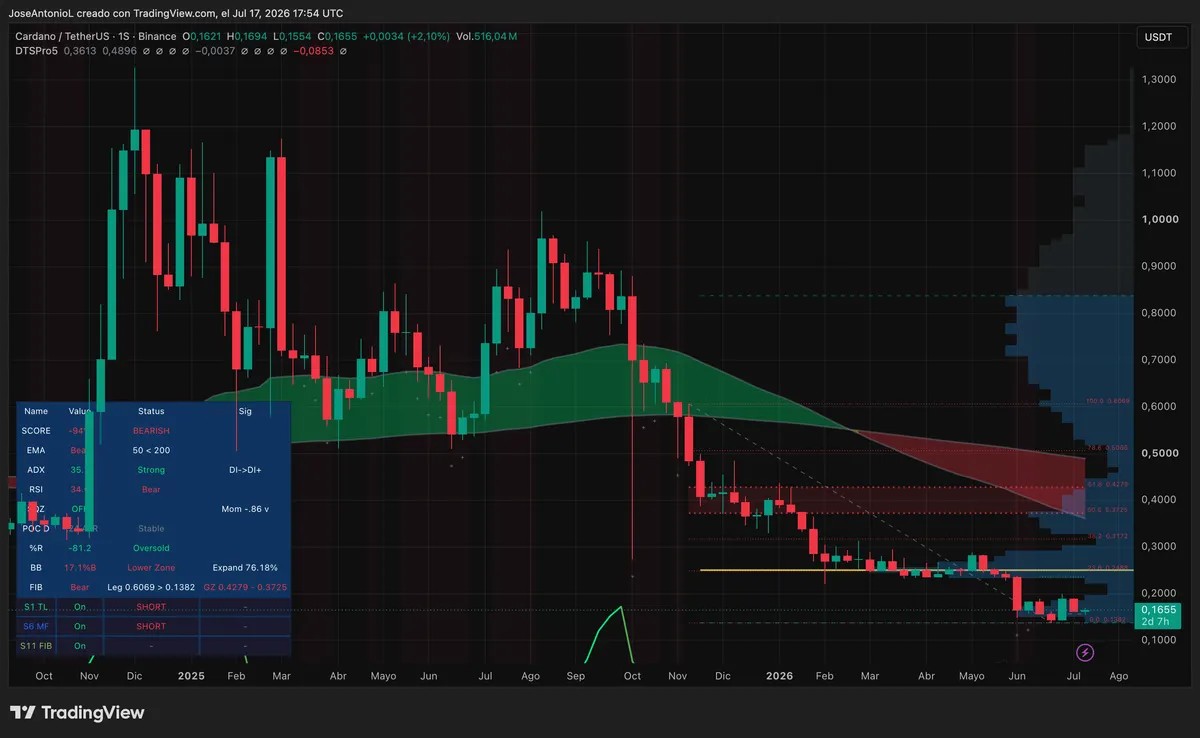
Cardano, which trades as $ADA, is up about 2% on the day, trading near $0.165, at $6 billion market capitalization. Open interest in $ADA futures sits around $193 million, with a long-to-short ratio of 2.84, meaning most traders are still betting on a spike.
For Input Output, the handover closes a chapter. The company will shift focus to research and new ventures through IO Labs and IO Ventures, leaving the community to prove whether a decentralized engineering model can move faster than the one it's replacing.
Should you buy the dip?
Based purely on the charts, probably not on impulse. $ADA hasn't come close to matching its 2024 highs near $1.20, and the charts aren't encouraging: The coin has been grinding lower since August 2025, with the 50-week exponential moving average below the 200-week.
The Relative Strength Index, or RSI, is sitting at 34. RSI measures momentum on a scale from 0 to 100, where above 70 is overbought and below 30 is oversold. The ADX, or Average Directional Index, measures trend direction and it’s pointing at a strong bearish long-term trend. Buying here is a leap of faith, not a conviction trade.
That said, $ADA has surprised traders before. If Van Rossem delivers on its cost-reduction promise, Leios arrives on schedule, and decentralized engineering turns out to be more productive than the status quo, those holding at 16 cents could be looking at serious upside.
Disclaimer
The views and opinions expressed by the author are for informational purposes only and do not constitute financial, investment, or other advice.

 decrypt.co