
 coinedition.com

Michigan inflation cooled and helped U.S. stocks recover late Friday, but pressure in tech stocks kept risk assets under stress. Bitcoin and Ethereum also remained weak as traders watched key levels after a chip-led sell-off reached crypto markets.
The late recovery followed the University of Michigan survey. The report showed consumers expect inflation at 3.3% over the next five to 10 years, down from the prior 3.4% reading.
Michigan Inflation Eases Pressure as Tech Stocks Slide
The lower Michigan inflation figure helped ease part of the market pressure. It reduced some concern that inflation expectations could keep rate-hike fears active.
However, Ash Crypto said in an X post that $780 billion entered the U.S. stock market in the last 45 minutes. The move came after Michigan inflation expectations arrived lower than expected.
$780,000,000,000 added to the US stock market in last 45 minutes as Michigan 5Y inflation expectations came lower than expected.
— Ash Crypto (@AshCrypto) June 26, 2026
Massive reversal. https://t.co/Fhv2TOWHcK pic.twitter.com/FbELGCR8Hj
The late buying helped the S&P 500 turn slightly higher Friday. Still, the index headed for a weekly loss of more than 1%. The Nasdaq faced more pressure than the broader market. It moved toward a weekly decline of about 4%, while the Dow paced for a weekly gain of 0.6%.
Tech stocks remained the main source of market stress. The Nasdaq dropped more than 1% during the session, while the semiconductor index fell nearly 8%. The chip-sector decline followed overnight weakness in Asian semiconductor shares. The selling then spread into U.S. chip names and AI-linked stocks.
A New York Times report added more pressure. It said OpenAI considered delaying its IPO to next year because of SpaceX’s poor performance after its debut and volatility in AI-related shares. The report raised concerns about funding conditions for AI companies. Investors have watched whether large infrastructure spending plans could continue during weaker market conditions. JPMorgan, in a note cited by CNBC, said the possible delay raised concerns about the sustainability of infrastructure spending. The concern focused on delayed funding from capital markets.
SoftBank Group led the sell-off in Asia. The OpenAI backer plunged more than 12% Friday as AI-related concerns moved across regions. The weakness in tech stocks did not come from one data point alone. Traders reacted to chip losses, AI funding concerns, and pressure across high-growth shares.
Tech Stock Weakness Pushes Bitcoin Toward Support
However, in an X post,The Kobeissi Letter said many tech stocks had fallen sharply from record highs, while the S&P 500 did not reflect the full weakness.
The post cited Coinbase down 69%, Oracle and Salesforce down 57%, Microsoft down 37%, Meta down 32%, Nvidia and Amazon down 19%, and Apple down 14%.
Most people do not realize how many tech giants are already deep bear market territory.
— The Kobeissi Letter (@KobeissiLetter) June 26, 2026
Tech Stocks From Record Highs:
1. Coinbase, $COIN: -69%
2. Oracle, $ORCL: -57%
3. Salesforce, $CRM: -57%
4. ServiceNow, $NOW: -56%
5. Netflix, $NFLX: -48%
6. Palantir, $PLTR: -48%
7.…
However, Bitcoin weakened as the tech-led sell-off pushed traders away from risk assets. $BTC fell to about $58,300 during the worst of the selling. The token later rebounded toward $60,000 as U.S. stocks trimmed earlier losses.
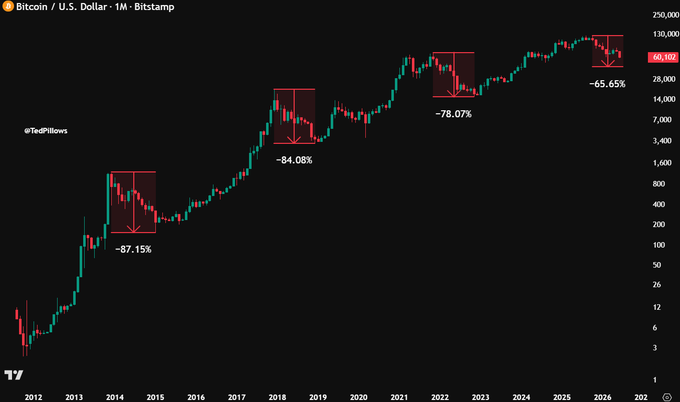
The recovery showed that buyers stepped in near the lows. Still, Bitcoin remained under pressure because traders continued to watch the $59,000 to $60,000 area. Analyst Ted said in an X post that Bitcoin reached past cycle bottoms after deeper drawdowns.
He cited declines of 87% in 2015, 84% in 2018, and 78% in 2022. Ted argued that Bitcoin may need a 60% to 65% decline before a full bottom forms. He placed possible support in the low $40,000s if $59,000 breaks.
Source: X
He also highlighted two short-side liquidity clusters for Bitcoin. Ted placed them around $62,000 and $63,500. Analysts said Bitcoin could take out both levels before continuing the downtrend.
Bitcoin and Ethereum Face Key Technical Tests
However, Fairlead Strategies founder Katie Stockton also pointed to technical risk. She said Bitcoin had failed at its 200-day moving average and sat near a key Fibonacci level.
Stockton said a break of that level could often lead to a full retracement. She added that 75% to 80% drawdowns remain possible. However, Stockton also said Bitcoin looks long-term oversold. She said $BTC needs a few weeks of stabilization before a bottom looks convincing.
However, Ethereum showed weaker relative performance than Bitcoin. $ETH slipped below $1,600 and added to its weekly decline. The move placed more focus on the $1,500 to $1,600 range.
CryptoReviewing said in an X post that Ethereum had not reached a bottom. The analyst said large buy orders sat between $1,580 and $1,500. That range has become a key test for sellers. Strong buying there could slow the decline, while a break lower could deepen pressure.
$ETH bottom isn't in yet.
— CryptoReviewing (@CryptoReviewing) June 26, 2026
Huge buy orders are pending between $1580-$1500.
The real test of Ethereum sellers will start now. pic.twitter.com/SP21wqpg7l
However, Ted highlighted Ethereum liquidity clusters. He placed upside liquidity around $1,700 and $1,600, while downside liquidity sat near $1,500. A move back above $1,600 could improve sentiment, while a fall toward $1,500 could confirm weaker momentum.
The next test for traders is whether tech stocks could stabilize after the chip-led sell-off. Bitcoin needs to hold the $59,000 to $60,000 range. Ethereum must defend the $1,500 to $1,600 zone to avoid deeper selling pressure.
Related: Peter Schiff Says Bitcoin Has Lost 60% Against Gold Since 2021