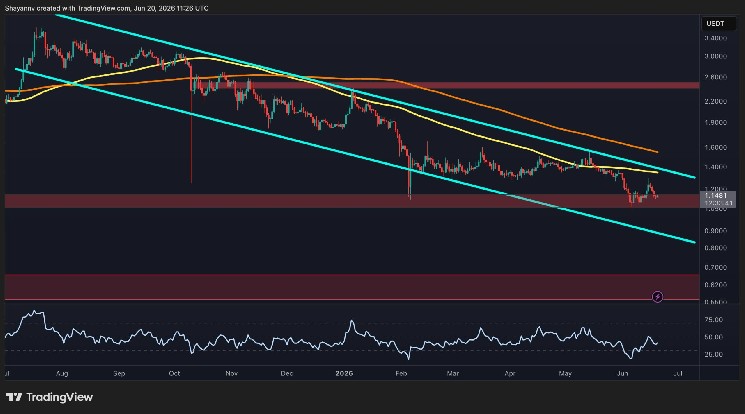
On the upside, $XRP is capped by several layers of resistance. The descending channel’s upper boundary currently coincides with the 100-day moving average near the $1.35 area, while the 200-day moving average is positioned higher around $1.75. Beyond that, the major supply zone at $2.5 remains the key level that buyers would need to reclaim to shift the long-term structure back in their favor.
Meanwhile, overall momentum remains weak. Although the RSI has stabilized above the oversold territory, it has yet to generate the type of bullish divergence or strength typically associated with a sustainable trend reversal.
As long as $XRP remains below the descending channel resistance and the major moving averages, the broader market structure continues to favor sellers despite the recent stabilization.
The $BTC Pair
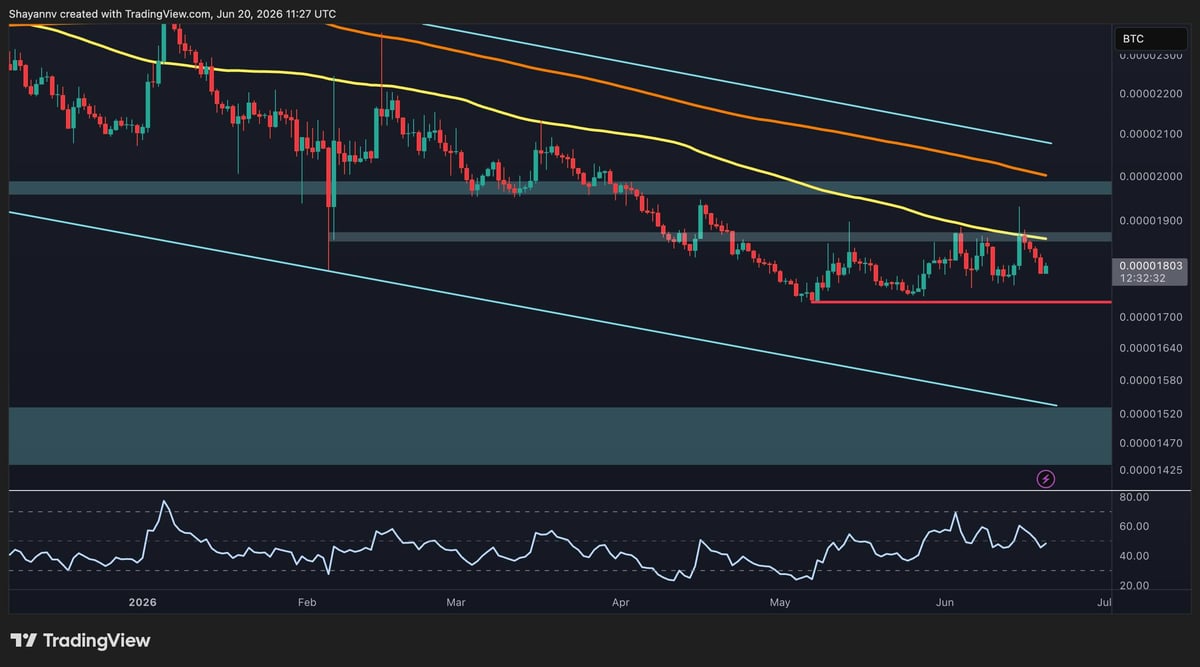
The $BTC pair paints a similarly cautious picture and highlights $XRP’s ongoing relative weakness against Bitcoin. After a prolonged decline within a descending channel, $XRP/$BTC has recently entered a consolidation phase above the key support area around 1,720 SATs. This level has been tested multiple times since May and continues to attract demand, forming the base of the current range.
However, despite holding support, buyers have repeatedly failed to establish a sustained breakout above the nearby resistance zone around 1,850 SATs. This area coincides with the 100-day moving average and has acted as a ceiling throughout June.
If $XRP/$BTC loses the 1,720 SATs support floor, the next major demand area sits considerably lower around 1,500 SATs. Conversely, a successful breakout above the 1,850 SATs level could open the door for a move toward the next resistance region near 2,000 SATs, where additional supply is likely to emerge.
Still, the $BTC pair suggests that $XRP has yet to establish meaningful relative strength, reinforcing the cautious outlook visible on the $USDT chart. Until buyers reclaim the nearby resistance levels and break the broader descending structure, rallies are likely to be viewed as corrective rather than the start of a new bullish trend.

 cryptopotato.com