Most significantly, daily outflow activity stays below the psychologically significant 1 billion $SHIB threshold, which traders frequently monitor for indications of whale-driven or institutional positioning. The current outflow spike appears more like regular wallet management than aggressive accumulation in the absence of sustained transfers that surpass that threshold.
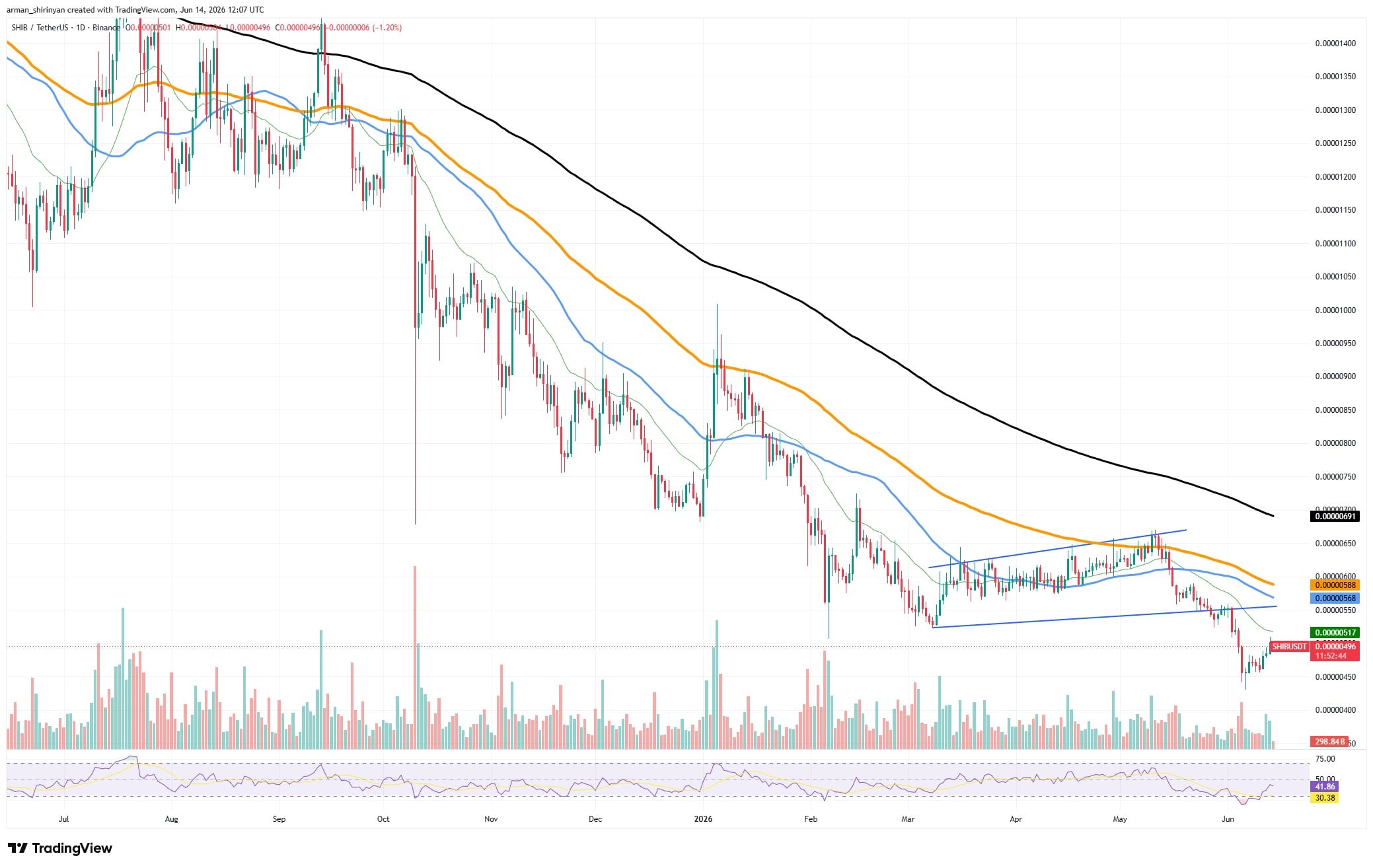
This weakness is reflected in the price chart. A descending wedge structure that had been forming since March was recently broken below by $SHIB. Rather than yielding the anticipated bullish breakout, the asset lost support and continued declining. The token is currently trading below its 50-, 100-, and 200-day moving averages, indicating that bears are still firmly in charge of the overall trend.
Recovery is closer than we think
While this is going on, some underlying network metrics are showing some improvement. Over the last 24 hours, active addresses, active sending addresses, and active receiving addresses have all shown slight increases. Despite the continuous price weakness, these increases imply that network participation has not entirely collapsed. The issue is that, without significant capital flows, activity growth by itself seldom propels price appreciation.
Traders will probably need to witness both a significant decline in exchange reserves and a significant increase in exchange outflows for $SHIB to stage a significant recovery. From a price-action perspective, the current signal is essentially meaningless until outflows regularly surpass the billion-token range and start removing a sizable portion of supply from exchanges.
In other words, although the outflow surge appears promising on paper, the movement's magnitude is currently insufficient to alter $SHIB's bearish trajectory.

 u.today