
 crypto.news

Plasma’s native token $XPL rose by double digits on June 12 as traders moved ahead of next week’s Plasma One card tier launch.
Plasma price rises before card launch
According to crypto.news market data, Plasma traded near $0.0826 on June 12, up about 30% over 24 hours. The move came with a 24-hour trading volume of about $158.27 million and a market cap near $207.55 million.
The token also gained 3.47% over the past seven days. Even with the daily jump, $XPL remained down 14.74% over 30 days, and 47.63% over 180 days.
The rally came as traders focused on the coming launch of tiered memberships for the Plasma One card. The card is tied to Plasma’s stablecoin payments app and is expected to add more direct utility for $XPL holders.
Introducing: Plasma One Tiers.
— Plasma (@Plasma) June 11, 2026
Platinum, Core, and Lite. Live for everyone next week with our launch. pic.twitter.com/8YyTMsAjAK
The market reaction shows that traders are pricing in possible token demand before the feature goes live. The key driver is that higher card tiers are expected to require users to hold or lock $XPL.
Card tiers could create $XPL demand
Plasma One is a stablecoin payments app built around spending, yield, and cashback. The card uses Visa rails and allows users to spend stablecoins in more than 150 countries where Visa cards are accepted.
Plasma’s official site says cashback is paid in $XPL. It also says cashback and yield rates depend on the user’s member tier, which makes the coming tier system important for token demand.
The strongest bullish argument is simple. If users need to lock $XPL for better cashback, yield, or card features, part of the circulating supply may move out of liquid trading.
That setup is similar to older crypto card models, where token holding gave users access to higher rewards. In Plasma’s case, the lockup is separate from the stablecoin spending balance, which keeps $XPL as the reward and access token, while stablecoins remain the payment asset.
Plasma also markets the app as a way to use stablecoins in daily life. The product targets users who want to spend digital dollars, receive cashback, and keep balances active without moving through several platforms.
Derivatives data shows rising speculation
CoinGlass data showed $XPL trading activity rose sharply during the move. Volume jumped 232.44% to $347.66 million, while open interest climbed 51.81% to $123.69 million.
Rising open interest during a price rally usually shows that new leveraged positions are entering the market. It does not prove spot buying alone is driving the move, but it confirms that traders are adding exposure.
The spot netflow chart showed a more cautious picture. On June 12, $XPL spot netflow stood near $17,280, which is small compared with the large flows seen near its earlier post-listing spike.
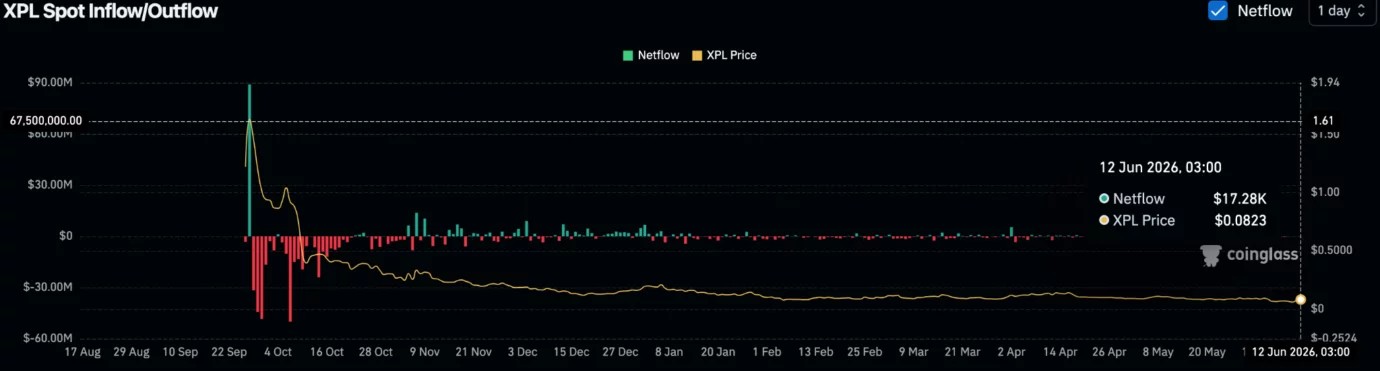
Most of the heavy spot activity happened around late September, when $XPL briefly traded near $1.61. After that, the token fell sharply, and large flows appeared during the sell-off phase.
Since November, spot netflows have stayed much smaller and closer to the zero line. That means the current rally has more support from derivatives activity than clear large spot inflows.
Technical chart still shows key resistance
The $XPL daily chart still shows a broader downtrend. After the sharp spike near the $1.50 to $1.60 area last year, the token kept forming lower highs and moved into a compressed lower range.
$XPL recently bounced from the $0.075 to $0.070 support area. If that zone breaks again, the next downside area sits near $0.060 to $0.065, based on recent lows.
On the upside, immediate resistance sits near $0.087 to $0.090. A stronger barrier stands around $0.10, which is both a chart level and a psychological level for traders.
A daily close above $0.10 would show stronger recovery momentum. Without that move, the rally may remain a short-term bounce inside a wider weak structure.
The RSI sat near 49.99, with its signal line near 43.06. That shows momentum is improving, but RSI has not yet moved into a strong bullish zone.
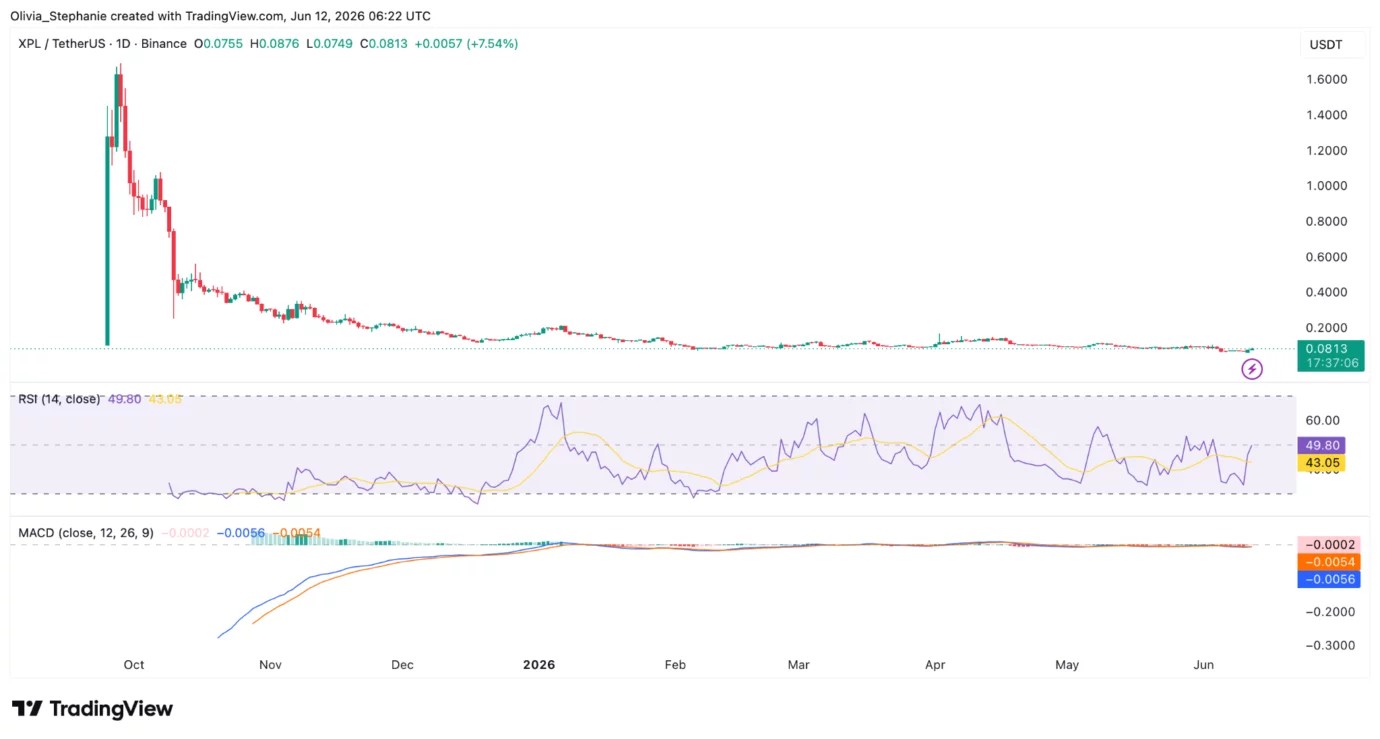
The MACD also remains weak and close to neutral. The MACD line and signal line were almost flat near -0.0055 and -0.0054, while the histogram stayed near zero.
Longer-term risks remain
The rally is tied to a clear catalyst, but $XPL still carries supply and execution risks. A large part of total supply remains unlocked, which means future emissions can add pressure if demand weakens.
As previously reported by crypto.news, Plasma’s tokenomics started with a 10 billion $XPL genesis supply and an initial circulating supply of 1.8 billion tokens at listing. The project also follows an inflationary model, with no fixed maximum supply.
Plasma raised $373 million in an oversubscribed public token sale before mainnet launch, as previously reported. The network also positioned itself around zero-fee stablecoin transfers and large stablecoin liquidity.