Cardano $ADA’s sharp weekly decline and what volume suggests
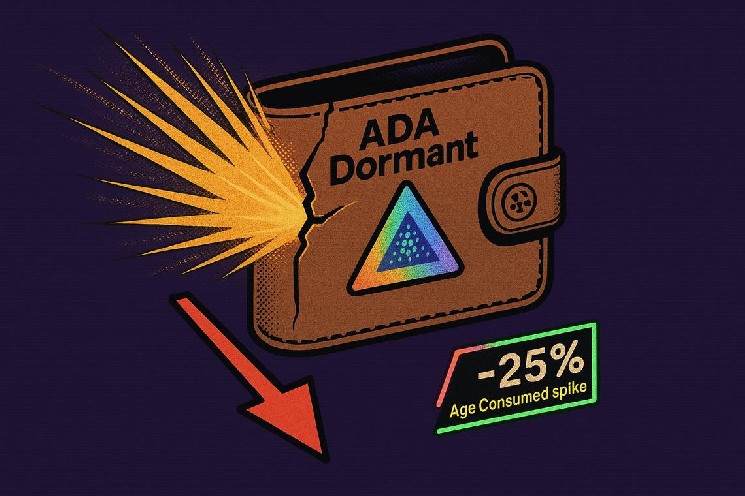
The numbers are stark. A 25.17% price drop in a single week pushed $ADA to $0.1605, reflecting broader crypto weakness and clear pressure on the token itself. Still, the elevated volume gives the move a different texture. Instead of a frozen market, $ADA appears to be going through a heavy transfer phase.
That gap between falling prices and strong trading volume is worth watching. It often means long-term holders, short-term traders, and opportunistic buyers are all responding at once. Santiment’s data adds more detail to that reading, and it points to unusual movement among older $ADA holdings.
Santiment on-chain metrics point to dormant wallet activity
Age Consumed spikes show long-dormant $ADA holders moving coins
The most striking signal Santiment identified was a sharp spike in the Age Consumed metric, the largest recorded since April. Age Consumed tracks how much coin-age is destroyed when tokens move. Put simply, when $ADA that has sat untouched for months or years suddenly moves, the metric jumps.
That is exactly what happened. Over a four- to five-day window, multiple Age Consumed spikes appeared in the data. As a result, long-dormant holdings became active again.
This matters because dormant wallet movements are not random noise. Long-term holders usually move coins with intent, whether to sell into liquidity, rotate into other assets, or consolidate positions ahead of a possible price move. The spikes do not reveal the motive, but they do confirm a shift in holder behavior.
Mean Dollar Invested Age pauses after a steady rise
Santiment also noted a meaningful change in the Mean Dollar Invested Age metric. This indicator tracks the average age of capital held across $ADA wallets. When it rises steadily, it usually suggests holders are sitting tight, accumulating, and not spending.
$ADA’s Mean Dollar Invested Age had been moving upward in that way. Then it paused. That pause lines up with the moment older coins entered circulation and the Age Consumed spikes began. Together, the two signals suggest a simultaneous shift among a segment of long-term $ADA holders.
Santiment has said that clusters of Age Consumed spikes, paired with a decline in Mean Dollar Invested Age, have historically appeared around notable market turning points. Even so, the firm framed the current pattern as evidence that something has changed beneath the surface rather than as a definitive directional call.
That distinction is important. On-chain data captures behavior, not outcomes. The price flush may have prompted long-term holders to reassess their positions, but the data alone cannot say whether that leads to more selling or a quieter phase of re-accumulation.
Cardano Foundation’s Brazilian Olympic Committee partnership adds a different signal
While the on-chain signals were drawing attention, Cardano also picked up institutional visibility on a separate front. The Cardano Foundation signed a three-year partnership with the Brazilian Olympic Committee, covering public blockchain, IoT, and artificial intelligence applications within Olympic sport.
The agreement puts Cardano among a small group of blockchain networks with direct ties to major international sports institutions. Notably, $ADA received an official mention on the Olympic Games website after the partnership was announced, which gives the project a level of visibility few crypto networks have reached.
The timing gives the deal extra weight. A partnership announcement during a bull run can blend into market excitement. By contrast, the same announcement during a 25% weekly drop becomes a counterpoint, showing that development and institutional interest are still moving forward despite weak price action.
Whether that visibility translates into measurable near-term support for $ADA is still unclear. However, for a network competing in a crowded layer-one market, the Cardano Olympic partnership adds a real-world narrative that pure trading data cannot provide.
What traders are watching next
The combination of Cardano $ADA dormant wallet activity, unusual on-chain metrics, and a high-profile institutional deal creates a layered setup that resists easy interpretation. Traders watching $ADA will likely focus on whether the Age Consumed spikes continue or begin to normalize in the coming days.
If the spikes continue, that would suggest more long-term holders are moving coins, which could keep pressure on price. If the activity fades, it may mean the wave of dormant movement has passed. In turn, Mean Dollar Invested Age could resume its climb and hint that holders are settling back into accumulation mode.
The $0.1605 level now sits at the center of that debate. For now, the market looks unsettled, but it is also active, and that distinction may prove important for anyone following the next move in $ADA.
FAQ
What does the Age Consumed metric indicate for Cardano?
Age Consumed measures how much coin-age is destroyed when tokens move. A spike in this metric means $ADA that had been sitting in wallets for an extended period, sometimes months or years, has suddenly become active. For Cardano, the metric recorded its largest spike since April, pointing to significant movement among long-dormant holders.
How does the Mean Dollar Invested Age metric relate to $ADA holders’ behavior?
Mean Dollar Invested Age tracks the average age of capital held across $ADA wallets. A steady increase usually signals that holders are accumulating and not spending. When it pauses or drops, it suggests older, longer-held coins are entering circulation, which is what Santiment observed alongside the recent Age Consumed spikes.
What is the significance of the Cardano Foundation’s partnership with the Brazilian Olympic Committee?
The Cardano Foundation signed a three-year agreement with the Brazilian Olympic Committee covering blockchain, IoT, and AI applications in Olympic sport. The partnership also led to $ADA being mentioned on the official Olympic Games website, giving Cardano institutional visibility at a global level during a period of heavy price weakness.
Can dormant wallet activity predict Cardano’s price movements?
On-chain data such as Age Consumed and Mean Dollar Invested Age can identify behavioral shifts among holders, and historically these patterns have appeared near market turning points. However, on-chain signals alone cannot confirm future price direction. They show what is happening, not necessarily what will happen next.
What market signals should traders watch following recent $ADA on-chain activity?
Traders should watch whether the Age Consumed spikes continue or fade in the days ahead, and whether Mean Dollar Invested Age resumes its upward trend or falls further. Volume levels relative to price action will also be important. A stabilization in dormant wallet movements, paired with sustained volume, could help show whether buyers are absorbing the recent selling pressure.

 en.cryptonomist.ch