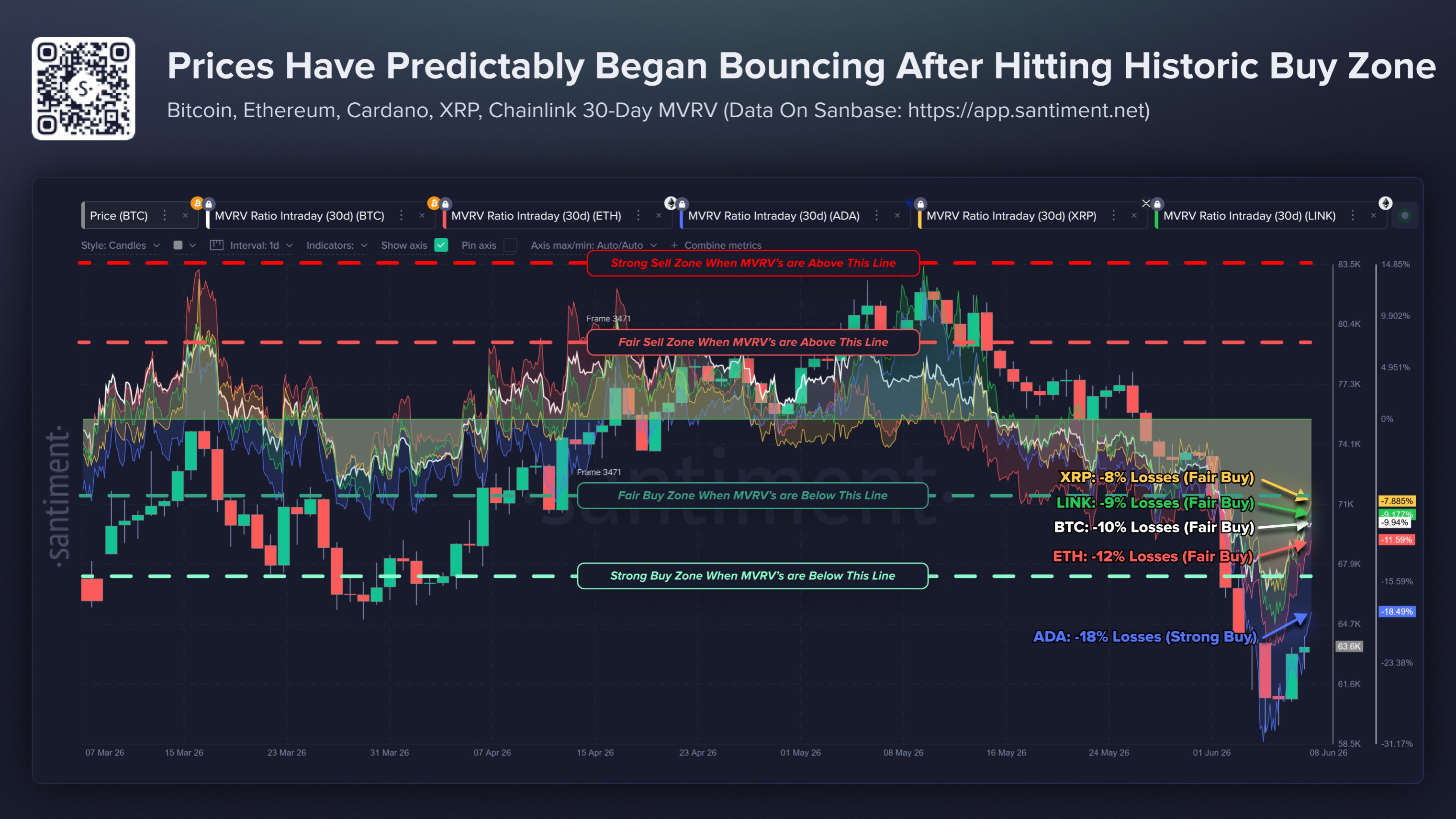
Analytics platform Santiment has recorded a strong buy signal for $XRP after short-term market participants began massively realizing losses in late May and early June. The main indicator was the 30-day MVRV metric, which estimates the average profitability of market participants over the past month.
When panic hits the market, professionals look for hidden entry points, and $XRP's current indicators point exactly to such a moment. By June 9, 2026, the coin's 30-day MVRV had fallen to -8%, which means that almost every retail buyer of the past month is now in the red.
Catalysts making $XRP a conviction play right now
While selling pressure is drying up, such an environment creates ideal conditions for accumulation by large players, especially as this technical low has coincided with large-scale lobbying pressure on the U.S. Senate.

More than 200 major crypto organizations, including Ripple, Coinbase and a16z, are now urgently pushing for the Clarity Act to be passed by July 4, 2026. The law is expected to legally move digital assets out from under old securities rules, with the Ripple ecosystem, the RLUSD stablecoin and the $XRP token itself likely to benefit most from the removal of enforcement risks.
While retail investors are afraid and counting losses, Santiment's chart shows that $XRP's technical rebound from the green zone has already effectively begun. The -8% reading puts the coin in the same group as other major assets such as Bitcoin (-10%) and Ethereum (-12%), which have also moved deep into the favorable buying zone, known as "Fair Buy."
However, unlike its competitors, $XRP is backed not only by a price rebound, but also by explosive fundamental growth in the real-world asset tokenization sector. Fresh data from analytics portal rwa.xyz shows the stated value of real-world assets on XRPL has already reached $3.67 billion, up 16.78% over 30 days.
Historical cycles confirm that when the MVRV indicator enters these values, it almost always comes before a trend change, meaning $XRP's local bottom has likely already passed and the current market price absolutely does not reflect this institutional demand.
While retail investors panic, big business is adopting the network and the industry is changing U.S. legislation, making the current entry point one of the most promising in recent months, according to Santiment.
u.today