XRP Price if XRP Moves $5B Daily with a Functional Reserve Ratio of 4
thecryptobasic.com
08 June 2026 12:20, UTC
An $XRP fair market valuation model suggests that the price could cross $50 if $XRP consistently moves $5 billion daily with a functional reserve ratio of 4.
Investors continue to look for ways to estimate $XRP’s fair market value, especially considering discussions suggesting that the asset remains undervalued. Amid this campaign, Jake Claver, CEO of Digital Ascension Group, introduced a structured valuation model.
Specifically, Claver and his team developed an $XRP fair-value calculator based on the work of Susan Athey and Robert Mitchnick. Athey and Mitchnick’s study, titled “A Fundamental Valuation Framework for Cryptoassets,” provided the foundation for the model.
More Than Just News Content, live market tracking, portfolio management, and price alerts — everything you need in the Crypto News app. Download now, stay on top of the crypto market, and take control of your information.
The calculator lets users adjust major inputs to test different future scenarios. It gives an estimate of a possible $XRP price when users change factors like transaction volume, supply, and holding patterns. This makes the process more structured.
Assumptions Behind the $5B Daily Volume Scenario
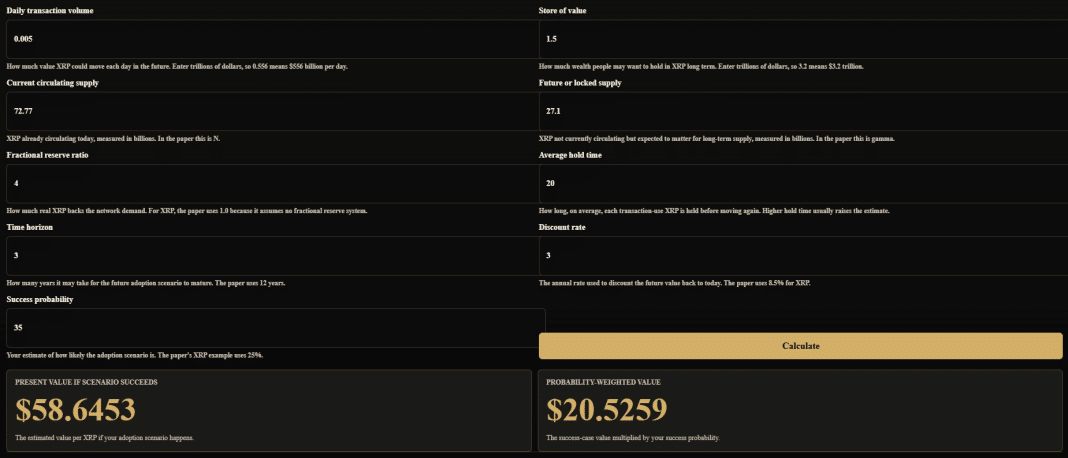
In our case, the model assumes $XRP consistently handles $0.005 trillion in daily transaction volume, which equals $5 billion per day. This suggests the network sees steady but not extreme usage, especially in areas like payments and liquidity.
The supply side also has an important role. We used a current circulating supply of 72.77 billion $XRP and a future or locked supply of 27.1 billion $XRP. Considering Ripple’s escrow leaves around 300 million more $XRP in circulation each month, this translates to 3.6 billion $XRP entering circulation each year.
We estimated that it would take 3 years for these parameters to take shape, so that sums up to an additional 10.8 billion $XRP entering circulation within the 3 years. This would bring $XRP’s circulating supply to 72.77 billion tokens, with 27.1 billion still in escrow.
Our estimates also include a fractional reserve ratio of 4, meaning each unit of $XRP supports multiple units of transaction value. This should increase efficiency.
Further, the model applies a discount rate of 3% to bring future value into today’s terms and uses a success probability of 35% to reflect uncertainty about whether the scenario will actually happen.
Holding Behavior and Store of Value Demand
The model also looks at how long $XRP is held before being used again. Here, we used an average hold time of 20, which means$XRP stays in wallets longer instead of moving quickly.Longer holding times tend to raise value because they reduce how much $XRP is available at any moment.
$XRP Fair Value Calculator
Meanwhile, another important factor is long-term demand. The model includes a store-of-value demand of $1.5 trillion. This doesn’t measure $XRP’s market cap but shows how much wealth users might choose to keep in $XRP.
Estimated $XRP Price Under This Scenario
Using all these inputs, the calculator estimates a present value of around $58 per $XRP if the scenario succeeds. This represents the price if adoption reaches the expected level.
After adjusting for risk using the 35% success probability, the value drops to a probability-weighted price of a little above $20 per $XRP. This gives a more cautious estimate that accounts for uncertainty.
However, it is important to note that this model presents what it suggests could be $XRP’s fair value if these parameters play out as expected. It doesn’t predict $XRP’s price for the future.

 thecryptobasic.com