The revised proposal came after an earlier request for about 14.07 million $ADA. The original plan included funding for the standalone Cardano Summit and a TOKEN2049 Singapore sponsorship connected to EMURGO, Cardano’s commercial arm. The Foundation later separated the two proposals and reduced the summit budget.
The updated version included audited fund management, milestone-based payments, and an independent oversight committee. Even with those changes, the proposal did not gain enough DRep stake to pass. By delegate count, 135 voted in favor, 61 voted against, and 24 abstained, while the Constitutional Committee approved the action.
Charles Hoskinson Suggests TOKEN2049 MiniSummit Option
The separate TOKEN2049 sponsorship proposal passed after being split from the Cardano Summit request. That means Cardano is still expected to have a presence around the Singapore crypto conference, even though the dedicated summit will not take place this year.
After the vote, Cardano founder Charles Hoskinson raised the possibility of expanding the TOKEN2049 presence instead. In a post on X, he asked whether there would be interest in scaling up the booth, hosting an embedded MiniSummit with Token, organizing a hackathon with a large $ADA prize, providing a stage for Cardano ventures, and subsidizing attendance for larger projects.
Hoskinson also pointed to other activity in the Cardano ecosystem. In a separate post, he said the upcoming hard fork, the opening of Korean markets, and increased activity in Japan could support a strong summer for Midnight. His comments came as the community continued discussing how Cardano should manage promotion, ecosystem events, and treasury spending after the summit vote.
The cancellation adds to a broader pattern of treasury scrutiny within Cardano’s governance system. DReps have pushed back on several funding requests tied to ecosystem organizations this year, including proposals linked to development, marketing, and events.
$ADA Price Prediction After Summit Cancellation
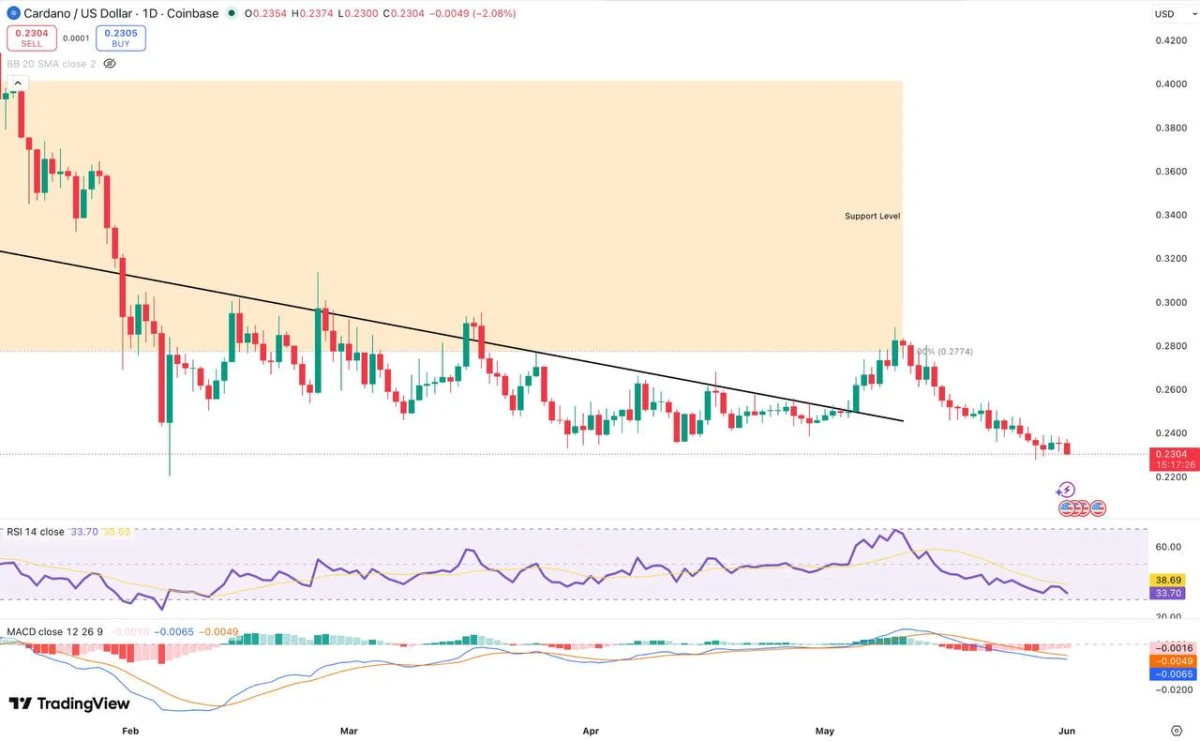
$ADA traded near $0.2325 on the daily chart following the governance decision. The token remained under pressure after a failed breakout attempt in early May. Price moved above a descending trendline during that period but failed to hold gains near the $0.277 to $0.285 area.
The broader $ADA chart still shows a downtrend, with lower highs forming since January. The recent rejection from the upper resistance area pushed the price back below its earlier consolidation range. $ADA is now testing a short-term support zone near $0.230 to $0.232.
A daily close below $0.230 would keep sellers in control and could open the next downside area around $0.220 to $0.225. That zone aligns with a previous wick low from February and may become the next level watched by traders if selling pressure continues.
Source: TradingView
On the upside, $ADA price needs to reclaim the $0.240 to $0.245 range to reduce near-term bearish pressure. A stronger recovery would require a move above $0.250 to $0.260. The $0.277 to $0.285 area remains the main resistance zone because it was where the prior breakout attempt failed.
Technical indicators also show weak momentum. The Relative Strength Index is near 35, indicating bearish pressure but not deeply oversold conditions. This suggests $ADA still has room for further downside before a stronger relief bounce develops.
The MACD also remains bearish, with the MACD line below the signal line and both readings below zero. The histogram remains negative, showing that short-term momentum has not yet shifted back toward buyers.

 coinpaper.com