
 coinedition.com

Hyperliquid is becoming one of crypto’s biggest breakout stories. That attention increased after Grayscale published a report arguing the platform could grow into a major financial services company.
Grayscale described Hyperliquid as a startup-style success story. The platform generated around $800 million in revenue in 2025 alone. It achieved that while competing in one of crypto’s toughest markets: derivatives trading.
Even though Hyperliquid is less than three years old and still blocks users in markets like the United States, it has already become one of the largest perpetual futures exchanges in crypto.
At the center of its growth is decentralized perpetual futures trading, often called “perps.” These contracts let traders speculate on asset prices without expiration dates. Perpetual futures have become one of crypto’s largest markets, averaging roughly $200 billion in daily trading volume across the industry in 2025.
For years, centralized exchanges like Binance, Bybit, and OKX dominated the sector. However, Hyperliquid became the first decentralized platform to seriously challenge them. It did this by offering a trading experience similar to centralized exchanges while still keeping trades on-chain and allowing self-custody.
Hyperliquid’s Core Breakthrough
According to Grayscale, Hyperliquid succeeded because it made on-chain trading fast and practical for active traders.
The platform offers deep liquidity, quick execution, visible order books, and exchange-style interfaces. At the same time, all trades and liquidations are recorded on-chain. This gives users more transparency than most centralized exchanges provide.
Hyperliquid processed about $2.9 trillion in perpetual futures volume in 2025. It also reached around $7 billion in open interest. That puts it among the top three or four perpetual futures exchanges globally by open interest.
Grayscale also said Hyperliquid remains cost-competitive. The report estimates the platform charges around 2 basis points for futures trading, compared with an industry average closer to 4 basis points on centralized exchanges.
Beyond Crypto Trading
Perpetual futures remain Hyperliquid’s core business, but the platform is expanding into broader financial markets.
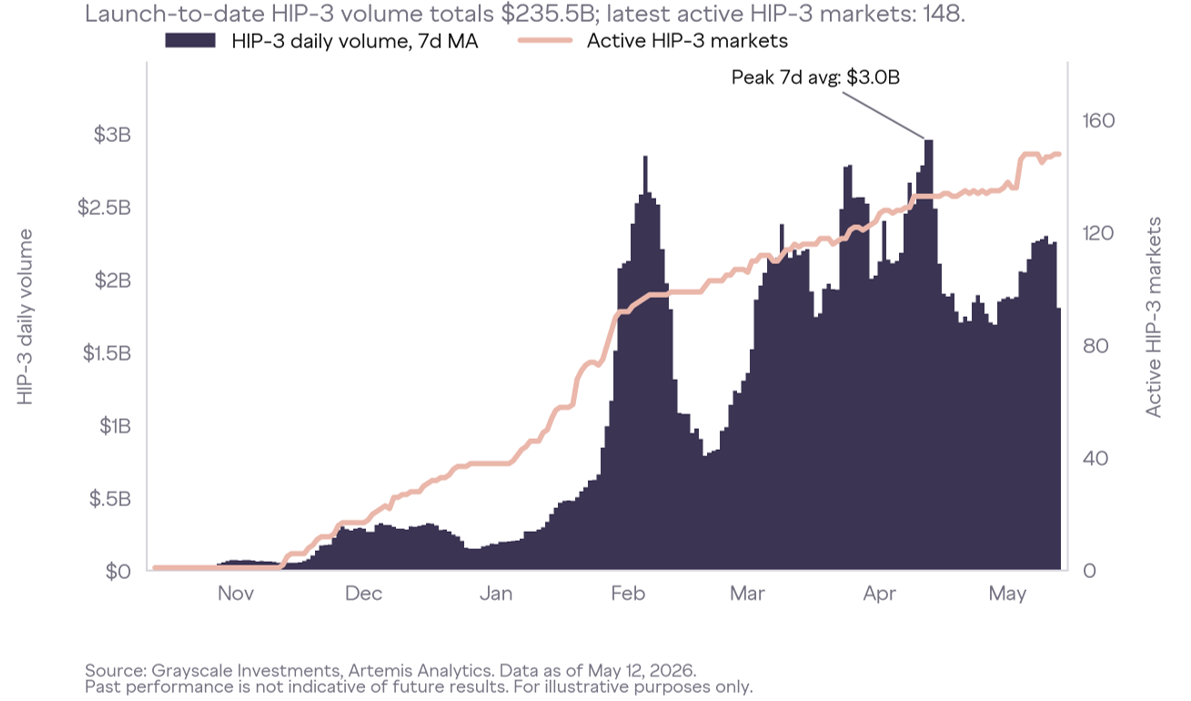
One major development is HIP-3. This system allows third-party developers to launch new perpetual futures markets directly on Hyperliquid. Those markets now include commodities, stock indexes, and other non-crypto assets.
Grayscale noted that commodity perpetuals on Hyperliquid have started functioning as 24-hour price discovery markets. Bloomberg reportedly described the platform as a “24-hour venue for leveraged commodity bets.”
Some of these products have already seen heavy activity during volatile periods. Silver perpetuals exceeded $4 billion in daily trading volume during a February spike. Oil perpetuals also crossed $4 billion in 24-hour volume during Middle East market turbulence in April. At one point, oil perpetuals briefly traded more volume than Bitcoin perpetuals.
Hyperliquid also introduced S&P 500 perpetual contracts that continue trading on weekends, when traditional markets are closed.
So far, HIP-3 markets have generated more than $230 billion in cumulative trading volume across more than 140 active trading pairs.
How Hyperliquid Works
The platform is built around several core systems. HyperCore powers the trading infrastructure. It handles order books, margin systems, spot trading, liquidations, and perpetual futures.
HyperEVM provides developers with an Ethereum-compatible environment for building applications connected to Hyperliquid’s liquidity network.
Meanwhile, HyperBFT serves as the delegated proof-of-stake consensus layer that secures the chain.
Grayscale argued that this architecture gives Hyperliquid an advantage over many blockchain applications. Instead of adapting a general-purpose blockchain for trading, Hyperliquid built its chain specifically for trading performance.
The $HYPE Token
The $HYPE token sits at the center of the ecosystem. Unlike many crypto projects, Hyperliquid launched without traditional venture capital funding. Nearly 30% of the token supply was distributed directly to users through an airdrop.
The token currently has a circulating market capitalization of around $14 billion. That makes it one of the largest crypto assets by market value.
$HYPE is tied closely to platform activity. According to Hyperliquid Labs, about 99% of platform fees go toward an assistance fund that buys and burns $HYPE tokens. Over time, that reduces the circulating supply.
The token also has several functions inside the ecosystem. It is used for validator staking, gas fees, trading fee discounts, and collateral requirements for developers launching new markets.
Grayscale compared $HYPE’s valuation with traditional exchange companies. The report estimated the token currently trades at roughly 14 times earnings based on the four quarters ending in Q1 2026. That is lower than the estimated 35x to 50x earnings multiples seen in high-growth trading firms like Robinhood and Interactive Brokers.
Regulatory Changes Could Be a Major Catalyst
Regulation was one of the report’s biggest themes. Perpetual futures products are still largely unavailable in the United States because they do not fit neatly into existing derivatives rules. As a result, Hyperliquid currently blocks U.S. users.
Grayscale believes that could eventually change as regulators work toward clearer frameworks for perpetual futures and decentralized exchanges.
The report pointed to growing industry activity from companies like Coinbase, Kraken, Robinhood, and Kalshi. It also highlighted growing discussion within the sector by the Commodity Futures Trading Commission.
If regulators eventually allow compliant perpetual futures trading in the U.S., Hyperliquid could gain access to a far larger market.
Grayscale believes the company sits at the intersection of two major trends: the growth of perpetual futures and the expansion of decentralized financial infrastructure.
Risks Still Remain
Despite the optimism, Grayscale also outlined several risks. $HYPE remains highly volatile. Its annualized volatility is estimated at around 80%, which is significantly higher than Bitcoin.
The report also noted that Hyperliquid still relies on a relatively centralized validator structure. In addition, its software remains closed source, which may concern decentralization advocates.
Another major risk is regulation. Hyperliquid’s long-term growth could depend heavily on future U.S. regulatory decisions. Without access to the American market, expansion may become more difficult.
“Believe the Hype”
Even with those risks, Grayscale argues that Hyperliquid has already achieved something rare in crypto: real usage at scale.
The firm said Hyperliquid combines strong product-market fit, growing liquidity, developer incentives, and a loyal community into a powerful network effect.
Its revenue already rivals major trading businesses, yet it still controls only a small share of the global perpetual futures market.
If adoption continues expanding across crypto, commodities, equities, and prediction markets, Grayscale believes Hyperliquid could evolve into a major financial services platform rather than remaining just another crypto exchange.
The report concluded that Hyperliquid is not directly comparable to any other project in crypto or traditional finance and stands as a model that breaks existing frameworks.
Related: Hyperliquid Hits All-Time High as SpaceX Pre-IPO Trading Gains Heat